API 5CT N80 is the most widely specified intermediate-strength casing grade in global oil well construction. With a minimum yield strength of 552 MPa (80,000 psi), it occupies the gap between the commodity J55/K55 grades and the sour-service-qualified L80 — covering the broad middle of onshore and shallow offshore programmes where sweet service conditions apply and cost efficiency matters. Two sub-grades exist within the N80 designation: N80-1 and N80Q. The distinction between them is not academic — it determines what heat treatment the mill applies, and in deeper wells, it determines the through-wall toughness profile of the string.
The most frequent order error we see on N80 purchase orders is the buyer writing "N80" without specifying the sub-grade. Under API 5CT, N80-1 is the default — but N80-1 may be supplied normalised, normalised-and-tempered, or quench-and-tempered. A buyer who needed Q+T properties for better through-wall toughness in a deeper well, but did not write "N80Q" on the PO, may receive N80-1 produced by normalising. The MTC will be correct; the microstructure will not be what was intended. The other pattern we see frequently is an engineer switching from N80 to L80 under the assumption that L80 provides better pressure containment. It does not — both grades have 80 ksi minimum yield. L80 costs more and provides something different: hardness control and NACE documentation. If H₂S is not in the picture, N80-1 is the right choice and the cost difference is unrecovered.
ZC Steel Pipe supplies API 5CT N80 casing in both N80-1 and N80Q sub-grades across all standard sizes from 4½ inch through 20 inch, with STC, LTC, BTC, and premium connections, to oil and gas operators and drilling contractors across Africa, South America, and Southeast Asia.
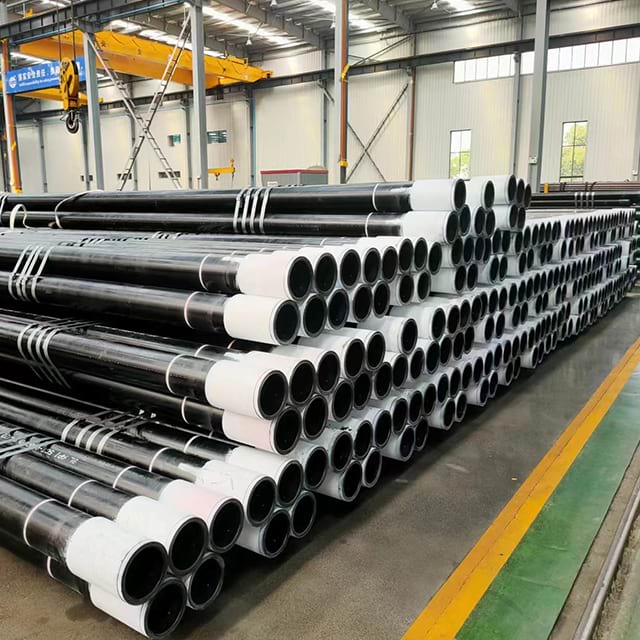 Finished N80 casing staged under the overhead crane at ZC Steel Pipe, couplings made up and thread-protected before dispatch.
What we see on N80 orders: The sub-grade omission is the most consistent N80 specification error. A purchase order that reads "API 5CT N80, 9⅝" × 47 lb/ft BTC" goes to the mill as N80 Type 1 by default. API 5CT permits Type 1 to be supplied in any of three heat treatment conditions: normalised (N), normalised and tempered (NT), or quench and tempered (Q+T). The mill chooses the cheapest route unless the order specifies Q+T. If your casing design assumed Q+T mechanical properties and got N-condition pipe, the yield test will still pass — but the through-wall toughness profile will not be what the design assumed.
Quick Answer — N80 Specs and the Sub-Grade Decision
N80 is an 80 ksi sweet-service casing grade. Both sub-grades share the same strength envelope — the only real decision is the heat treatment route, and it must be named on the PO.
| Property | N80-1 | N80Q |
|---|---|---|
| Min / max yield | 552 MPa (80 ksi) / 758 MPa (110 ksi) | 552 MPa (80 ksi) / 758 MPa (110 ksi) |
| Min tensile | 689 MPa (100 ksi) | 689 MPa (100 ksi) |
| Heat treatment | Normalised, N+T, or Q+T (mill's choice) | Q+T only |
| Hardness limit | None | None |
| Sour service (NACE) | No | No |
| Best for | Shallow-to-moderate sweet wells | Deeper wells needing consistent Q+T toughness |
- Sub-grade: write "N80Q" (not "N80") whenever the design assumed Q+T through-wall toughness — "N80" defaults to N80-1, which the mill may supply normalised.
- Sour service: N80 is not NACE-qualified. For any H₂S well, step to L80 — same 80 ksi yield, but with the 23 HRC hardness ceiling and NACE trail. The full trade-off is in the N80 vs L80 comparison →, and the heat-treatment detail is in the N80-1 vs N80Q guide →.
What Is API 5CT N80?
API Specification 5CT, 11th Edition, is the American Petroleum Institute specification governing oil country tubular goods for well construction. N80 is a Group 1 casing grade within that standard — "Group 1" meaning it covers both the N80-1 and N80Q sub-grades under a shared yield strength envelope. The "80" in the designation refers to the minimum yield in thousands of psi: 80,000 psi, or 552 MPa.
N80 sits above J55 and K55 (55,000 psi minimum yield) and shares the same 80 ksi minimum yield as L80, but without the hardness ceiling that L80 carries. Above N80, the next rung in the sweet-service grade ladder is P110, which starts at 110,000 psi minimum yield and is designed for deeper or higher-load well programmes. N80 is the default specification for intermediate and production casing in sweet wells at moderate depth — typically 1,500 to 4,000 metres — where the well design does not require the tighter hardness control of L80 or the higher strength of P110.
The two sub-grades exist because the API committee recognized that normalising and quench-and-tempering produce genuinely different microstructures — and that buyers needed a way to specify which one they required without creating an entirely separate grade. N80-1 leaves the heat treatment choice to the mill. N80Q removes that choice and mandates Q+T.
N80-1 vs N80Q — The Critical Distinction
The most important specification decision when ordering N80 is the sub-grade. Both N80-1 and N80Q meet identical yield strength requirements, but they are produced by fundamentally different heat treatment routes with real consequences for mechanical behaviour under load.
A point that causes confusion: N80-1 is not restricted to normalising. API 5CT permits N80-1 to be produced by normalising, normalised-and-tempering, or quench-and-tempering. N80Q, by contrast, permits only quench-and-tempering. The defining characteristic of N80Q is not that Q+T is permitted — it is that Q+T is the only permitted route.
| Property | N80-1 | N80Q |
|---|---|---|
| Permitted heat treatments | Normalised, N+T, or Q+T | Q+T only |
| Microstructure (N or NT route) | Ferritic-pearlitic | — |
| Microstructure (Q+T route) | Tempered martensitic | Tempered martensitic |
| Min yield strength | 552 MPa (80,000 psi) | 552 MPa (80,000 psi) |
| Max yield strength | 758 MPa (110,000 psi) | 758 MPa (110,000 psi) |
| Min tensile strength | 689 MPa (100,000 psi) | 689 MPa (100,000 psi) |
| Hardness limit (API 5CT) | None | None |
| CVN toughness required | No | No |
| Through-wall toughness | Variable — depends on mill route | Consistent — Q+T only |
| Cost | Lower | Higher — Q+T premium |
| Best for | Shallow to moderate sweet wells | Deeper wells, higher loads, Q+T required by spec |
The practical consequence of the three permitted routes for N80-1 is that two different N80-1 heats from two different mills can have completely different microstructures while both passing the API 5CT yield test. A normalised N80-1 and a Q+T N80-1 will both show yield at or above 552 MPa — but their fracture toughness, particularly through the wall thickness, can differ substantially. For shallow wells with modest burst and collapse loading, this difference may be immaterial. For deeper wells where the casing is under sustained axial load, or in environments with cyclic thermal loading, the Q+T microstructure provides meaningfully better toughness.
When to specify N80Q: Use N80Q when the casing design requires consistent Q+T properties — for deeper wells where through-wall toughness matters, in colder environments where low-temperature ductility is a concern, or when an IOC company specification mandates Q+T heat treatment for all intermediate casing regardless of grade. Specify it on the PO: "API 5CT N80Q."
When N80-1 is correct: For straightforward onshore sweet wells under 2,500 metres with standard load cases, N80-1 delivers the required mechanical performance at lower cost. Most wells in West African onshore programmes and South American land drilling at moderate depth use N80-1 for production and intermediate strings without issues.
API 5CT does not require hardness testing for N80 — either sub-grade. There is no hardness limit. A quench-and-tempered N80-1 heat and a Q+T N80Q heat from the same mill may produce identical hardness readings on the MTC — because Q+T N80-1 and N80Q are metallurgically the same process; the designation only controls whether non-Q+T routes are permitted. The real difference is traceability: N80Q guarantees Q+T, N80-1 does not. For wells where Q+T microstructure is required for toughness reasons, N80Q is the only safe specification.
Chemical Composition
API 5CT sets maximum element limits for N80. The limits are narrow: only phosphorus and sulphur carry explicit maxima. All other elements — carbon, manganese, silicon, chromium, nickel, molybdenum, and others — are unrestricted by the standard.
| Element | N80-1 Max % | N80Q Max % | Note |
|---|---|---|---|
| Phosphorus (P) | 0.030 | 0.030 | Embrittlement risk at grain boundaries |
| Sulphur (S) | 0.030 | 0.030 | Lower is better for toughness |
| Carbon (C) | Not restricted | Not restricted | Mill-formulated |
| Manganese (Mn) | Not restricted | Not restricted | Mill-formulated |
| Silicon (Si) | Not restricted | Not restricted | Mill-formulated |
| Chromium (Cr) | Not restricted | Not restricted | Mill-formulated |
| Nickel (Ni) | Not restricted | Not restricted | Mill-formulated |
The consequence of this open chemistry is significant for procurement: N80 mechanical properties vary more across different mill heats than for grades where chemistry is tightly controlled. Grades like L80 and T95 carry explicit carbon equivalent limits and tighter alloy restrictions precisely because their sour service or HPHT applications require predictable microstructure. N80 does not have those constraints — which is why mills have latitude to formulate very different chemistries and still produce pipe that passes the API 5CT yield and tensile tests. When consistent mechanical behaviour across multiple heats matters — for a multi-string programme or a project with tight collapse design margins — requesting yield histograms from the mill before placing the order is worth the time.
For the complete grade ladder with tensile, hardness, and chemistry limits, see the API 5CT specification tables →
To match a grade to your well conditions, use the Pipe Grade Selector →
Standard Dimensions and Weights
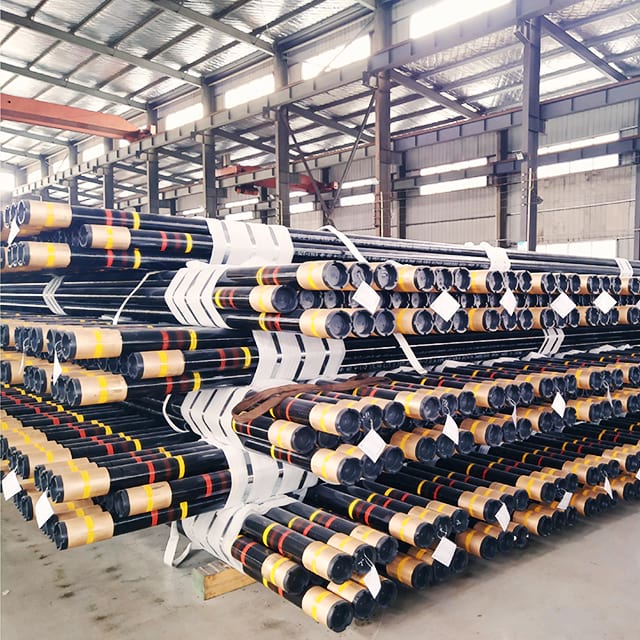 Casing bundles banded and colour-coded by size, with thread protectors on the ends — the handling identification ZC applies before shipping mixed-size N80 orders.
API 5CT N80 casing is available in all standard casing sizes from 4½ inch through 20 inch OD. The table below shows the most commonly ordered sizes with typical weight ranges and drift diameter ranges.
| OD (inches) | Common Weights (lb/ft) | Wall Range (mm) | Drift Dia. Range (in) | Typical Use |
|---|---|---|---|---|
| 4½ | 9.5–15.1 | 5.21–8.56 | 3.965–3.701 | Production casing, liners |
| 5 | 11.5–18.0 | 5.59–9.19 | 4.435–4.151 | Production casing |
| 5½ | 14.0–23.0 | 5.69–10.54 | 4.887–4.545 | Production casing |
| 7 | 17.0–35.0 | 6.43–13.06 | 6.413–5.879 | Intermediate and production |
| 7⅝ | 24.0–39.0 | 7.62–13.84 | 6.900–6.500 | Intermediate casing |
| 9⅝ | 32.3–53.5 | 8.94–16.13 | 8.845–8.379 | Intermediate casing |
| 10¾ | 32.75–55.5 | 7.09–13.72 | 10.036–9.604 | Surface and intermediate |
| 13⅜ | 48.0–72.0 | 8.38–13.56 | 12.559–12.191 | Surface casing |
| 16 | 65.0–84.0 | 9.53–16.13 | 15.062–14.822 | Surface casing, conductor |
| 20 | 94.0–133.0 | 11.13–16.13 | 18.936–18.542 | Conductor casing |
The two most common sizes in intermediate casing programmes are 9⅝ inch (47 lb/ft being the most frequently ordered weight) and 13⅜ inch. Production strings in land wells typically use 5½ inch or 7 inch. For full dimension tables including ID, drift diameter, and coupling OD for every weight within each size, see the API 5CT specification tables → or use the Barlow pressure calculator → to check burst ratings at your chosen weight.
N80 Tubing Sizes — 2⅜, 2⅞, and 3½ Inch
N80 is supplied as production tubing as well as casing, and the mechanical grade is identical in both forms — only the size tables differ. In tubing, the dominant size by order volume is 2⅞ inch (73.02 mm OD), followed by 2⅜ inch and 3½ inch. The table below gives the full 2⅞ inch weight ladder plus the common 2⅜ and 3½ inch weights, with nominal weight in both non-upset (NU) and external-upset (EU) end finishes, wall thickness, and inside diameter, per API 5CT 11th Edition, Table C.19.
| OD (in) | OD (mm) | Weight NU / EU (lb/ft) | Wall (mm) | ID (mm) | End finish |
|---|---|---|---|---|---|
| 2⅜ | 60.32 | 4.60 / 4.70 | 4.83 | 50.66 | NU / EU |
| 2⅜ | 60.32 | 5.80 / 5.95 | 6.45 | 47.42 | NU / EU |
| 2⅞ | 73.02 | 6.40 / 6.50 | 5.51 | 62.00 | NU / EU |
| 2⅞ | 73.02 | 7.80 / 7.90 | 7.01 | 59.00 | NU / EU |
| 2⅞ | 73.02 | 8.60 / 8.70 | 7.82 | 57.38 | NU / EU |
| 2⅞ | 73.02 | 9.35 / 9.45 | 8.64 | 55.74 | NU / EU |
| 2⅞ | 73.02 | 10.50 / — | 9.96 | 53.10 | NU only |
| 2⅞ | 73.02 | 11.50 / — | 11.18 | 50.66 | NU only |
| 3½ | 88.90 | 9.20 / 9.30 | 6.45 | 76.00 | NU / EU |
| 3½ | 88.90 | 12.70 / 12.95 | 9.52 | 69.86 | NU / EU |
For 2⅞ inch N80 tubing, the 6.40 lb/ft (5.51 mm wall, 62.00 mm ID) and 8.60 lb/ft (7.82 mm wall, 57.38 mm ID) weights cover most onshore completions — the heavier wall raises burst and collapse ratings but cuts flow area, so read the weight column against the ID column rather than in isolation. Unlike casing, API 5CT specifies no fixed drift diameter for tubing: drift is set on the purchase order per API 5B, so state the drift your logging or intervention string requires rather than accepting the mill default. For the complete tubing ladder from 1.9 inch through 4½ inch with every weight, see the API 5CT tubing sizes and weights guide →.
Worked Burst Pressure Calculation
To understand what N80's yield strength buys in terms of pressure containment — and to illustrate exactly where N80 versus L80 is not a relevant distinction — consider a standard 9⅝ inch × 47 lb/ft intermediate casing string.
For this pipe, the OD is 9.625 inches and the nominal wall thickness is 0.472 inches. Using the API 5C3 burst pressure formula:
P = 0.875 × (2 × Yp × t / D)
Where Yp is minimum yield strength in psi, t is wall thickness in inches, D is OD in inches, and 0.875 is the API 5C3 mill tolerance factor.
N80 at 9⅝" × 47 lb/ft: P = 0.875 × (2 × 80,000 × 0.472 / 9.625) P = 0.875 × 7,841 P = 6,860 psi (68.6 MPa)
For context, the same geometry in J55 (55,000 psi minimum yield): P = 0.875 × (2 × 55,000 × 0.472 / 9.625) P = 0.875 × 5,391 P = 4,720 psi (32.6 MPa)
N80 provides 45% more burst resistance than J55 at identical geometry. That gap is meaningful for intermediate strings where reservoir pressure has not depleted and kick scenarios must be designed for.
Now the critical comparison: L80, also at 80,000 psi minimum yield, produces the same result — 6,860 psi for this pipe. The burst rating is identical. The difference between N80 and L80 is not pressure containment. It is hardness control and sour service qualification. Engineers who specify L80 in sweet-service wells on the assumption that it provides better burst performance are paying a cost premium for a benefit they are not receiving. N80-1 is the correct sweet-service choice at this yield level; L80 is the correct choice when H₂S is present.
Connection Types
N80 casing is compatible with all API 5CT standard connections and premium connection designs.
| Connection | Abbrev. | Seal Type | Joint Efficiency | Typical Use |
|---|---|---|---|---|
| Short Thread Coupling | STC | Compound-dependent | ~60% | Surface casing, low-pressure applications |
| Long Thread Coupling | LTC | Compound-dependent | ~70% | Intermediate, moderate pressure |
| Buttress Thread Coupling | BTC | Compound-dependent | ~95% | Higher collapse/burst, standard intermediate |
| Premium Connection | Various | Metal-to-metal | 100%+ | Gas wells, HPHT, critical gas-tight service |
BTC is the industry default for 9⅝ inch and 13⅜ inch N80 intermediate casing in onshore wells. It provides near pipe-body tensile efficiency and better collapse resistance than LTC at a modest cost premium. STC should not be used for intermediate or production casing where burst or collapse loading is meaningful — its thread engagement is insufficient for those load cases. Premium connections are used when the connection must be gas-tight independent of thread compound, in gas wells where the compound can be displaced by produced gas over time, or in deviated wells where connection integrity under combined axial and bending load is critical.
ZC Steel Pipe holds independent patents in premium connection designs qualified to API 5C5 CAL IV. Premium-connected N80 casing is available across all standard sizes.
What N80Q looks like on the order book: N80Q is a grade we ship in volume as couplings, not just pipe — for a South American operator we supplied 15,000 API 5CT N80Q and J55 couplings in 3½″, 4½″ and 5½″ across EU and LTC thread forms for onshore production strings. The split on that order is instructive: N80Q went on the deeper, higher-pressure strings where the quench-and-temper condition gives consistent properties, and J55 covered the shallower, lower-pressure ones where budget drove the choice — the same sub-grade logic this article describes, applied at the coupling.
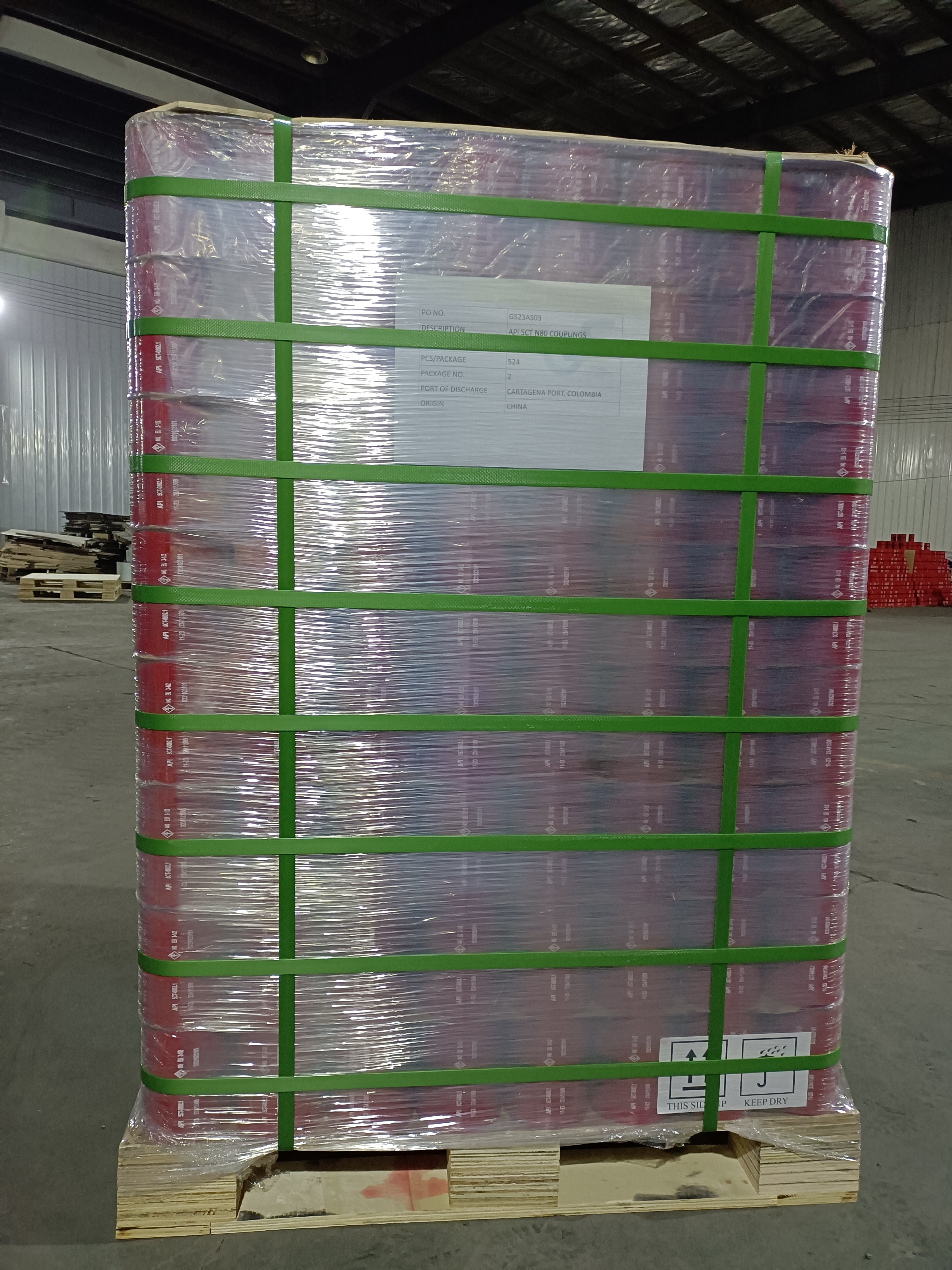 Palletised, shrink-wrapped API 5CT N80 couplings from the South American coupling order — labelled and ready for export.
N80 vs Other API 5CT Grades
| Property | J55/K55 | N80-1 | N80Q | L80 | P110 |
|---|---|---|---|---|---|
| Min yield (MPa / ksi) | 379 / 55 | 552 / 80 | 552 / 80 | 552 / 80 | 758 / 110 |
| Max yield (MPa / ksi) | 552 / 80 | 758 / 110 | 758 / 110 | 655 / 95 | 965 / 140 |
| Min tensile (MPa / ksi) | 517 / 75 | 689 / 100 | 689 / 100 | 655 / 95 | 862 / 125 |
| Permitted heat treatments | None required | N, NT, or Q+T | Q+T only | Q+T only | Q+T |
| Hardness max (HRC) | None | None | None | 23 | None |
| Sour service (NACE) | No | No | No | Yes | No |
| Typical depth range | Under 1,500 m | 1,500–3,500 m | 1,500–4,000 m | 1,500–4,000 m | 3,000–6,000+ m |
| Relative cost | Lowest | Low | Moderate | Moderate–High | Highest |
The table makes clear that N80 and L80 are the same grade for burst and collapse calculations — both use 80,000 psi minimum yield. L80's narrower maximum yield ceiling (655 MPa versus N80's 758 MPa) means L80 is in practice a tighter yield band, which aids string design predictability — but the minimum burst and collapse ratings for the same geometry are identical. P110 is a fundamentally different well condition: at 110 ksi minimum yield, it is designed for deep, high-load applications where N80 is structurally insufficient.
Sour Service Limitations
N80 is not a sour-service-qualified grade under NACE MR0175 / ISO 15156. API 5CT imposes no maximum hardness limit on N80 — either sub-grade — and NACE MR0175 restricts carbon steel tubulars in H₂S service to 22 HRC maximum. Some N80 heats, particularly those produced by normalising with higher carbon content, can develop areas exceeding this limit, creating susceptibility to sulphide stress cracking (SSC).
A point that surprises some engineers: N80Q's Q+T heat treatment does not qualify it for sour service. The distinction between N80Q and L80 is not the heat treatment — both are Q+T. The distinction is the hardness ceiling and the NACE documentation trail. L80 carries a mandatory 23 HRC maximum hardness and the testing records to prove it; N80Q does not. NACE MR0175 requires both the hardness limit and the documented verification. N80Q provides neither. If H₂S partial pressure exceeds 0.0003 MPa (0.05 psi) — the NACE MR0175 threshold — specify L80. Substituting N80Q on cost grounds in a sour well is non-compliant regardless of what the Q+T microstructure looks like on a given heat.
When Not to Use N80
Six conditions where N80 is the wrong specification:
Any well with confirmed H₂S partial pressure above 0.0003 MPa (0.05 psi). Specify L80. N80 — neither sub-grade — qualifies under NACE MR0175 / ISO 15156. This is a compliance issue, not a preference.
When the project specification requires a documented maximum hardness. N80 has no hardness limit and no hardness testing requirement under API 5CT. If a company specification, project QAQC plan, or regulatory requirement mandates a maximum HRC value on the MTC, N80 cannot satisfy it. Specify L80.
Deep wells where a casing design program requires Q+T heat treatment confirmation on the MTC. N80-1 cannot guarantee Q+T — the mill may supply normalised pipe and be fully API-compliant. Specify N80Q (if sour service is not a factor) or L80 (if it is).
HPHT wells where collapse and burst require 110 ksi yield or above. N80's maximum yield is 758 MPa (110 ksi) — at the ceiling, not the floor. L80 caps at 655 MPa (95 ksi) and P110 starts at 758 MPa (110 ksi). For high-pressure deep wells where the design load requires assured 110 ksi yield, P110 is the correct grade. N80 at 80 ksi minimum is insufficient.
Gas wells requiring gas-tight connections where the connection premium would offset grade savings. If the connection must be a premium type regardless of grade, the cost argument for N80 over L80 weakens. Evaluate the full string cost including connections before assuming N80-1 is the economical choice.
Strings where yield consistency across multiple heats matters for string design calculations. Because N80's chemistry is almost entirely unrestricted, yield strength can vary widely across heats from different mills or even different production runs at the same mill. If the casing design is sensitive to yield variation — tight collapse design factors, high-deviation wells with combined load — consider L80 or specify a supplemental yield histogram requirement.
Inspection and Testing Requirements
| Test | N80-1 | N80Q | Frequency |
|---|---|---|---|
| Tensile test | Required | Required | Per heat and per lot |
| Hardness test | Not mandatory | Not mandatory | Not required by API 5CT |
| Flattening test | Required | Required | Per pipe |
| Hydrostatic test | Required | Required | Per pipe |
| NDE (UT/EM) | Optional | Optional | Per pipe if specified on PO |
| Drift test | Required | Required | Per pipe |
| CVN impact test | Not required | Not required | Not required by API 5CT |
| MTC (EN 10204 3.1) | Standard | Standard | Per heat |
The absence of mandatory hardness testing is the most important line in this table. API 5CT does not require hardness testing for N80, and the MTC will reflect this — the hardness column will be blank or marked N/A. This is compliant. It is also the reason N80 cannot satisfy sour service requirements and cannot be used where a project specification mandates hardness documentation. NDE — ultrasonic testing of the pipe body and ends — is optional under API 5CT for N80 unless specified on the purchase order. For production casing in wells above 3,000 metres, or any well with elevated burst or collapse requirements, add 100% UT of the pipe body as a supplemental requirement. Third-party inspection at the mill — SGS, Bureau Veritas, or TÜV — is standard practice for OCTG orders sourced from China and recommended for EPC projects in Africa and South America where project documentation requirements are strict.
Procurement Trap — The Sub-Grade Omission
This is the single most consistent specification error on N80 orders, and it costs engineers and procurement teams real money when it surfaces during MTC review.
Wrong PO language: "API 5CT N80, 9⅝" × 47 lb/ft, BTC"
What the mill ships: N80-1 produced by normalising — the cheapest permitted route under API 5CT. The MTC will correctly list "N80 Type 1" and show tensile test results meeting the 552 MPa minimum. Everything on the MTC is accurate and compliant. The microstructure is ferrite-pearlite, not tempered martensite.
What to write instead (if Q+T is required): "API 5CT N80Q, 9⅝" × 47 lb/ft, BTC, Q+T heat treatment required, EN 10204 3.1 MTC"
If sour service is ever possible in the well's life: Switch to L80. Do not use N80Q for wells where H₂S may be encountered — even occasionally or unexpectedly. The MTC trail required by NACE MR0175 does not exist for N80Q, and retroactively qualifying a string that has been installed is not an option.
The sub-grade omission is especially common on repeat orders where the first order was written correctly by the drilling engineer but subsequent reorders are placed by procurement from a simplified spreadsheet. Building the sub-grade into the item description in the procurement system — not just a free-text PO note — is the fix.
How to Specify N80 Casing on a Purchase Order
A complete N80 purchase order must include these fields to avoid ambiguity and incorrect deliveries:
- Standard — API 5CT (or ISO 11960), 11th Edition
- Grade and sub-grade — N80-1 or N80Q explicitly (never "N80" alone)
- Heat treatment — State "Q+T required" when ordering N80Q; state "N or NT acceptable" when N80-1 is specified and normalising is acceptable
- OD and nominal weight — e.g. 9⅝ inch × 47.00 lb/ft
- Thread type — STC, LTC, BTC, or premium connection designation with full qualification reference
- Range — R1, R2, or R3 (most casing strings are R3)
- PSL level — PSL-1 or PSL-2
- Quantity — in joints or metric tonnes
- Inspection scope — third-party witness (SGS / BV / TÜV), supplemental NDE requirements
- MTC level — EN 10204 3.1 (standard) or 3.2 (third-party witnessed)
Always specify N80-1 or N80Q explicitly. A purchase order that carries only "N80" is legally ambiguous and will default to N80-1 at the mill. Mixing sub-grades in a string is technically permissible under API 5CT but creates traceability complications on projects with strict MTC documentation requirements — avoid it unless the design explicitly allows it.
Frequently Asked Questions
What is the difference between N80-1 and N80Q?
N80-1 permits three heat treatment routes — normalising, normalised-and-tempering, or quench-and-tempering — so the mill chooses the cheapest unless the PO specifies otherwise. N80Q restricts the mill to quench-and-tempering only, which produces a tempered martensitic microstructure with better through-wall toughness. Both sub-grades have identical yield strength requirements: 552 MPa minimum, 758 MPa maximum. For deeper wells or where consistent Q+T properties matter, N80Q is the correct specification. For straightforward shallow sweet wells, N80-1 is more economical.
Can N80 casing be used in H₂S sour service wells?
No. N80 — neither N80-1 nor N80Q — is approved for sour service under NACE MR0175 / ISO 15156. API 5CT sets no maximum hardness limit on N80, and some heats exceed the 22 HRC NACE threshold, creating sulphide stress cracking risk. N80Q's Q+T heat treatment does not qualify it for sour service — the key requirement is the hardness ceiling and NACE documentation trail, which only L80 carries. For any well with H₂S partial pressure above 0.0003 MPa (0.05 psi), specify L80.
What sizes are available in API 5CT N80 casing?
API 5CT N80 casing is available in all standard sizes from 4½ inch through 20 inch OD. The most commonly ordered sizes are 5½ inch, 7 inch, 9⅝ inch, and 13⅜ inch for production, intermediate, and surface strings. Multiple wall thickness options exist for each OD, and ZC Steel Pipe supplies all sizes with STC, LTC, BTC, and premium connections.
What weights are available in N80 2⅞ inch tubing?
N80 2⅞ inch (73.02 mm OD) production tubing is supplied in six API 5CT weights: 6.40, 7.80, 8.60, 9.35, 10.50, and 11.50 lb/ft. The two most commonly ordered are 6.40 lb/ft (5.51 mm wall, 62.00 mm ID) and 8.60 lb/ft (7.82 mm wall, 57.38 mm ID). The 6.40 and 8.60 weights are available in both non-upset (NU) and external-upset (EU) end finishes, while the heavier 10.50 and 11.50 lb/ft weights are non-upset only. Mechanical properties are identical to N80 casing — 552 MPa (80,000 psi) minimum yield, 758 MPa maximum, no hardness limit — because the grade does not change with product form.
What is the minimum yield strength of N80 casing?
N80 casing has a minimum yield strength of 552 MPa (80,000 psi) and a maximum yield strength of 758 MPa (110,000 psi). The minimum tensile strength is 689 MPa (100,000 psi). These limits apply identically to both N80-1 and N80Q sub-grades. API 5CT sets no hardness limit for either sub-grade.
What connections are available for N80 casing?
N80 casing is available with all API 5CT standard connections — STC, LTC, and BTC — as well as premium connections with metal-to-metal seals. For intermediate and production casing in onshore wells, BTC is the standard choice. Premium connections are used for gas wells, HPHT applications, and any service requiring a gas-tight seal independent of thread compound.
What is the difference between N80 and L80 casing?
N80 and L80 share identical minimum yield strength of 552 MPa (80,000 psi), but they serve different purposes. L80 has a mandatory maximum hardness of 23 HRC, is always quenched and tempered, and carries NACE MR0175 certification for H₂S service. N80 has no hardness limit and is not sour-service-qualified. L80 also has a lower maximum yield ceiling of 655 MPa versus N80's 758 MPa. For sweet wells, N80-1 is more economical. For any H₂S-containing well, L80 is the correct and only compliant specification.
Does N80 require hardness testing under API 5CT?
No. API 5CT does not require hardness testing for N80-1 or N80Q. There is no maximum hardness limit for either sub-grade. This is a key difference from L80, which has a mandatory 23 HRC maximum and requires hardness testing per API 5CT. If a project specification requires documented hardness — even for a sweet-service well — N80 cannot satisfy that requirement. Specify L80 instead.
What is the correct way to specify N80Q on a purchase order to ensure Q+T heat treatment?
Write the sub-grade explicitly: 'API 5CT N80Q' — not 'API 5CT N80.' Adding 'Q+T heat treatment required' as a supplemental line item is good practice even with N80Q, because it confirms intent on the MTC. Also specify EN 10204 3.1 MTC minimum, and PSL level. A PO that reads only 'N80' without the sub-grade designation gives the mill legal latitude to supply N80-1 produced by normalising, which may not deliver the through-wall toughness your casing design assumed.