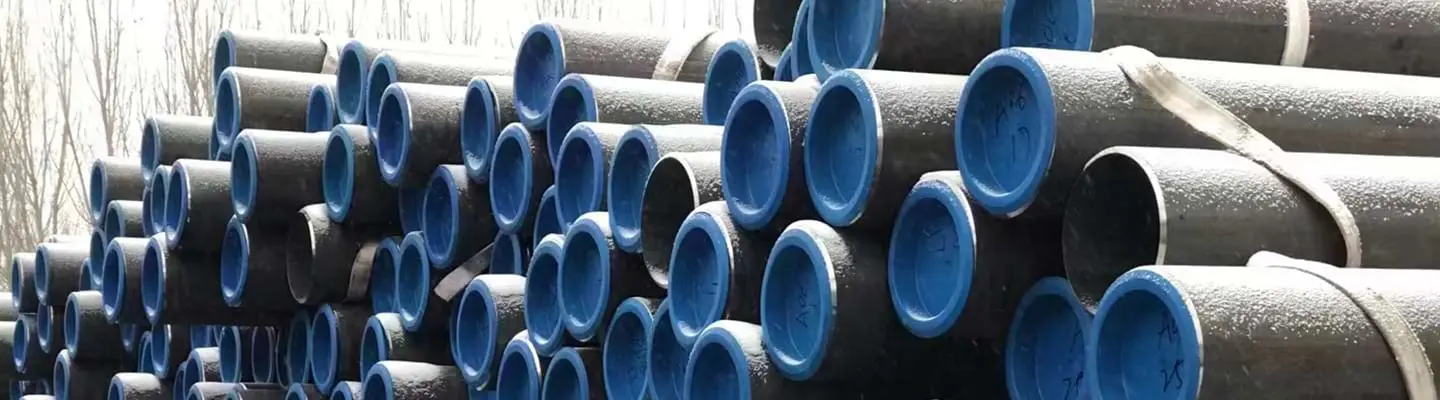
X52 is the line pipe grade we most often supply for sour service gathering systems, and the ordering pattern is consistent: PSL2, X52M or X52N, Annex H with HIC testing, low sulphur. The chemistry controls that make X52 reliable in sour service — the 0.015% PSL2 sulphur limit and the carbon equivalent ceiling — are the same controls that make it straightforward to weld and inspect in the field. This is why X52 is often chosen over X60 or X65 for sour gathering systems even when the design pressure could support a higher-grade pipe: the sour service chemistry and field welding requirements pull in the same direction.
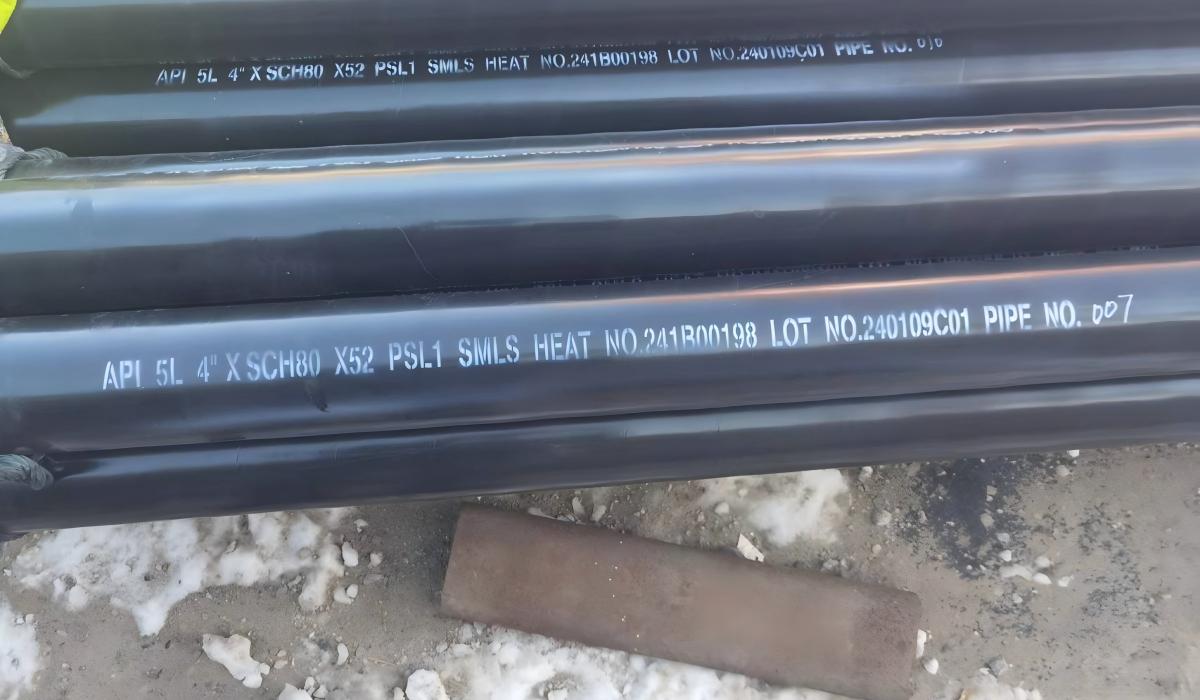 A ZC seamless X52 line pipe bound for Nigeria — the stencil reads API 5L, 4in, SCH80, X52, PSL1, SMLS.
At 360 MPa (52,200 psi) minimum yield, X52 sits below the threshold where sulphide stress cracking becomes a primary design concern, making it one of the most consistently specified grades for onshore gathering lines in H2S environments. It is produced in seamless and welded forms across a size range from 2-inch to 60-inch OD, with PSL2 offering the chemistry and NDE controls that operating company specifications require for gas transmission and sour service.
One pattern we see on X52 orders that causes problems downstream is the omission of the delivery condition from the PO. For X65 and X70, the delivery condition (Q or M) is largely a mill decision. For X52, it matters more because PSL2 permits three conditions — N, Q, and M — with different carbon limits and different welding procedure implications. X52Q at C_max 0.18% has meaningfully better weldability than X52N at C_max 0.24%. If the field welding specification was written for X52M or X52Q and the mill supplies X52N, the preheat requirements may need to be revised.
What we see on X52 sour service orders: The most common X52 procurement gap is the sour service supplementary requirement being added after the order is placed. A buyer contacts us with an X52 PSL2 order already in progress and asks to add HIC testing. Under API 5L, the sour service requirements for X52 sit in Annex H and need a different production heat — ultra-low sulphur, calcium treatment, tighter inclusion control. A standard PSL2 X52 heat cannot be retrospectively qualified for sour service by testing alone; it has to be re-ordered against a new heat. Write "Annex H applies" on the original purchase order, and note that there is no API 5L supplementary-requirement code for this — an SR number in a project spec is someone's local shorthand, not a clause you can hold a mill to.
Quick Answer
X52 (ISO designation L360) is a 360 MPa (52,200 psi) minimum-yield carbon steel line pipe grade. Specify PSL2 for gas transmission, sour, and offshore service; PSL1 covers water and low-pressure liquid lines. For sour gathering systems, order PSL2 to Annex H with HIC testing and ultra-low sulphur on the original purchase order — it cannot be added afterwards.
| X52 PSL1 | X52 PSL2 | |
|---|---|---|
| Minimum yield | 360 MPa (52,200 psi) | 360 MPa (52,200 psi) |
| Maximum yield | Not controlled | 530 MPa (76,900 psi) |
| Sulphur (max) | 0.030% | 0.015% |
| Charpy CVN / NDE | Not mandatory | Mandatory |
| Typical use | Water, low-pressure liquid | Gas, sour, offshore |
What Is API 5L X52?
API Specification 5L, 46th Edition (technically equivalent to ISO 3183) is the governing standard for steel line pipe used in oil, gas, and water transmission systems. The grade designation X52 follows the API 5L convention: the letter X identifies a high-strength line pipe grade as distinct from the lower-strength A and B grades, and the number 52 is the minimum yield strength expressed in thousands of pounds per square inch (ksi). In the ISO dual-designation system used in the standard, X52 is written as L360 — the 360 referring to the minimum yield in megapascals.
Within the API 5L grade ladder, X52 sits above X46 and below X56 and X60. It occupies the practical middle ground for onshore pipeline projects: strong enough to contain moderate operating pressures without excessive wall thickness, ductile enough to tolerate the ground loading and field welding conditions common in developing-market projects, and common enough that multiple mills can compete on supply. For sour service applications specifically, X52's yield level allows it to be qualified under NACE MR0175 / ISO 15156 with standard hardness controls, without the additional SSC testing burden that higher-strength grades carry.
Mechanical Properties
The mechanical properties table below covers both PSL1 and PSL2. The minimum yield and tensile values are identical across both specification levels — what PSL2 adds is a ceiling on yield strength and a yield-to-tensile ratio limit that PSL1 does not impose.
| Property | PSL1 | PSL2 |
|---|---|---|
| Minimum yield strength | 360 MPa (52,200 psi) | 360 MPa (52,200 psi) |
| Maximum yield strength | Not specified | 530 MPa (76,900 psi) |
| Minimum tensile strength | 460 MPa (66,700 psi) | 460 MPa (66,700 psi) |
| Maximum tensile strength | Not specified | 760 MPa (110,200 psi) |
| Yield-to-tensile ratio (max) | Not specified | 0.93 (when D > 323.9 mm only) |
| Charpy V-notch impact testing | Not mandatory | Mandatory |
Two points require emphasis. First, the PSL2 maximum yield of 530 MPa (76,900 psi) is a real upper bound — mills supplying PSL2 X52 must demonstrate the heat meets this ceiling, not just the floor. Second, the 0.93 yield-to-tensile ratio limit applies only when the outer diameter exceeds 323.9 mm (12.750 inches). For 12-inch and smaller pipe, PSL2 does not impose a Y/T ratio limit. This threshold matters when ordering 12-inch X52 PSL2: the ratio limit is absent, so a material with very little post-yield ductility reserve can still be API-compliant. For applications where deformation capacity matters — landslide zones, permafrost — state a Y/T ratio requirement explicitly on the PO regardless of pipe diameter.
For the complete PSL1 and PSL2 grade tables and full property ranges, see the API 5L specification tables → and ASME B36.10M pipe schedule chart →.
To calculate minimum wall thickness and design pressure for your pipeline, use the Pipeline Design Calculator →.
Chemical Composition
PSL1 Chemistry
PSL1 separates chemistry limits by manufacturing method — seamless pipe and welded pipe have slightly different carbon limits.
| Element | PSL1 Seamless (max) | PSL1 Welded (max) |
|---|---|---|
| Carbon (C) | 0.28% | 0.26% |
| Manganese (Mn) | 1.40% | 1.40% |
| Phosphorus (P) | 0.030% | 0.030% |
| Sulphur (S) | 0.030% | 0.030% |
| Nb + V + Ti combined | 0.15% | 0.15% |
| Carbon equivalent (IIW) | Not specified | Not specified |
| Carbon equivalent (Pcm) | Not specified | Not specified |
PSL1 does not break out individual limits for niobium, vanadium, and titanium — only the combined Nb+V+Ti total is controlled at 0.15% maximum. There is no carbon equivalent requirement under PSL1, and no maximum yield or ratio limit. PSL1 X52 is not a weldability-controlled specification.
PSL2 Chemistry by Delivery Condition
PSL2 chemistry for X52 varies by delivery condition. The three conditions have different carbon ceilings, which is the key driver of weldability differences between them.
| Element | X52N (max) | X52Q (max) | X52M (max) |
|---|---|---|---|
| Carbon (C) | 0.24% | 0.18% | 0.22% |
| Silicon (Si) | 0.45% | 0.45% | 0.45% |
| Manganese (Mn) | 1.40% | 1.50% | 1.40% |
| Phosphorus (P) | 0.025% | 0.025% | 0.025% |
| Sulphur (S) | 0.015% | 0.015% | 0.015% |
| Vanadium (V) | 0.10% max | 0.05% max | — |
| Niobium (Nb) | 0.05% max | 0.05% max | — |
| Titanium (Ti) | 0.04% max | 0.04% max | — |
| Nb + V + Ti combined | — | — | 0.15% max |
| CE (IIW formula) | 0.43% max | 0.43% max | 0.43% max |
| CE (Pcm formula) | 0.25% max | 0.25% max | 0.25% max |
Three observations from this table: the sulphur limit tightens from PSL1's 0.030% to PSL2's 0.015% across all three delivery conditions — a twofold improvement that is the chemistry foundation for PSL2's better sour service and weldability performance. X52Q has the lowest carbon maximum at 0.18% — the best weldability of any X52 delivery condition. X52M uses a combined Nb+V+Ti limit rather than individual element caps, which gives the mill more flexibility in microalloy design while keeping total alloy addition bounded.
The PSL2 carbon equivalent ceiling (CE IIW 0.43%, Pcm 0.25%) is identical across all three conditions. For most field construction scenarios with standard ambient preheat, pipe at or below these CE limits can be welded without a formal preheat requirement, though project specifications and actual CE values on the MTC should be reviewed by the welding engineer before finalising the welding procedure specification.
Standard Sizes
X52 is available in the size ranges below. ZC Steel Pipe supplies seamless X52 from 2-inch to 24-inch OD and welded X52 (ERW and LSAW) from 4-inch to 48-inch OD.
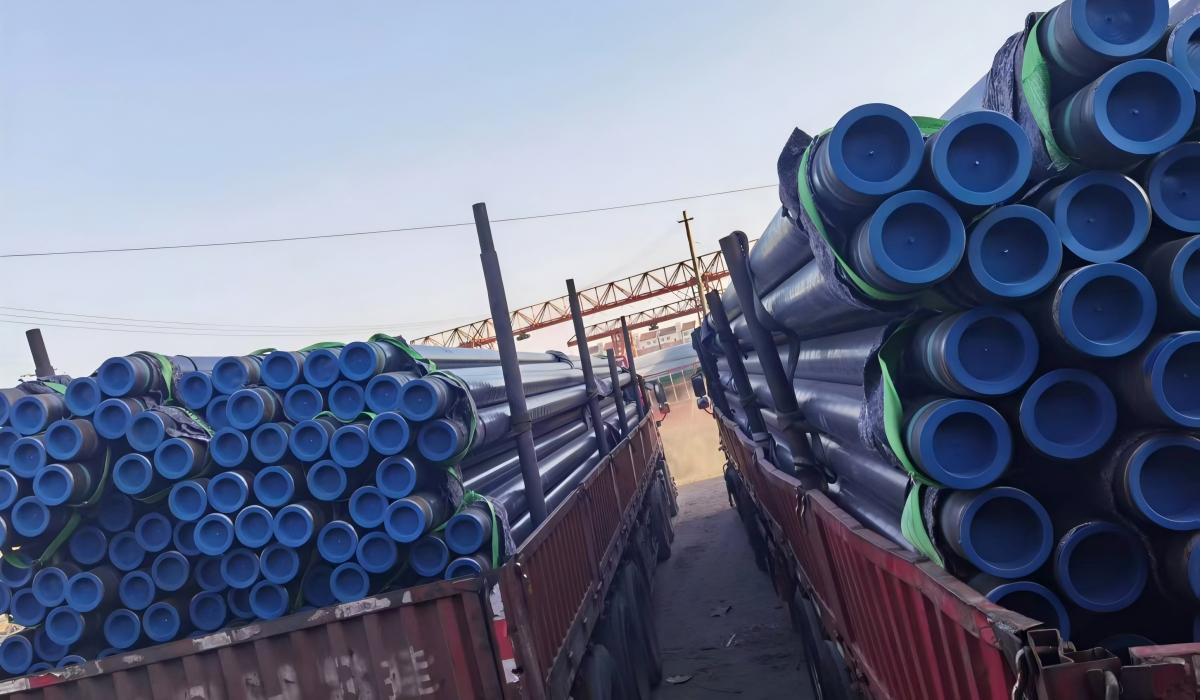 Two flatbeds loaded with 3LPE-coated X52 line pipe at sunset — a real ZC shipment leaving the yard.
| OD (inches) | OD (mm) | Wall Range (mm) | Pipe Type |
|---|---|---|---|
| 2 – 4 | 60.3 – 114.3 | 3.2 – 8.6 | Seamless |
| 4 – 16 | 114.3 – 406.4 | 4.0 – 17.5 | Seamless / ERW |
| 16 – 24 | 406.4 – 609.6 | 6.4 – 25.4 | Seamless / LSAW |
| 24 – 48 | 609.6 – 1219.2 | 8.0 – 25.4 | LSAW / SSAW |
| 48 – 60 | 1219.2 – 1524.0 | 10.0 – 25.4 | LSAW / SSAW |
Seamless X52 up to 24-inch OD is the standard specification for sour service gathering lines and moderate-pressure transmission where wall thickness is in the 6–18 mm range. For large-diameter pipeline projects above 24 inches — typically long-distance transmission or water injection mains — LSAW is the standard manufacturing method, supplied in delivery condition M (thermomechanically rolled). SSAW is used for lower-pressure large-diameter applications, but is generally not accepted for gas transmission under most operating company specifications.
What a real X52 gathering package looks like: X52 rarely ships as a single size. A 4,500-piece order to Nigeria ran 2″, 4″, and 6″ SCH 80 seamless together, all 3LPE-coated for direct burial, with PSL1 and PSL2 material in the same shipment matched to each line's service. The procurement detail that catches buyers is documentation: separate EN 10204 3.1 MTCs are required per PSL level, so a mixed PSL1/PSL2 package generates two certificate streams — and customs clearance needs both reconciled against the packing list.
Worked Wall Thickness Calculation
Wall thickness selection for X52 line pipe under ASME B31.8 uses the Barlow formula adjusted for design factor, efficiency, and temperature:
t = P × D / (2 × SMYS × F × E × T)
Where P is maximum allowable operating pressure (psi), D is outside diameter (inches), SMYS is the specified minimum yield strength (psi), F is the design factor, E is the longitudinal joint factor, and T is the temperature derating factor.
For X52, SMYS = 52,200 psi (from API 5L).
Example: 16-inch OD X52 PSL2 gathering line, MAOP = 870 psi (6 MPa), Class 2 location (F = 0.60), E = 1.0, T = 1.0
t = 870 × 16 / (2 × 52,200 × 0.60 × 1.0 × 1.0) = 13,920 / 62,640 = 0.222 inches (5.6 mm)
Add 12.5% mill undertolerance: nominal = 0.222 / 0.875 = 0.254 inches
Order 6.4 mm (0.252 inches) or the nearest standard wall above. Add corrosion allowance per project specification before finalising the ordered wall.
Same line, Class 1 location (F = 0.72):
t = 13,920 / (2 × 52,200 × 0.72 × 1.0 × 1.0) = 13,920 / 75,168 = 0.185 inches (4.7 mm)
Nominal with undertolerance = 0.185 / 0.875 = 0.212 inches → order 5.6 mm (0.220 inches) or nearest standard wall above.
The location class change from Class 2 to Class 1 shifts the required nominal wall from 6.4 mm to 5.6 mm on this example — a difference that affects weight per metre, coating cost, and total project tonnage on a long-distance pipeline. Location class is set by the population density methodology in ASME B31.8 and must be determined before the pipe specification is finalised. We have seen orders placed at Class 1 wall thickness where the route survey later reclassified segments as Class 2, requiring a pipe re-order or a maximum operating pressure reduction. Verify the area classification before ordering.
PSL1 vs PSL2 — Key Differences for X52
| Requirement | X52 PSL1 | X52 PSL2 |
|---|---|---|
| Maximum yield strength | Not controlled | 530 MPa (76,900 psi) |
| Yield-to-tensile ratio | Not controlled | 0.93 max (D > 323.9 mm) |
| Carbon equivalent | Not specified | CE IIW ≤ 0.43%, Pcm ≤ 0.25% |
| Sulphur limit | 0.030% | 0.015% |
| Charpy V-notch impact testing | Not mandatory | Mandatory |
| NDE — pipe body | Not mandatory | Mandatory |
| NDE — weld seam | Not mandatory | Mandatory (welded pipe) |
| Delivery condition designation | Not applicable | N, Q, or M required |
| Sour service requirements | Not addressed at PSL1 | Annex H, ordered with the pipe |
| Typical application | Water, low-risk liquid | Gas transmission, sour service, offshore |
For any gas transmission pipeline, PSL2 is the practical minimum — not because PSL1 X52 is inferior pipe from a strength standpoint, but because PSL2 is the only level where impact toughness, NDE, carbon equivalent, and yield ceiling are formally tested and documented. Most operating company specifications and national pipeline codes (including ASME B31.8 for gas and API RP 1111 for offshore) mandate PSL2 for gas service regardless of operating pressure. PSL1 retains a role for water transmission and low-pressure liquid gathering lines where the economics justify the simpler specification. For a grade-independent breakdown of the two levels, see the PSL1 vs PSL2 line pipe selection guide →, or run the PSL selector → to confirm the level your service requires.
X52 in Sour Service
X52 is one of the preferred grades for sour service pipelines because its 52 ksi yield strength is below the threshold where sulphide stress cracking (SSC) becomes a primary concern. NACE MR0175 / ISO 15156-2 permits carbon steel pipe in H2S service at hardness not exceeding 22 HRC — X52 at standard production hardness is well within this limit. The primary sour service risk for X52 is hydrogen-induced cracking (HIC) rather than SSC. HIC occurs when atomic hydrogen diffuses into the steel and accumulates at sulphide inclusions, producing blistering or step-wise cracking through the pipe wall. It is a material and process control issue, not a strength issue.
A critical point that is frequently misunderstood: standard PSL2 sulphur content of 0.015% is not sufficient for sour service HIC resistance. Project specifications for HIC-resistant pipe consistently require sulphur at 0.002–0.003% maximum — an order of magnitude lower than the PSL2 baseline. Achieving this sulphur level requires a separate production heat with desulphurisation treatment and calcium treatment to control the morphology of any remaining sulphide inclusions. This is not a testing upgrade to a standard PSL2 heat — it is a different production run.
For sour service X52, specify all five of the following requirements on the purchase order:
| Requirement | Specification |
|---|---|
| PSL level | PSL2 mandatory |
| Sulphur content | ≤ 0.002–0.003% (per project specification; beyond PSL2 minimum) |
| HIC testing | API 5L Annex H, test per NACE TM0284 |
| Inclusion shape control | Calcium treatment specified |
| Mill sour service capability | Confirm with documented HIC test records from recent production |
Mills supplying sour service X52 should provide HIC test records from recent production heats on the same pipe size and wall. API 5L mill certification alone does not confirm sour service capability — request and review the mill's HIC qualification data before placing the order. The delivery condition for sour service orders is typically X52M or X52Q, not X52N, because the lower carbon in M and Q conditions provides better HIC resistance in the heat-affected zone at girth welds.
PSL2 Delivery Conditions — N, Q, M
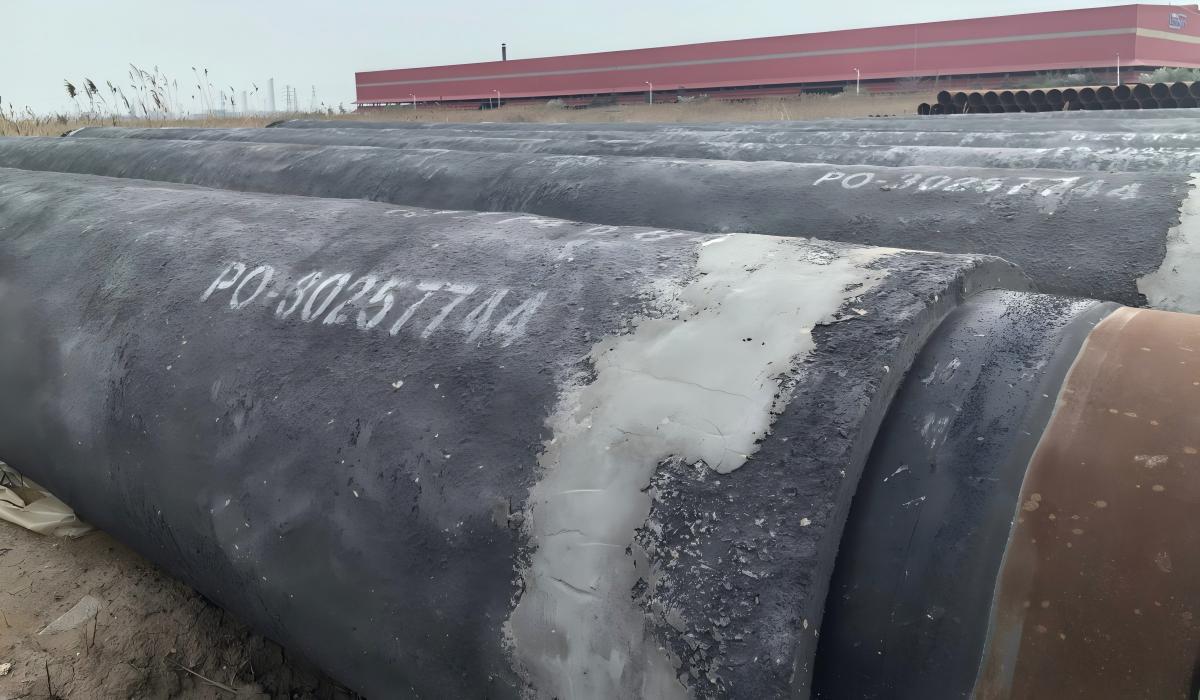 Large-diameter X52M line pipe with grey concrete weight coating over a black 3LPE layer — a ZC project shipment for Africa.
X52 is unique among the API 5L high-strength grades in that PSL2 permits three delivery conditions: N (normalised), Q (quenched and tempered), and M (thermomechanically rolled). X65 and X70 are limited to Q and M. This wider range of permitted conditions for X52 creates an ordering ambiguity that does not exist at higher grades.
X52N — Normalised
X52N is produced by heating the pipe above the austenitising temperature and cooling in still air. Carbon maximum is 0.24%. Normalising is the traditional heat treatment for seamless line pipe, and many mills use it as the default condition for smaller-diameter seamless X52. X52N is most commonly specified for moderate-temperature service and for projects where normalising is the mill's standard seamless production process. Its carbon maximum is the highest of the three PSL2 conditions, which has implications for preheat requirements when welding in cold ambient conditions. If your welding procedure specification was developed for X52M or X52Q material, verify the preheat requirements are adequate for X52N's higher carbon ceiling before accepting a change of delivery condition from the mill.
X52Q — Quenched and Tempered
X52Q is produced by quenching from the austenitising temperature followed by tempering. Carbon maximum is 0.18% — the lowest of any X52 delivery condition, giving the best intrinsic weldability. X52Q is less common for large-diameter pipe because quench and temper is less easily applied to plate-based LSAW production. For seamless pipe in sizes where Q+T is practical, X52Q offers the most predictable welding procedure qualification, particularly for sour service applications where the heat-affected zone chemistry is critical.
X52M — Thermomechanically Rolled
X52M is produced by controlled rolling and accelerated cooling, with the final reduction applied in a defined temperature window. Carbon maximum is 0.22%, and microalloy additions are controlled by a combined Nb+V+Ti limit of 0.15%. X52M is the standard delivery condition for ERW and LSAW X52 and the most common condition we see on large-diameter sour service orders. The thermomechanical process produces a fine-grained microstructure that combines adequate strength, toughness, and weldability. For most gathering line and transmission pipeline projects, X52M is the appropriate default when the delivery condition is not specified by the project engineer.
When Not to Use X52
X52 is the wrong specification in the following conditions:
High-pressure transmission requiring yield strength above 530 MPa. PSL2 X52 has a maximum yield of 530 MPa — a ceiling, not just a floor. A wall thickness calculation that requires the pipe to contribute yield strength above 530 MPa cannot be met by X52 at any wall thickness. Where the design pressure and diameter combination drives a minimum yield requirement above this ceiling, specify X60 or X65.
Sour service orders without confirmed HIC qualification and ultra-low sulphur. Standard X52 PSL2 is not sour-service-qualified material. The HIC qualification — including the ultra-low sulphur production heat, calcium treatment, and Annex H testing — must be part of the original mill order. An order placed without these requirements cannot be upgraded after the fact.
Projects where the owner specification mandates a higher minimum grade. X52 cannot satisfy a procurement specification written for X60 minimum, even if the design pressure calculation would permit a lower grade. Some NOC and major operator standards set grade minimums for reasons unrelated to pressure containment — standardisation across a field development, inspection equipment qualification, or coating qualification scope. Check the owner's project specification before proposing a grade substitution.
Large-diameter offshore applications with demanding toughness requirements. X65 PSL2 has an established offshore qualification track for subsea applications that X52 generally does not have. Offshore pipeline qualification for low-temperature Charpy toughness and fracture arrest typically targets X65 or X70. X52 is rarely specified for deepwater flowlines or risers regardless of pressure level.
Applications where minimum wall thickness from handling and corrosion allowance is not the governing constraint. Where design pressure genuinely governs the wall, X52's 360 MPa yield means more steel is required to contain the same pressure compared to X65 or X70. For large-diameter, high-pressure transmission pipelines where weight matters — both for steel cost and installation — a higher grade may be more economical despite the material premium.
Procurement Trap — Sour Service Omission
The most common and costly X52 procurement error is sour service language that does not activate the correct API 5L requirements.
Wrong PO: API 5L X52 PSL2, 16" × 6.4 mm, BE, sour service
Why it fails: The phrase "sour service" in plain text on the PO description does not activate Annex H requirements under API 5L. The mill is required to supply pipe that meets the stated standard, grade, and PSL level — and standard X52 PSL2 with 0.015% maximum sulphur, no calcium treatment requirement, and no HIC testing is fully compliant with that PO. The mill ships standard PSL2 pipe, the MTC shows sulphur at 0.012%, and the project QA team then discovers there is no HIC test data and the sulphur is not at the 0.002% level required for sour service. Re-order, 10–12 weeks lost.
What to write: API 5L X52 PSL2, delivery condition M, 16" × 6.4 mm, BE, Annex H applies (HIC test per NACE TM0284, acceptance criteria stated below), S ≤ 0.002%, calcium treatment, EN 10204 3.2 MTC
Every element of that PO line activates a specific production and testing requirement. "Annex H" triggers the sour service production controls and the HIC test. "S ≤ 0.002%" overrides the PSL2 sulphur limit. "Calcium treatment" requires the mill to document the inclusion shape control treatment. "3.2 MTC" requires third-party witness at the mill. None of these requirements are implied by the phrase "sour service" alone.
X52 vs X60 and X65 — When X52 Is the Right Choice
Higher yield strength grades are not always the better engineering choice. X52 is correctly specified when:
Sour service is confirmed. At PSL2 with Annex H, X52 provides proven HIC resistance at a yield level that avoids SSC risk without additional testing. Specifying X60 or X65 for a sour service gathering system adds cost and tightens the chemistry requirements without improving pipeline performance for the application. X52's sour service chemistry and field welding requirements align — both are served by low carbon, low sulphur, and calcium treatment.
Wall thickness is governed by minimum thickness or corrosion allowance, not design pressure. For small-diameter gathering lines in the 4–8-inch range where minimum wall for handling or corrosion allowance governs the design, X52 provides adequate strength at lower cost than higher grades. Upgrading to X65 in this scenario increases material cost without reducing required wall thickness.
Field welding conditions are challenging. X52 PSL2's CE IIW ceiling of 0.43% and Pcm of 0.25% are easier to weld under marginal conditions — low ambient temperature, remote locations without controlled preheat facilities — than X65 or X70, which require tighter preheat and inter-pass temperature controls and are more sensitive to heat input variation. The field construction risk profile often favours the lower-strength grade.
Project specifications mandate it. Some NOC and operating company standards specify X52 as the maximum grade for field gathering systems to limit the number of grade qualifications required across a field development. Where the specification is fixed, engineering arguments for a higher grade are not relevant.
How to Specify X52 on a Purchase Order
A complete X52 line pipe purchase order must state all twelve items below. Missing any of them creates ambiguity that the mill will resolve in its favour — which is not necessarily in the project's interest.
- Standard — API Specification 5L, 46th Edition or ISO 3183
- Grade — X52 (or L360 in ISO notation)
- PSL level — PSL1 or PSL2
- Delivery condition — N, Q, or M (PSL2 only; required to determine chemistry compliance)
- Pipe type — seamless, ERW, LSAW, or SSAW
- OD and wall thickness — e.g. 406.4 mm × 9.5 mm or 16" × 0.375"
- End finish — plain end (PE), bevelled end (BE), or threaded
- Length — random (R1, R2, or R3) or specified cut length
- Sour and low-temperature requirements — "Annex H applies" for sour service production controls and HIC testing, with the acceptance criteria stated; for low-temperature service, state the Charpy test temperature, minimum absorbed energy and specimen orientation explicitly
- Quantity — in metres or metric tonnes
- MTC level — EN 10204 3.1 (mill certificate) or 3.2 (third-party witnessed)
- Coating — bare, FBE, 3LPE, or 3LPP if applicable; state application standard and holiday test voltage
For sour service orders, add: maximum sulphur percentage, calcium treatment requirement, and the mill's obligation to provide HIC test records from the production heat before shipment.
References
- API Specification 5L, 46th Edition — Specification for Line Pipe (American Petroleum Institute)
- ISO 3183 — Petroleum and Natural Gas Industries: Steel Pipe for Pipeline Transportation Systems
- ASME B31.8 — Gas Transmission and Distribution Piping Systems
- NACE MR0175 / ISO 15156 — Materials for Use in H2S-Containing Environments in Oil and Gas Production
- NACE TM0284 — Evaluation of Pipeline and Pressure Vessel Steels for Resistance to Hydrogen-Induced Cracking
- NACE TM0177 — Laboratory Testing of Metals for Resistance to Sulphide Stress Cracking and Stress Corrosion Cracking
Frequently Asked Questions
What is API 5L X52 line pipe?
API 5L X52 is a carbon steel line pipe grade defined in API Specification 5L, 46th Edition with a minimum yield strength of 360 MPa (52,200 psi) and a minimum tensile strength of 460 MPa (66,700 psi). The X52 designation follows the API 5L naming convention where the number indicates the minimum yield in thousands of psi. X52 is widely used for onshore oil and gas gathering lines, moderate-pressure transmission pipelines, and sour service pipelines where HIC resistance is required.
What is the difference between X52 PSL1 and PSL2?
PSL1 is the baseline requirement — it specifies minimum yield and tensile but does not mandate impact testing, NDE, carbon equivalent limits, or a maximum yield ceiling. PSL2 adds mandatory Charpy V-notch impact testing, a maximum yield strength of 530 MPa (76,900 psi), a yield-to-tensile ratio cap of 0.93, tighter chemistry controls including CE limits, and mandatory NDE for pipe body and weld seam. For gas transmission, sour service, and offshore applications, PSL2 is the practical minimum and is required by most operating company specifications.
Can X52 be used in sour service H2S pipelines?
X52 PSL2 ordered to API 5L Annex H, which carries the sour service requirements including HIC testing per NACE TM0284, is widely used in sour service gathering systems. The grade's 52 ksi yield strength is below the threshold where sulphide stress cracking is a primary concern under NACE MR0175. However, standard PSL2 sulphur content of 0.015% is not sufficient for sour service — project specifications for HIC-resistant pipe typically require sulphur at or below 0.002–0.003%, combined with calcium treatment and a confirmed HIC-qualified production heat. Write Annex H on the original purchase order, not as an add-on after the order is placed.
What are the three PSL2 delivery conditions for X52?
API 5L PSL2 permits X52 in three delivery conditions: N (normalised), Q (quenched and tempered), and M (thermomechanically rolled). X52N has a carbon maximum of 0.24% and is common for moderate-temperature service where normalising is the mill's standard process for seamless pipe. X52Q has a carbon maximum of 0.18%, giving the best weldability of the three conditions, but Q+T is less common for large-diameter plate-based pipe. X52M has a carbon maximum of 0.22% and is the standard condition for LSAW and ERW X52. Unlike X65 and X70, which are limited to Q and M, X52 is unique in that the N condition is also permitted — and this difference has welding procedure implications.
What sizes are available for X52 line pipe?
API 5L X52 is available in a wide size range. Seamless X52 is typically produced in OD from 2 inches to 24 inches (60.3 mm to 609.6 mm). Welded X52 — ERW, LSAW, and SSAW — extends the range from 2 inches to 60 inches (508 mm to 1524 mm) for large-diameter pipeline projects. Wall thickness ranges from approximately 3.2 mm to 25.4 mm depending on OD and manufacturing method. Confirm the specific OD and wall combination with the mill, as not all combinations are available in every manufacturing process.
What is the carbon equivalent limit for X52 PSL2?
API 5L PSL2 specifies a maximum carbon equivalent (IIW formula) of 0.43% and a maximum Pcm of 0.25% for all three X52 delivery conditions. These limits apply to N, Q, and M conditions equally. PSL1 X52 has no carbon equivalent requirement at all. The CE and Pcm limits are the mechanism by which PSL2 controls field weldability — mills must demonstrate the pipe meets these limits on the MTC, and EPC welding engineers use them to determine preheat requirements per BS EN ISO 17671 or AWS D1.1.
What is the yield-to-tensile ratio limit for X52 PSL2?
API 5L PSL2 specifies a maximum yield-to-tensile ratio of 0.93 for X52, but this limit applies only when the pipe outer diameter exceeds 323.9 mm (12.750 inches). For smaller diameters, no Y/T ratio limit applies under PSL2. The ratio limit ensures the pipe retains adequate post-yield ductility for pipelines subject to displacement loads from ground movement or seismic events. PSL1 has no yield-to-tensile ratio limit at any diameter.
How do I specify X52 for sour service on a purchase order?
A sour service X52 purchase order must explicitly state: API 5L, grade X52, PSL2, delivery condition (M or Q recommended), OD and wall thickness, bevel end, Annex H compliance including HIC testing per NACE TM0284, maximum sulphur 0.002% (or per project specification), calcium treatment, and EN 10204 3.2 MTC. Writing 'sour service' in plain text on the PO description is not sufficient — the Annex H reference and the specific HIC acceptance criteria must appear explicitly. Omitting these means the mill can supply standard PSL2 X52 and be fully API-compliant.