The choice between seamless and welded line pipe — and between ERW, LSAW, and SSAW within the welded category — is driven by OD and wall thickness, operating pressure, fluid type, and what the applicable pipeline code actually permits for that service. Preference does not enter into it. A procurement team that specifies ERW for a 20-inch gas transmission line and an engineer who specifies SSAW for a high-pressure offshore trunkline have both made the same type of error: they have selected a manufacturing method without reading what the code requires for that combination of diameter, pressure, and fluid.
We supply seamless, ERW, LSAW, and SSAW line pipe at ZC Steel Pipe in API Specification 5L, 46th Edition, grades X52 through X80, PSL1 and PSL2. The orders we receive for West African and Middle Eastern gas transmission projects are almost entirely LSAW PSL2 X65 or X70 in the 20- to 48-inch OD range. Seamless orders come predominantly from compressor station piping packages and subsea spool fabricators working in sizes from 2 to 16 inches.
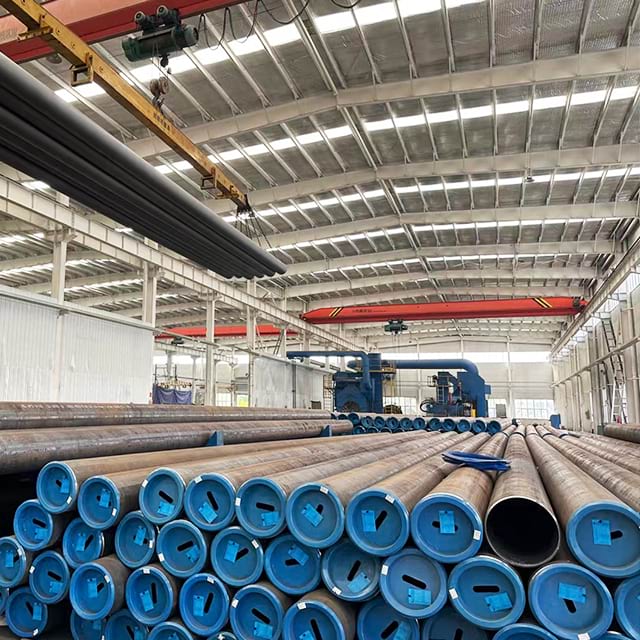 Seamless line pipe stacked with protective end caps in the ZC warehouse, served by overhead crane.
How Each Type Is Made
Seamless — a solid steel billet is heated to rolling temperature, pierced on a mandrel mill or push bench to form a hollow shell, and then elongated and rolled to the target OD and wall thickness. No weld seam exists anywhere in the pipe wall. The piercing process introduces circumferential variation in wall thickness that seamless mills control through tight rolling pass schedules; API 5L permits a wall thickness tolerance of +20% / −12.5% for seamless, which is wider than the tolerance for welded pipe formed from plate of known thickness. Practical seamless OD for line pipe grades runs from ½ inch to approximately 24 inches; above that, production yield drops sharply and the commercial case for seamless disappears.
ERW (Electric Resistance Welding) — strip steel is cold-formed into a cylinder and the abutting edges are fused by high-frequency electrical resistance — the current flowing across the interface generates heat that welds the edges without filler metal. The ERW weld is narrow, fully solid-state, and runs the full length of the pipe. When 100% weld seam ultrasonic testing is applied and the strip material is clean, ERW produces good mechanical properties. The seam's solid-state character is also its weakness: hook cracks and lack-of-fusion defects can form at the seam edges if the forming geometry or power parameters drift, and these defects can be invisible to inadequate NDE. Practical range: 2 to 24 inches OD, wall up to approximately 19 mm.
LSAW (Longitudinal Submerged Arc Welding) — steel plate is pressed into a U-shape then an O-shape (the UOE process) or formed progressively by the JCO process, and the longitudinal seam is welded inside and outside by submerged arc welding — a high-heat-input process using a flux-covered arc and filler wire that produces a deep, narrow, fusion weld with excellent mechanical properties and a large HAZ that subsequent PWHT or controlled cooling manages. LSAW is the engineering standard for large-diameter, high-pressure gas transmission pipelines. Practical range: 16 to 60 inches OD, wall up to approximately 50 mm.
SSAW (Spiral Submerged Arc Welding) — strip steel is fed at an angle into a forming head that wraps it into a helix; the spiral seam is welded by submerged arc welding, also inside and outside. The SSAW process produces pipe of any diameter from a single strip width by adjusting the helix angle, which makes it flexible and cost-effective for large diameters. The seam orientation — angled to the pipe axis — has consequences discussed in the weld quality section below. Practical range: 16 to 100 inches OD, though above 60 inches is rare for oil and gas service.
What we see on orders: When procurement teams in West Africa or the Middle East write "ERW" on a purchase order for a 20-inch gas transmission pipeline, we know the specification is wrong before we even open the pressure design calculation. LSAW is the correct manufacturing method for 20-inch high-pressure gas lines — not because ERW is incapable in principle, but because most national gas pipeline codes and major operating company standards explicitly require LSAW or seamless for mainline gas transmission above 16 inches. The issue surfaces at the insurance and project handover stage, not during installation. We flag it on the PO and ask the buyer to confirm the correct manufacturing method before we proceed.
Size and Pressure Ranges
The table below covers the practical production range for each manufacturing method. Overlap zones — particularly 16 to 24 inches OD — are where the selection decision requires engineering judgment rather than a simple size rule.
| Manufacturing Method | OD Range | Typical Application | Key Constraint |
|---|---|---|---|
| Seamless | ½″ – 24″ (21.3 – 609.6 mm) | Compressor station piping, subsea spools, high-pressure gathering | Wall eccentricity tolerance wider than welded; above 24″ commercially impractical |
| ERW | 2″ – 24″ (60.3 – 609.6 mm) | Gas distribution, onshore liquid gathering, moderate-pressure service | Solid-state seam; susceptible to hook cracks without full-length UT; not suited for high-pressure gas above ~70 bar |
| LSAW | 16″ – 60″ (406.4 – 1524 mm) | High-pressure gas transmission, offshore mainline, large-diameter sour service | Requires plate in specific widths; minimum OD constrained by plate-forming geometry |
| SSAW | 16″ – 100″ (406.4 – 2540 mm) | Water transmission, low-pressure gas distribution, structural casing | Spiral seam geometry limits suitability for high-pressure gas and fatigue service |
In the 16-to-24-inch overlap zone, seamless, ERW, and LSAW can all produce pipe to the same API 5L grade. The practical guide: above 70 bar MAOP for gas, specify LSAW or seamless and confirm which the project code requires. Below 50 bar for liquid service, ERW in this size range is commercially reasonable where the project code permits it.
For the complete grade tables with PSL1 and PSL2 mechanical properties and chemistry limits, see the API 5L specification tables and the PSL1 vs PSL2 selection guide.
What we ship in small-bore line pipe: For gathering and flow lines at 6 inches and below, seamless is almost always what we quote. Our 4,500-piece multi-size supply to a Nigerian operator covered 2-inch, 4-inch, and 6-inch SCH 80 API 5L X52 — all seamless, all 3LPE-coated for direct burial. At these diameters seamless is cost-competitive with welded and sidesteps the seam-weld inspection and sour-service qualification questions that come with ERW, which is why the small-bore packages we see out of West Africa rarely specify welded at all.
Weld Quality — ERW vs LSAW vs SSAW
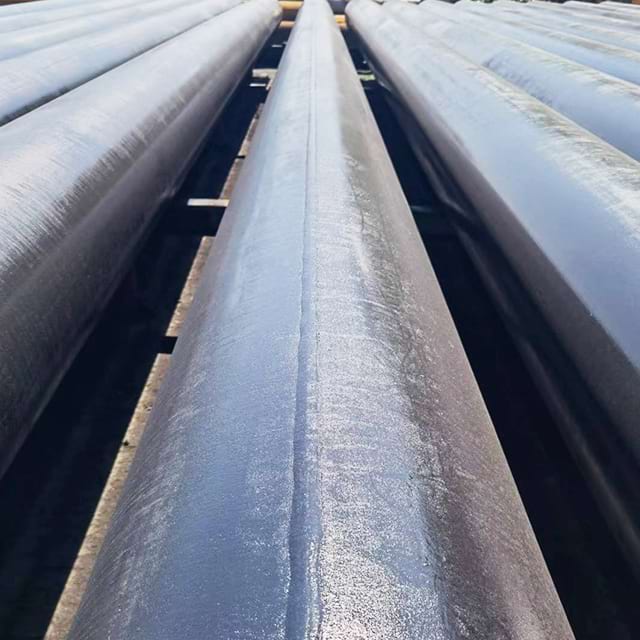 Coated LSAW line pipe on ZC outdoor racks — the straight longitudinal submerged-arc seam runs the length of each joint.
The weld quality differences between the three welded manufacturing methods matter most in two scenarios: high-pressure gas service and cyclic pressure loading. For low-pressure water service, all three methods produce adequate weld quality under proper QC.
ERW seam failure modes the industry has documented include hook cracks — elongated inclusions at the weld line that open under tensile or pressure loading — and lack-of-fusion defects at the seam edges, which result from insufficient heat input or poor edge preparation. Both defect types can run parallel to the seam, making them difficult to detect with transverse UT alone. The API 5L PSL2 requirement for full-length, multi-angle ultrasonic testing of the weld seam addresses this, but seam quality in ERW is only as good as the strip cleanliness and the process control at the weld station.
LSAW seam — the submerged arc process deposits filler metal into a prepared groove and produces a metallurgically sound weld with a large fusion zone. Full-length UT of the inside and outside weld passes, combined with weld repair NDE and end-area radiography, gives confidence that LSAW weld quality under PSL2 is consistent. The failure mode in LSAW is not typically a seam defect missed at production — it is weld repair quality. Repairs performed to access a defect and re-weld must be re-tested to the same standard as the original seam, and repair records must be traceable on the MTC.
SSAW seam failure in cyclic pressure service is the documented concern: the spiral seam introduces a weld orientation relative to the applied hoop stress that is less favourable for fatigue crack initiation and propagation than LSAW's longitudinal seam. The mechanism is geometric — the spiral seam is longer per unit pipe length, and the HAZ runs at an angle to the principal stress direction. In sustained steady-pressure liquid service, this is rarely critical. In high-pressure gas service with start-stop cycling or pressure fluctuation, SSAW's seam geometry is one reason most project codes exclude it from mainline gas transmission.
SSAW's spiral seam is not fundamentally weaker than LSAW's longitudinal seam — the weld material and process (submerged arc welding) are identical. The difference is geometric: the spiral seam is longer per unit of pipe length, and the heat-affected zone orientation relative to applied hoop stress is less favourable for fatigue and fracture mechanics. In low-pressure water transmission this geometry difference is irrelevant — the operating stress is well below the fatigue threshold. In high-pressure gas transmission, particularly where pressure cycling occurs, the geometry matters enough that most international project codes — DNV-ST-F101 for offshore, and most national gas code requirements that derive from it — exclude SSAW from mainline gas service. The exclusion is not about weld quality per se; it is about the structural mechanics of that seam orientation under fatigue loading.
When NOT to Use Each Type
Do not use SSAW for high-pressure gas transmission mainlines. Above approximately 40 bar MAOP, most national gas pipeline codes and major operator project specifications exclude SSAW from mainline service. The combination of spiral seam fatigue sensitivity and the dimensional variability inherent in the spiral forming process (OD and wall tolerance is wider for SSAW than LSAW) makes SSAW unsuitable for this application regardless of the grade specified. SSAW has a legitimate role in water transmission, structural casing, and low-pressure gas distribution trunk mains — use it there.
Do not use ERW above 24 inches. ERW mills do not produce pipe at this OD; the cold-forming process is not practical at large diameters. More relevant is the threshold where project codes stop permitting ERW for high-pressure service: most gas pipeline codes cap ERW at 70 bar or require additional testing above that pressure. If the MAOP is above 70 bar for a gas pipeline in the 8-to-24-inch range, check the applicable code before specifying ERW — the code may require LSAW or seamless.
Do not specify seamless above 24 inches for volume orders. Seamless production above 24 inches OD is limited to specialist mills and the commercial quantities available are small. If a project requires 100 km of 30-inch pipe, seamless is not a viable manufacturing method regardless of budget. The correct specification for large-diameter, high-pressure pipe is LSAW PSL2.
Do not use seamless where LSAW is the engineering standard for that size. Specifying seamless X65 PSL2 at 20-inch OD instead of LSAW X65 PSL2 is not a conservative decision — it is an unnecessary cost premium (seamless at 20 inches, where it exists, costs significantly more than LSAW) without a corresponding reliability gain. For large-diameter mainline gas transmission, LSAW with full-length NDE under PSL2 is the engineering correct specification, not a compromise.
Wall Thickness Worked Example (ASME B31.8)
A 20-inch (508 mm OD) LSAW X65 PSL2 pipeline with a maximum allowable operating pressure (MAOP) of 10 MPa in a Class 1 location. Minimum wall thickness under ASME B31.8 (Gas Transmission and Distribution Piping):
Formula:
t = (P × D) / (2 × SMYS × F × E × T)
Variables:
- P = 10 MPa (MAOP)
- D = 508 mm (nominal OD)
- SMYS = 450 MPa (X65 minimum yield per API 5L, 46th Edition)
- F = 0.72 (design factor, Class 1 location per ASME B31.8 Table 841.114A)
- E = 1.0 (longitudinal joint factor for LSAW per ASME B31.8 Table 841.115A)
- T = 1.0 (temperature derating factor, ambient temperature)
Calculation:
t = (10 × 508) / (2 × 450 × 0.72 × 1.0 × 1.0)
t = 5,080 / 648
t = 7.84 mm
Round up to the nearest commercially available wall: 8.0 mm, or confirm against the project's standard wall schedule. For LSAW at 20 inches, 9.5 mm and 12.7 mm are common stocked walls in the Middle East and West African supply chain; the 8.0 mm minimum wall leaves a margin that most operators accept.
The same formula applies identically to seamless X65 PSL2 — the SMYS is the same and the calculation does not change. The practical difference is that seamless at 20 inches OD is not commercially available in the quantities required for a mainline pipeline in most markets. The specification for a 20-inch high-pressure gas line in these markets is LSAW X65 PSL2, not seamless — not because the formula is different but because the supply chain does not support seamless at this size for volume orders.
To run this calculation for your specific pipeline parameters, use the Pipeline Design Calculator.
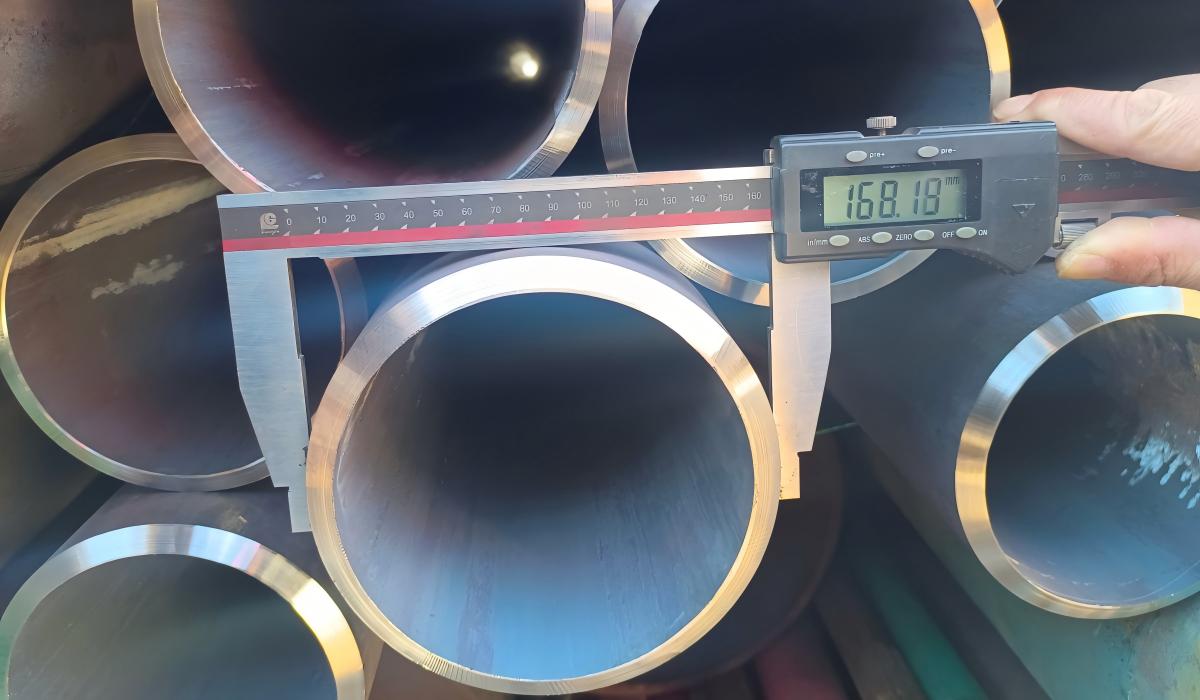 Dimensional QC on a machined bevel — a digital caliper check on the pipe end before dispatch.
Procurement Trap — Contradictory Specification
A PO or project datasheet that specifies "seamless LSAW X65 PSL2" is not a conservative specification — it is a contradictory one. Seamless and LSAW are mutually exclusive manufacturing methods. Seamless pipe has no weld seam; LSAW pipe has a longitudinal submerged arc weld seam. A pipe cannot be both.
When contractors receive a PO with contradictory manufacturing method terms, they resolve the ambiguity in their favour — which typically means the cheaper option. If LSAW is less expensive at the required OD (which it usually is above 16 inches), the mill produces LSAW and ships it against the PO. The MTC will read "LSAW" because that is what was made. If the purchaser's receiving inspection then flags that the MTC does not say "seamless," the dispute begins.
The correct PO language is one of these — not both:
- "API 5L, Grade X65, PSL2, Seamless, [OD] × [wall]..." — for small-bore, high-pressure, or fatigue-sensitive applications below 16 inches
- "API 5L, Grade X65, PSL2, LSAW, [OD] × [wall]..." — for large-diameter gas transmission mainlines
We see this contradiction most often on specifications drafted from a previous project datasheet that mixed requirements from different line items. Carry the manufacturing method review through to the purchase order explicitly — do not leave it to the mill to resolve.
A second common trap: specifying "seamless or equivalent" without defining what constitutes an equivalent. Mills will interpret "equivalent" as any welded manufacturing method, including SSAW for large diameters. If seamless is required, the PO must say "seamless" only.
Supply
We supply seamless line pipe from ½ inch through 16 inches OD, LSAW from 16 through 48 inches OD, ERW from 2 through 16 inches OD, and SSAW from 20 through 60 inches OD for water service and structural applications. PSL2 is our default for all gas transmission inquiries in any manufacturing method — PSL1 is available on request for lower-specification applications.
Most LSAW orders for West African and Middle Eastern gas projects ship in X65 or X70 PSL2 with Charpy V-notch testing at −20°C and EN 10204 3.2 MTC (third-party witnessed). For compressor station piping packages, seamless X65 or X70 PSL2 in 6 through 16 inches OD is a standard procurement. SSAW we supply for water transmission projects and structural casing where the project specification explicitly permits spiral pipe.
For further reading on PSL1 vs PSL2 requirements and which delivery condition is appropriate for your project, see the PSL1 vs PSL2 selection guide, X65 PSL2 specifications, and X70 PSL2 specifications.
Frequently Asked Questions
What is the difference between seamless and welded line pipe?
Seamless line pipe is formed from a solid steel billet that is pierced and rolled into a tube — there is no weld seam anywhere in the pipe wall. Welded line pipe is formed by rolling steel plate or strip into a cylinder and welding the seam, either longitudinally (LSAW, ERW) or spirally (SSAW). The absence of a weld seam in seamless pipe gives it more uniform mechanical properties around the circumference and eliminates the weld-related defect risk, but limits the size range and increases cost versus welded alternatives in larger diameters.
Which is stronger — seamless or welded line pipe?
For the same grade and wall thickness, seamless and welded line pipe have the same minimum yield and tensile strength requirements under API 5L. The practical difference is consistency and defect risk. Seamless pipe has uniform mechanical properties with no seam — the entire circumference has the same microstructure. Welded pipe has a weld zone with different mechanical properties than the parent metal, and the weld introduces a potential defect site. However, modern LSAW production with submerged arc welding and full-length weld NDE produces weld quality that meets or exceeds the pipe body in most mechanical property measures.
When should I specify seamless instead of ERW or LSAW?
Specify seamless when: the application requires high reliability with no weld seam risk (subsea spool pieces, riser connections, compressor station piping, high-pressure small-bore gathering); the OD is below 16 inches where seamless is cost-competitive with LSAW; the pipe will see fatigue loading from cyclic pressure or vibration where weld fatigue is a concern; or the project specification explicitly requires seamless. For large-diameter (above 16 inches) pipeline applications, LSAW is more economical than seamless and produces equivalent quality under proper QC.
What is the difference between ERW, LSAW, and SSAW?
ERW (Electric Resistance Welding) forms pipe from strip steel by cold-forming and welding the seam using electrical resistance heating — no filler metal is used. Suitable for diameters up to approximately 24 inches and moderate pressures. LSAW (Longitudinal Submerged Arc Welding) forms pipe from plate by pressing into a U and O shape (UOE) or JCO process, then welding with submerged arc welding — produces high-quality welds suitable for large-diameter, high-pressure applications. SSAW (Spiral Submerged Arc Welding) forms pipe by helically winding strip steel and welding the spiral seam — economical for large diameters at lower pressure, but the spiral seam is less suited to high-pressure gas transmission than LSAW.
Is LSAW better than SSAW for high-pressure gas pipelines?
Yes — LSAW is the preferred manufacturing method for high-pressure gas transmission pipelines above approximately 16 inches OD. LSAW's longitudinal weld produces a more consistent weld geometry and allows better NDE coverage than the spiral seam in SSAW. LSAW pipe also has better dimensional consistency — OD, wall thickness, and straightness — which is important for automated field welding. SSAW is suitable for lower-pressure applications such as water transmission, drainage, and low-pressure gas distribution, where its cost advantage over LSAW justifies its use.
What size range does each pipe type cover?
Seamless covers ½ inch to approximately 24 inches OD (21.3 mm to 609.6 mm) for line pipe applications. ERW covers approximately 2 inches to 24 inches (60.3 mm to 609.6 mm). LSAW covers approximately 16 inches to 60 inches (406.4 mm to 1524 mm). SSAW covers approximately 16 inches to 100 inches (406.4 mm to 2540 mm), though above 60 inches is rare for oil and gas applications. In the overlap zones — particularly 16 to 24 inches — seamless, ERW, and LSAW all produce valid pipe, and the choice depends on pressure rating, quality requirements, and project economics.