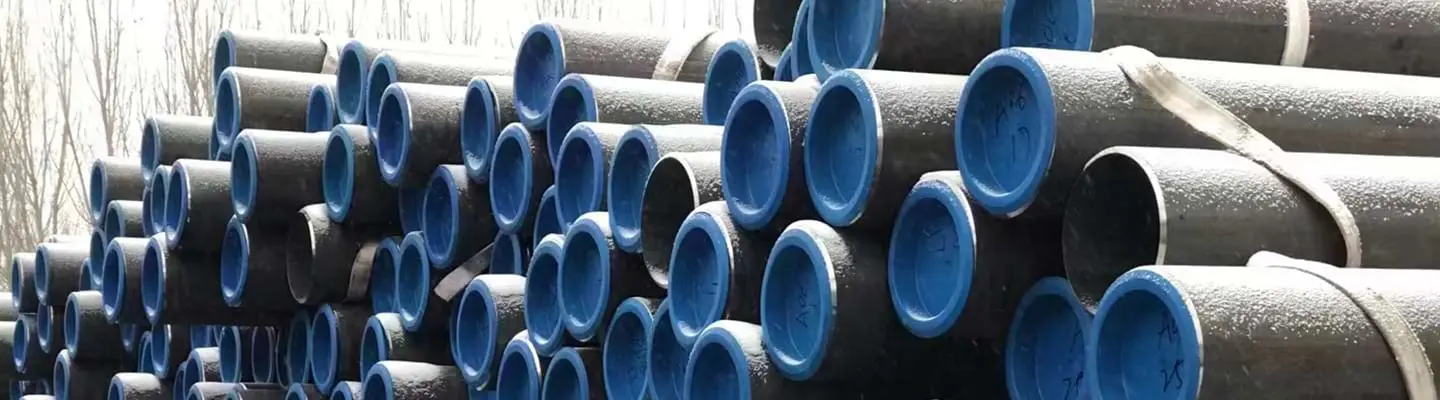
API 5L X65 is the workhorse grade of high-pressure gas transmission and offshore pipeline design. Its 450 MPa (65 ksi) minimum yield represents the point on the API grade ladder where wall savings over lower grades become commercially significant in large-diameter pipeline projects, while remaining within the weldability envelope that established welding procedures can manage without exotic preheat requirements. For offshore and subsea pipelines in particular, X65 PSL2 has decades of qualification history that makes it the default specification for most project engineers.
At ZC Steel Pipe, we supply X65 PSL2 to pipeline contractors working offshore West Africa and in the Gulf. The most consistent pattern we see is that X65 is almost always specified as PSL2 by the time the project gets to us — PSL1 X65 technically exists in API 5L but we rarely see it ordered, and the applications that drive engineers to X65 yield (deepwater, subsea, high-pressure gas transmission) nearly always require PSL2's impact testing and NDE documentation. We have had to contact procurement teams and ask whether PSL1 was actually intended before proceeding.
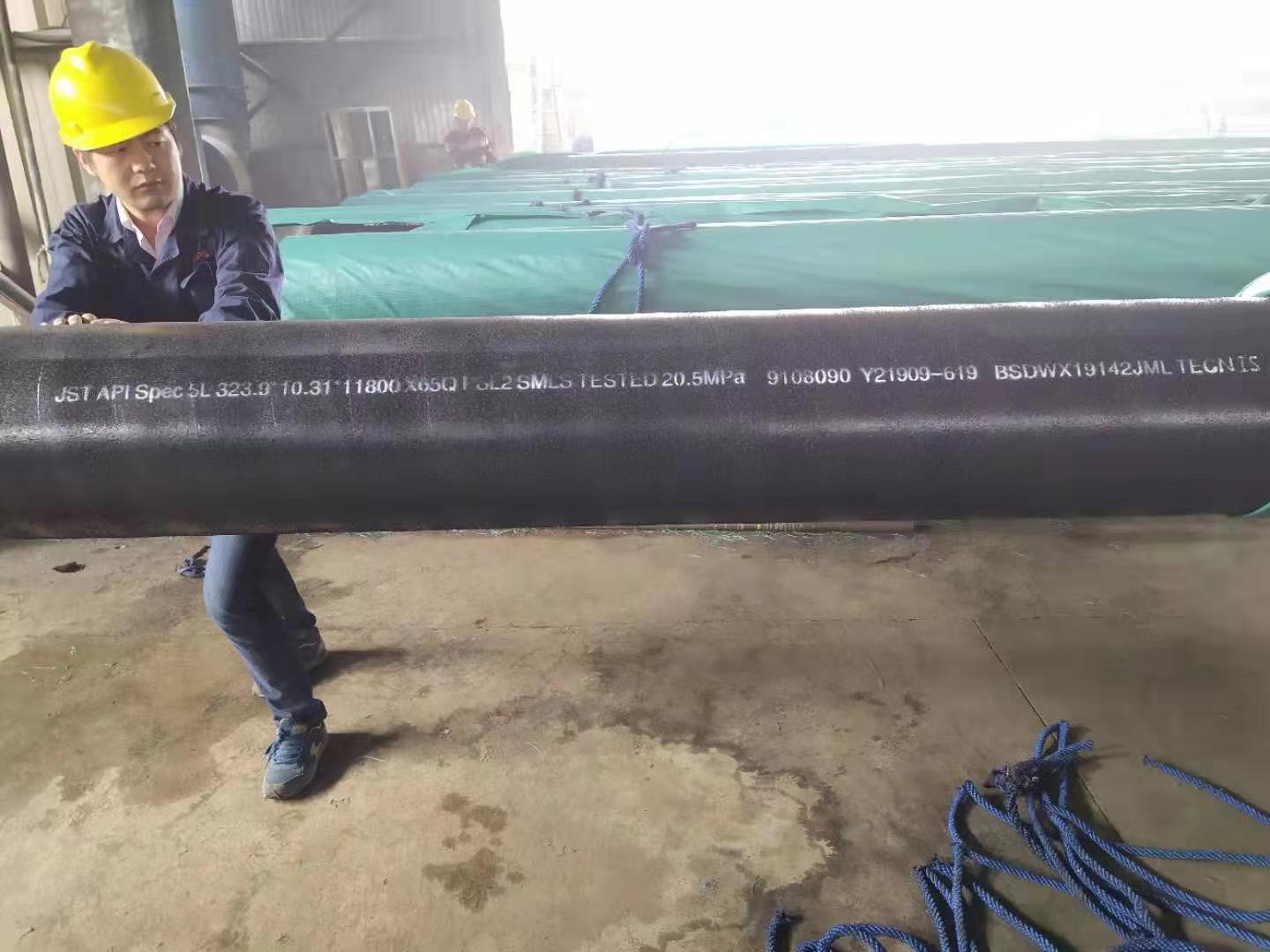 A ZC X65Q PSL2 seamless line pipe on a shipment bound for Africa — the mill stencil reads API Spec 5L, X65Q, PSL2, SMLS.
At a Glance
X65 (L450 / X65) is API 5L's default grade for offshore, subsea, and high-pressure gas transmission: a 450 MPa (65,300 psi) minimum yield that is high enough to save wall over X52 and X60, yet low enough to weld with standard procedures. Specify it as PSL2 — the applications that drive engineers to X65 nearly always require PSL2's Charpy testing, carbon-equivalent control, and NDE. For sour service, PSL2 alone is not enough; order to Annex H and write the HIC test and its acceptance criteria out in full.
| Attribute | X65 PSL2 (per API 5L) |
|---|---|
| Minimum yield | 450 MPa / 65,300 psi |
| Maximum yield | 600 MPa / 87,000 psi |
| Minimum tensile | 535 MPa / 77,600 psi |
| Y/T ratio (max) | 0.93 (applies when OD > 323.9 mm) |
| Delivery conditions | Q (typical seamless) or M (typical LSAW / ERW) |
| Sour service | X65 PSL2 ordered to Annex H, HIC test per NACE TM0284 named in full |
The full grade ladder is in the API 5L specification tables; size the wall against your design pressure with the Pipeline Design Calculator. If you are still weighing PSL1 against PSL2, work through the API 5L PSL1 vs PSL2 selection guide first.
A question we get regularly from engineers specifying X65 for the first time is which delivery condition to specify — Q or M. In most cases the mill decides based on their manufacturing route: seamless pipe is produced Q, LSAW and ERW pipe is produced M. But the CE limit and the carbon ceiling are the same for both per API 5L, so for procurement purposes the distinction matters mainly when a project specification requires a specific delivery condition for heat input control reasons.
What we see on X65 offshore orders: West African operators routinely request EN 10204 3.2 MTC (third-party witnessed) for X65 PSL2 offshore pipe, even when the project specification only requires 3.1. We treat 3.2 as the default for offshore supply in that market. We also consistently see late-stage additions of sour service requirements (the NACE TM0284 HIC test) to X65 orders that were initially specified for sweet service — often after the well programme is updated mid-project. For large-diameter X65 orders, we recommend confirming the sour service classification in writing before mill scheduling begins.
What Is API 5L X65?
API 5L X65 is defined in API Specification 5L / ISO 3183 with a minimum yield of 450 MPa. It is produced by controlled rolling with microalloying — primarily niobium, vanadium, and titanium additions — that deliver high strength without requiring the high carbon levels that would compromise weldability and toughness.
X65 occupies a specific engineering position: it is the highest grade for which standard welding procedures (typically preheat-free at ambient temperature above 5°C) are straightforward to qualify. Higher grades (X70, X80) deliver additional wall savings but impose stricter heat input controls and preheat requirements that increase welding costs, particularly in field conditions.
PSL1 X65 exists in the standard but carries no yield ceiling, no tensile ceiling, no yield-to-tensile ratio limit, no mandatory Charpy testing, and no carbon equivalent requirement. The resulting specification gap between PSL1 and PSL2 is wide enough that most project engineers writing an X65 specification are implicitly writing PSL2 — they simply assume it. That assumption should be made explicit on the purchase order.
Mechanical Properties
| Property | PSL1 | PSL2 |
|---|---|---|
| Minimum yield strength | 450 MPa (65,300 psi) | 450 MPa (65,300 psi) |
| Maximum yield strength | Not specified | 600 MPa (87,000 psi) |
| Minimum tensile strength | 535 MPa (77,600 psi) | 535 MPa (77,600 psi) |
| Maximum tensile strength | Not specified | 760 MPa (110,200 psi) |
| Yield-to-tensile ratio (max) | Not specified | 0.93 (applies when OD > 323.9 mm) |
| Charpy impact testing | Not mandatory | Mandatory |
| Delivery conditions | Not restricted | Q (quench and temper) or M (thermomechanical) |
For the complete PSL1 and PSL2 grade tables, see the API 5L specification tables → and the ASME B36.10M pipe schedule chart →
To calculate design pressure or minimum wall thickness for your pipeline, use the Pipeline Design Calculator →
The delivery condition suffix (Q vs M) changes the chemistry limits, not the strength. X65Q achieves 450 MPa yield by quench and temper — a process that works well for seamless pipe but is less common in LSAW. X65M achieves the same yield by thermomechanical rolling, which produces a finer grain structure and often better toughness in the as-rolled condition. For offshore and subsea LSAW pipe, X65M is the standard — its carbon ceiling of 0.12% (vs 0.18% for X65Q) also means better weldability in field conditions where preheat control is difficult.
Chemical Composition
API 5L 46th edition specifies X65 PSL2 in two delivery conditions — Q (quenched and tempered) and M (thermomechanically rolled) — with different chemistry limits for each. There is no N (normalized) delivery condition for X65 PSL2.
For PSL1, the standard gives separate chemistry limits for seamless and welded pipe. The seamless limit is carbon maximum 0.28%; the welded limit is carbon maximum 0.26%. The Mn_max of 1.45 applies to both forms. The combined Nb + V + Ti limit of 0.15 applies to both.
| Element | PSL1 Max % (welded) | PSL2 — X65Q | PSL2 — X65M |
|---|---|---|---|
| Carbon (C) | 0.26 | 0.18 | 0.12 |
| Manganese (Mn) | 1.45 | 1.70 | 1.60 |
| Silicon (Si) | — | 0.45 | 0.45 |
| Phosphorus (P) | 0.030 | 0.025 | 0.025 |
| Sulphur (S) | 0.030 | 0.015 | 0.015 |
| Nb + V + Ti combined | 0.15 | 0.15 | 0.15 |
| Carbon Equivalent (IIW) | Not specified | 0.43 max | 0.43 max |
| Carbon Equivalent (Pcm) | Not specified | 0.25 max | 0.25 max |
Note: API 5L specifies Nb + V + Ti as a combined maximum of 0.15% for all three delivery conditions shown above. The standard does not publish separate per-element limits for the combined Nb/V/Ti group in the same table row — individual element limits appear elsewhere in the standard text.
X65 PSL2 demands significantly tighter carbon control than the PSL1 grade — 0.18% maximum for Q delivery and 0.12% for M delivery, compared to 0.26% for welded PSL1. The lower carbon is compensated by higher manganese (up to 1.70% for Q, 1.60% for M) and microalloying additions. The two delivery conditions produce the same yield strength by different metallurgical routes: X65Q achieves it through quench and temper heat treatment, while X65M uses thermomechanically controlled rolling. Which delivery condition is supplied depends on the manufacturing route — seamless X65 is typically Q; welded X65 (LSAW, ERW) is typically M. The route also drives weld-seam inspection and availability at a given OD, covered in the seamless vs welded line pipe selection guide.
The CE_IIW limit of 0.43% is identical for X65Q and X65M. This is the value used in most welding procedure qualification documents. The Pcm limit of 0.25% applies to both and is the more conservative of the two for low-carbon steels — mills supplying X65M will often achieve Pcm values well below this ceiling given the 0.12% carbon maximum.
Standard Sizes
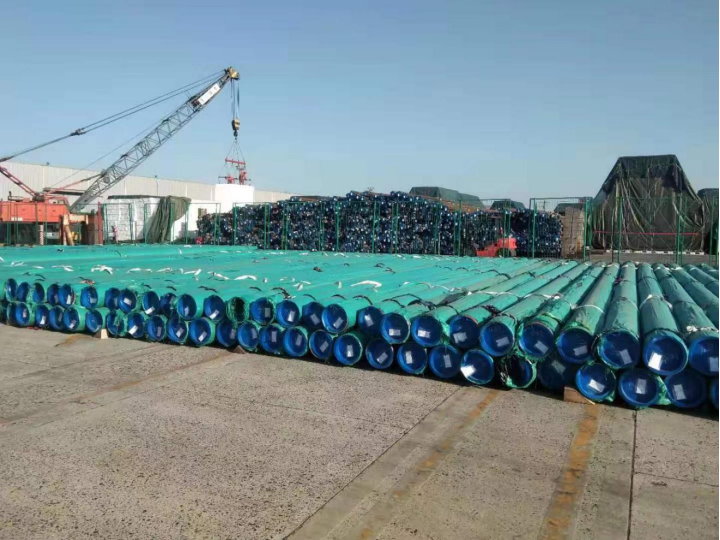 Coated X65 line pipe stacked and tarped in a ZC yard, crane alongside — a real project shipment staged for loading.
| OD (inches) | OD (mm) | Wall Range (mm) | Common Pipe Type |
|---|---|---|---|
| 4 – 16 | 114.3 – 406.4 | 5.0 – 19.1 | Seamless / ERW |
| 16 – 24 | 406.4 – 609.6 | 7.9 – 25.4 | Seamless / LSAW |
| 24 – 48 | 609.6 – 1219.2 | 9.5 – 31.8 | LSAW |
| 36 – 56 | 914.4 – 1422.4 | 12.7 – 38.1 | LSAW |
For offshore applications, the most common X65 sizes are 8 inches to 36 inches in LSAW with wall thickness 12.7 mm to 25.4 mm, typically with FBE or 3LPE coating and concrete weight coating for negative buoyancy.
Both ends of the X65 range reach us as different products: The two size regimes show up in our order book as genuinely distinct supply. On the seamless side we shipped X65Q at OD 12″ SCH 40 with 3 mm 3LPE and a non-slip granular topcoat for marine service in Africa; at the large-diameter end we delivered 18,000 tonnes of X65M PSL2 LSAW at 24″ with FBE for the EACOP crude oil pipeline. Same grade and yield — but the delivery condition, coating, and inspection regime diverge entirely by size and manufacturing route.
Worked Wall Thickness Calculation
The ASME B31.8 minimum wall thickness formula for a pressure pipeline is:
t = P × D / (2 × SMYS × F × E × T)
Where:
- P = maximum allowable operating pressure (MAOP)
- D = outside diameter
- SMYS = specified minimum yield strength (65,300 psi for X65 from API 5L)
- F = design factor (location class dependent)
- E = longitudinal weld factor
- T = temperature de-rating factor
Example: 20-inch X65 PSL2 gas transmission pipeline
Inputs:
- MAOP = 1,440 psi
- OD = 20 inches
- SMYS = 65,300 psi (X65, from API 5L)
- F = 0.72 (Class 1 location, ASME B31.8)
- E = 1.0 (seamless, or LSAW with 100% NDE)
- T = 1.0 (operating temperature ≤ 120°C)
Calculation:
t = 1,440 × 20 / (2 × 65,300 × 0.72 × 1.0 × 1.0)
t = 28,800 / 94,032
t = 0.306 in (7.8 mm) — this is the design minimum wall
Applying the API 5L undertolerance correction:
API 5L permits a minus 12.5% wall undertolerance. The ordered nominal wall must be thick enough that even a pipe at the minus tolerance limit meets the design minimum:
t_nominal = t_design / 0.875 = 0.306 / 0.875 = 0.350 in (8.9 mm)
Standard order: 9.0 mm (0.354 in) nominal wall — the next standard increment above 8.9 mm.
Note: This calculation gives the structural minimum. Corrosion allowance must be added separately according to the project specification before finalising the ordered wall thickness. Internal and external corrosion allowances are project-specific and are not part of ASME B31.8 wall thickness design.
X65 PSL2 — Offshore and Subsea Requirements
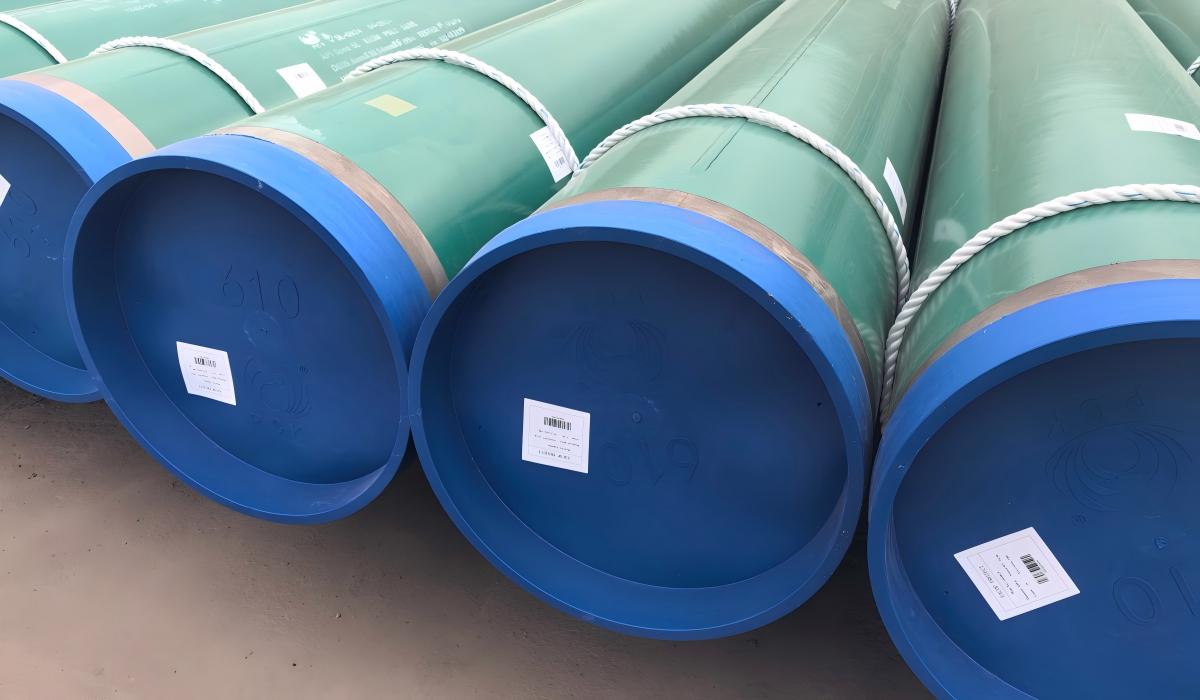 FBE-coated 24-inch (610 mm) X65 LSAW line pipe from a ZC shipment to Nigeria — green external coating over a bare, blue-lined bore.
Offshore and subsea applications impose requirements beyond API 5L PSL2 minimums. Key additional items typically specified for X65 in offshore service:
Toughness beyond PSL2 minimum — project specifications for deepwater and subsea X65 typically require Charpy testing at -20°C or lower, CTOD (crack tip opening displacement) testing of the pipe body and weld HAZ, and minimum absorbed energy values well above API 5L Table E.7 minimums. DNV-ST-F101 (Submarine Pipeline Systems) is the common reference for subsea toughness requirements and imposes its own testing matrix separate from API 5L.
Dimensional tolerances — offshore pipeline coatings (FBE, concrete weight coating) impose tighter OD tolerances than API 5L PSL2 requires. Most offshore project specs add an OD tolerance of ±1.0% or tighter, and out-of-roundness limits for pipe that will receive automated girth welding. Automated welding equipment used for offshore pipeline construction is sensitive to OD variation — a pipe that is within API tolerance can still cause weld misalignment issues.
Weld seam quality for LSAW — subsea LSAW X65 typically requires 100% radiographic testing (RT) or automated ultrasonic testing (AUT) of the longitudinal weld seam, plus TOFD (time of flight diffraction) for critical applications. These are supplementary requirements beyond PSL2's NDE requirements. The seam weld in an LSAW pipe is a potential fatigue initiation site in dynamic riser or flowline applications, and project specifications for such service routinely require weld profile inspection and weld cap geometry reports.
MTC level — EN 10204 3.2 (inspection certificate with results witnessed and countersigned by an independent third-party inspection body) is standard for offshore X65. We treat 3.2 as the default for all offshore supply. If a project specification states 3.1 but the end client is a West African operator or an IOC with a quality standard above API minimum, expect a request to upgrade to 3.2 before delivery.
Strain-based design — for reeled or S-lay installation and for pipelines in seismically active areas, strain-based design requirements may impose additional limits on yield-to-tensile ratio (tighter than 0.93), Lüders band extension, and uniform elongation. These requirements must be agreed with the mill before order placement — they are not standard delivery requirements and affect which heat chemistry can be accepted.
Sour Service and HIC Requirements for X65
X65 can be used in sour gas pipelines under API 5L Annex H (PSL2 sour service requirements), but the conditions for doing so are more restrictive than for lower grades.
At 65 ksi minimum yield, X65 sits below the SSC threshold for carbon steel under NACE MR0175 / ISO 15156-2 at ambient temperature — which is why it can be qualified for sour service where X70 and X80 cannot without additional processing. However, X65 grade strength requires chemistry additions (primarily higher manganese and microalloying additions such as Nb, V, and Ti) that increase the risk of hydrogen-induced cracking (HIC) in wet H₂S if sulphur content and microstructure are not carefully controlled.
For sour service X65 PSL2, the practical requirements beyond base API 5L include:
- Sulphur content ≤ 0.002% — tighter than the API 5L PSL2 limit of 0.015%, and mandatory for HIC resistance in wet H₂S service
- Calcium treatment — to control sulphide inclusion shape and reduce HIC initiation sites
- HIC testing per NACE TM0284 — required for sour service, and added to the order by name together with its CLR, CTR and CSR acceptance limits
- SSC testing of weld HAZ — required for girth welds in sour service; not automatic under PSL2
- Centre-line segregation control — mid-wall segregation in LSAW pipe is an HIC initiation site; project specifications often add ultrasonic mapping of centre-line quality
We have supplied sour service X65 LSAW to gas gathering projects in the Middle East where all five requirements above were specified. In those orders, the mill qualification process takes 6–8 weeks longer than standard PSL2 X65. Factor this into your project schedule.
The combination of low sulphur (≤ 0.002%), calcium treatment, and a controlled centre-line segregation profile is achievable at the mill level — but it requires the mill to have the ladle metallurgy capability to hit that sulphur target consistently across a heat. Not all X65 mills are qualified for sour service. Confirm mill sour service qualification and review previous NACE TM0284 test records before committing to a supplier for sour service X65.
X65 vs X70 — When to Choose Each
| Property | X65 PSL2 | X70 PSL2 |
|---|---|---|
| Min yield (MPa / ksi) | 450 / 65 | 485 / 70 |
| Max yield (MPa / ksi) | 600 / 87 | 635 / 92 |
| CE limit (IIW) | 0.43% | 0.43% |
| Wall savings vs X65 | Baseline | ~7% thinner |
| Offshore qualification history | Extensive | Growing |
| Sour service qualification | Established | More restricted |
| Field welding complexity | Standard | More controlled HI |
| Seamless availability | Good | Limited above 16″ |
Choose X65 for offshore, subsea, and sour service applications where qualification history and weldability take priority. Choose X70 for large-diameter onshore gas transmission where wall savings drive project economics and welding is done under controlled conditions. The API 5L X70 PSL2 specification article covers the higher grade in full, and the X70 vs X65 weldability and cost comparison works through the decision quantitatively.
When Not to Use X65
- Low-pressure gathering or distribution lines — X65's strength advantage over X52 or X60 translates to wall savings on paper, but at low operating pressures the minimum wall for handling and corrosion allowance governs, not design pressure. The X65 premium is not recovered in those applications.
- Applications where the project specification requires X70 or higher — X65 will not satisfy a project spec written for X70 minimum yield even if the project engineer would accept X65 in principle. Grade substitution requires a documented engineering deviation.
- High-temperature service above 120°C without thermal de-rating — X65 SMYS is specified at ambient temperature. At elevated operating temperatures, yield strength decreases. For service above 120°C, apply the temperature de-rating factor from ASME B31.8 Appendix A before checking the wall thickness calculation.
- Installations where field welding heat input cannot be controlled — X65 weld procedures are more sensitive to heat input than lower grades. In remote locations without power source control and prequalified welders, X60 or X52 can be the safer specification.
- Sour service without confirmed HIC qualification — standard X65 PSL2 is not sufficient for sour service. Ordering X65 PSL2 without the HIC test, calcium treatment, and low sulphur chemistry is a specification error that will only become apparent at the inspection stage.
Procurement Trap — PSL Level and Sour Service
The most common X65 procurement error we see is a purchase order that specifies "API 5L X65 PSL2" without the sour service supplementary requirement — then the project specification is updated to include sour service qualification three months later.
Under API 5L, PSL2 does not include HIC testing. The sour service requirements for X65 sit in Annex H, and the pipe must be ordered against it with the HIC test named explicitly. A PSL2 X65 order placed without that cannot retrospectively be qualified for sour service — the pipe must be reordered.
What to write on the PO to prevent this:
- For sweet service: API 5L X65 PSL2, delivery condition M or Q
- For sour service: API 5L X65 PSL2, delivery condition M or Q, ordered to Annex H, NACE TM0284 HIC test with CLR/CTR/CSR acceptance limits stated, sulphur ≤ 0.002%, calcium treatment
One line on the purchase order — "ordered to Annex H, HIC test per NACE TM0284, acceptance CLR/CTR/CSR as stated" — prevents a reorder. In a project timeline, a reorder costs 12–16 weeks. Writing the test out rather than trusting an abbreviation is what makes that line work.
A second common trap is specifying the grade as "X65" without a PSL level. API 5L mills will default to PSL1 if no PSL level is written. A PSL1 X65 mill test certificate will not satisfy an offshore project specification that requires PSL2 impact testing, NDE, and chemistry documentation. The project QA team will reject the MTCs and you will be re-sourcing pipe on a live project schedule.
How to Specify X65 on a Purchase Order
- Standard — API 5L or ISO 3183
- Grade — X65
- PSL level — PSL2 (mandatory for offshore and gas service)
- Pipe type — seamless, ERW, or LSAW
- OD and wall thickness
- End finish — bevelled end standard; confirm bevel angle for automated welding
- Length — random or mill-specified; confirm with project pipeline spread requirement
- Additional testing beyond base PSL2 — low-temperature Charpy at the specified test temperature, sour service HIC per NACE TM0284, CTOD testing if required by project spec; each named in full with its acceptance criteria
- Coating — FBE, 3LPE, 3LPP, or bare
- Quantity — in metres or metric tonnes
- Delivery port
- MTC level — EN 10204 3.2 for offshore and subsea
For sour service X65, add to the above: ordering to Annex H, NACE TM0284 HIC test with acceptance limits stated, maximum sulphur 0.002%, calcium treatment requirement, and centre-line segregation inspection if required by the project specification. Confirm mill sour service qualification before issuing the PO.
References
- API Specification 5L — Specification for Line Pipe
- ISO 3183 — Steel Pipe for Pipeline Transportation Systems
- DNV-ST-F101 — Submarine Pipeline Systems
- NACE MR0175 / ISO 15156-2 — Materials for Use in H₂S-Containing Environments
- NACE TM0284 — Evaluation of Pipeline Steels for Resistance to HIC
- ASME B31.8 — Gas Transmission and Distribution Piping Systems
Frequently Asked Questions
What is API 5L X65 line pipe?
API 5L X65 is a high-strength line pipe grade with a minimum yield strength of 450 MPa (65,300 psi) and a minimum tensile strength of 535 MPa (77,600 psi), defined in API Specification 5L / ISO 3183. X65 is one of the most widely used grades for offshore and high-pressure onshore gas transmission pipelines, where its combination of high strength, proven toughness, and established weld procedure qualification makes it the standard specification for demanding applications.
Is X65 always supplied as PSL2?
In practice, yes — X65 is almost always specified as PSL2. The applications that drive X65 specification (offshore, high-pressure gas transmission, subsea pipelines) all require PSL2's mandatory impact testing, NDE, chemistry controls, and tighter dimensional tolerances. PSL1 X65 technically exists in the standard but is rarely ordered. If your application has driven you to X65 grade, the well conditions almost certainly also require PSL2 documentation. Always specify PSL2 for X65.
What is the difference between X65 and X70?
X65 has a minimum yield of 450 MPa (65 ksi) versus X70's 485 MPa (70 ksi). Both are PSL2 grades used in high-pressure gas transmission, but X70 delivers approximately 8% more yield strength, enabling slightly thinner walls for the same design pressure. X65 is more widely available in seamless form and has a longer track record in offshore and sour service applications. X70 is the preferred grade for large-diameter, high-pressure onshore transmission where wall savings drive significant project cost reductions. For offshore and subsea applications, X65 remains dominant due to the more established qualification base.
Can X65 be used in sour service pipelines?
X65 PSL2 with HIC testing per NACE TM0284 is used in sour service pipelines, but requires careful attention to chemistry and process controls. At 65 ksi yield, X65 remains below the SSC threshold under normal ambient conditions, but the chemistry required to achieve X65 strength — particularly higher manganese and microalloying additions — can increase susceptibility to HIC if not controlled. Sour service X65 requires sulphur content typically ≤ 0.002%, calcium treatment, verified HIC test results per NACE TM0284, and in some cases SSC testing of the weld heat-affected zone.
What manufacturing processes are used for X65 line pipe?
X65 is produced by seamless rolling (up to 24 inches OD typically), ERW (up to 20 inches), LSAW (16 to 56 inches), and SSAW (24 to 60 inches). For offshore and subsea applications, LSAW is the standard manufacturing method for diameters above 16 inches due to its superior weld quality and dimensional consistency. Seamless X65 is preferred for small-bore high-pressure applications such as risers, jumpers, and spool pieces. ERW X65 is used for moderate-diameter onshore gathering and distribution lines.
What toughness requirements apply to X65 PSL2?
API 5L PSL2 mandates Charpy V-notch impact testing for X65, with minimum absorbed energy requirements that vary by pipe OD and wall thickness per API 5L Table E.7. For offshore and subsea applications, project specifications typically impose additional toughness requirements beyond the API minimum — often specifying minimum Charpy values at -20°C or -40°C, CTOD testing of weld and heat-affected zone, and specimen orientation (transverse to pipe axis). Always confirm the project toughness requirements before ordering — API 5L PSL2 minimums may be insufficient for deepwater or arctic applications.
What coating systems are used with X65 line pipe?
The most common coating system for X65 is 3LPE (three-layer polyethylene) for onshore burial applications and FBE (fusion bonded epoxy) for subsea and offshore where external coating must be compatible with concrete weight coating or field joint coating systems. 3LPP (three-layer polypropylene) is specified for high-temperature pipelines above 80°C where polyethylene's temperature limit is exceeded. Bare pipe is supplied for applications where the operator applies coating separately at a coating yard.
What does the Y/T ratio limit of 0.93 mean for X65 PSL2, and when does it apply?
The yield-to-tensile ratio (Y/T) limit of 0.93 in API 5L PSL2 applies only when pipe OD exceeds 323.9 mm (12.750 inches). It limits how close the yield strength can be to the tensile strength, which is a measure of strain hardening capacity. A lower Y/T ratio means more ductile behaviour before fracture — critical for strain-based design used in reeled pipe installation and seismically active areas. For large-diameter offshore LSAW pipe, the 0.93 Y/T ceiling is a mandatory check; for small-diameter seamless pipe below 323.9 mm OD, it does not apply.
How do I calculate the minimum wall thickness for an X65 pipeline under ASME B31.8?
The ASME B31.8 wall thickness formula is t = P × D / (2 × SMYS × F × E × T), where P is MAOP, D is outside diameter, SMYS is 65,300 psi for X65, F is the design factor (0.72 for Class 1 location), E is the longitudinal weld factor (1.0 for seamless or 100% NDE-qualified LSAW), and T is the temperature de-rating factor (1.0 below 120°C). The calculated t must then be divided by 0.875 to account for the API 5L permitted wall undertolerance of minus 12.5% before selecting a nominal wall. Add corrosion allowance per your project specification before finalising the ordered wall thickness.