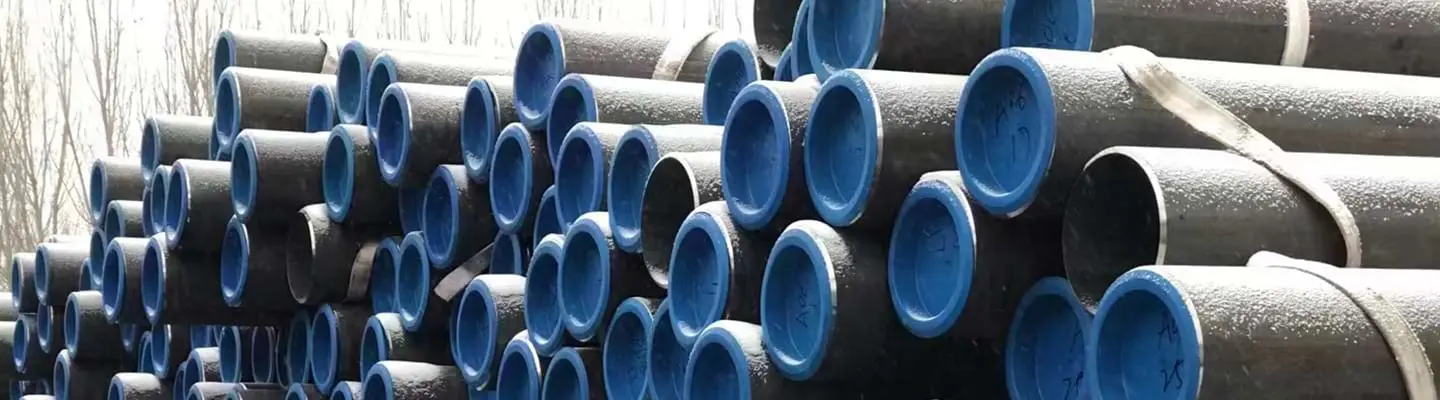
Most of our X70 orders are for large-diameter LSAW pipe for long-distance onshore gas transmission — 36-inch, 42-inch, and 48-inch in Africa and the Middle East. The pattern we see is consistent: X70 is chosen when the project's pipeline design engineer has done the wall thickness comparison against X65 and determined that the steel tonnage savings justify the additional welding discipline. On a 500 km trunk line, the difference between X65 and X70 wall is typically 1 mm at 48-inch diameter — which represents thousands of tonnes of steel and significant freight and welding cost.
The question we get most often from buyers considering X70 for the first time is about welding — specifically whether their field construction spread can handle X70 welding procedures. The answer is usually yes, but not without reviewing the welding procedure specifications and confirming that the spread has X70 procedure qualification. Projects that run into trouble are those that order X70 and then discover mid-procurement that the field welding contractor's WPS covers X65 only.
ZC Steel Pipe supplies API 5L X70 PSL2 in LSAW large-diameter and seamless small-bore to onshore pipeline projects in West Africa, the Middle East, and South America. This article covers X70 mechanical properties, corrected chemistry limits, a worked wall thickness calculation showing the X65-to-X70 savings on a 500 km project, welding considerations, sour service restrictions, and purchase order specification.
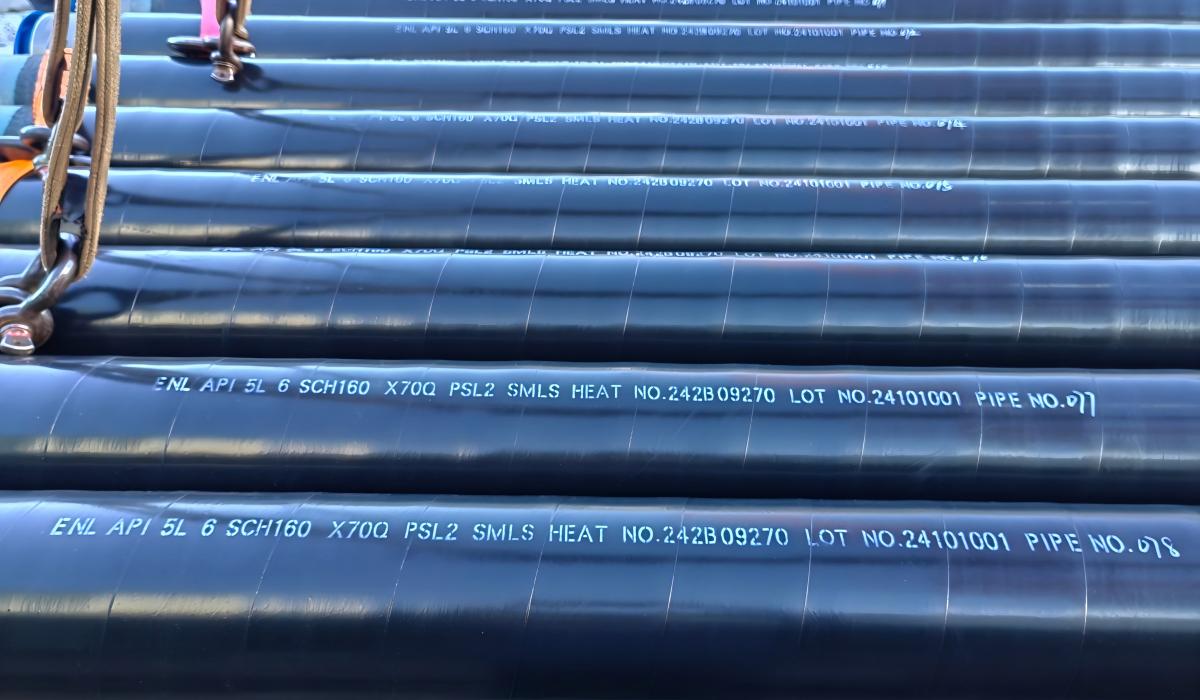 A ZC seamless X70Q PSL2 line pipe bound for sour-service duty in Nigeria — the stencil reads API 5L, SCH160, X70Q, PSL2, SMLS.
Quick Answer
API 5L X70 (L485) is a PSL2 high-strength line pipe grade with a 485 MPa (70,300 psi) minimum yield and 570 MPa (82,700 psi) minimum tensile, used mainly for large-diameter onshore gas transmission. Specify delivery condition M for LSAW large-diameter and Q for seamless small-bore. Choose X70 over X65 when the roughly 1 mm wall saving at 48-inch pays back the tighter welding discipline; stay on X65 for sour service, offshore, and any spread without a current X70 WPS.
| Property | X70 PSL2 |
|---|---|
| Minimum yield | 485 MPa (70,300 psi) |
| Minimum tensile | 570 MPa (82,700 psi) |
| Maximum yield | 635 MPa (92,100 psi) |
| Delivery conditions | M (LSAW), Q (seamless) |
| Primary use | Large-diameter onshore gas transmission |
What we see on X70 LSAW orders: Large-diameter X70 orders for onshore Africa pipelines almost always request EN 10204 3.2 MTC (third-party witnessed) and full-length automated UT of the pipe body and weld seam, regardless of whether the project specification specifically requires 3.2. This is standard practice in that market, and we treat 3.2 as the default for X70 LSAW. We also consistently see requests for CTOD (crack tip opening displacement) testing added mid-order — typically after the project's fracture mechanics assessment is completed. For X70 orders going to cold-climate service or high-toughness specifications, confirm CTOD requirements before mill scheduling begins.
What Is API 5L X70?
X70 sits at the top of the standard onshore transmission grade ladder in API Specification 5L, 46th Edition / ISO 3183, with 485 MPa (70,300 psi) minimum yield. The designation combines the ISO metric notation (L485) and the traditional USC notation (X70) — both refer to the same grade and the same minimum yield.
In commercial practice, X70 is a PSL2-only grade. PSL1 allows X70 on paper but no project with a genuine engineering case for X70 — high design pressure, large diameter, long distance — would accept PSL1's lack of mandatory Charpy impact testing, reduced NDE requirements, and wider chemistry tolerances (see the PSL1 vs PSL2 selection guide for the full comparison). Any supplier offering PSL1 X70 at a discount has misread the specification or is offering a grade downgrade — not a cost saving.
The two delivery conditions used commercially are Q (quenched and tempered) and M (thermomechanically rolled). There is no N (normalized) delivery condition for X70 PSL2 — API 5L 46th Edition does not include X70 in the N-condition grade group. For LSAW large-diameter transmission pipe, delivery condition M is the industry standard. Seamless X70 for small-bore high-pressure applications is typically supplied Q. The metallurgical reason for this split — and why it matters for field welding — is covered in the chemistry section below.
The primary market for X70 is onshore gas transmission: 24-inch to 56-inch LSAW pipe for long-distance trunk lines at design pressures of 7–14 MPa (1,000–2,000 psi). Outside this application, X70 has a limited role — it is more restricted than X65 for offshore, sour service, and subsea applications, and has been superseded by X80 in the small number of ultra-high-pressure projects where further wall reduction is economically justified.
Mechanical Properties
All values from API Specification 5L, 46th Edition, for PSL2 grade L485 / X70.
| Property | PSL2 Value |
|---|---|
| Minimum yield strength | 485 MPa (70,300 psi) |
| Maximum yield strength | 635 MPa (92,100 psi) |
| Minimum tensile strength | 570 MPa (82,700 psi) |
| Maximum tensile strength | 760 MPa (110,200 psi) |
| Yield-to-tensile ratio (max) | 0.93 (see note) |
| Weld seam minimum tensile | 570 MPa |
| Charpy V-notch impact testing | Mandatory (PSL2) |
| Delivery conditions | Q, M (no N condition) |
The Y/T ratio limit of 0.93 applies only when pipe OD exceeds 323.9 mm (12.750 in). For smaller-diameter X70, API 5L sets no yield-to-tensile ratio requirement. On large-diameter transmission pipe — the dominant X70 application — the 0.93 Y/T ceiling applies across the board. Mills producing X70 for 24-inch to 56-inch LSAW pipe report that achieving a yield close to the 635 MPa ceiling while staying below 0.93 Y/T becomes a meaningful metallurgical constraint. Request yield histograms from the mill when your string design depends on the upper yield range.
For the complete PSL2 grade tables and grade-to-grade comparisons, see the API 5L specification tables →
To calculate design pressure or minimum wall thickness for your pipeline, use the Pipeline Design Calculator →
Chemical Composition — PSL2
API 5L 46th Edition specifies X70 PSL2 chemistry separately for Q-condition and M-condition pipe. The table below uses the correct JSON values — note that both X70Q and X70M share a combined Nb + V + Ti maximum of 0.15%, not individual per-element limits.
| Element | X70Q (max %) | X70M (max %) |
|---|---|---|
| Carbon (C) | 0.18 | 0.12 |
| Manganese (Mn) | 1.80 | 1.70 |
| Silicon (Si) | 0.45 | 0.45 |
| Phosphorus (P) | 0.025 | 0.025 |
| Sulphur (S) | 0.015 | 0.015 |
| Nb + V + Ti combined | 0.15 | 0.15 |
| Carbon equivalent (IIW) | 0.43 max | 0.43 max |
| Carbon equivalent (Pcm) | 0.25 max | 0.25 max |
The most important number in this table is X70M's carbon ceiling of 0.12%. That 6 percentage-point difference from X70Q's 0.18% is not a small adjustment — it is a fundamentally different metallurgical strategy for reaching 70 ksi yield, and it has direct consequences for field welding. X70M reaches its strength target through a combination of thermomechanical rolling, controlled cooling, and microalloy additions (Nb, V, Ti within the 0.15% combined limit) rather than through carbon and the hardening effect of quench and temper. The sulphur limit of 0.015% applies to both conditions under the corrected API 5L PSL2 limits — the older table in the previous version of this article incorrectly showed 0.025% for X70Q.
X70M's carbon ceiling of 0.12% is not just a chemistry limit — it is the reason X70M welds better in the field than X70Q at the same CE. At equivalent CE (both capped at 0.43% IIW), a lower-carbon steel achieves that CE via higher manganese and microalloy additions rather than carbon. Lower carbon means lower martensite hardness in the weld heat-affected zone under rapid cooling — which is what governs HAZ cold cracking risk in wet-weather field welding. The practical implication: X70M field welding procedures generally require less preheat at low ambient temperatures than X70Q procedures written for the same pipe size.
Standard Sizes
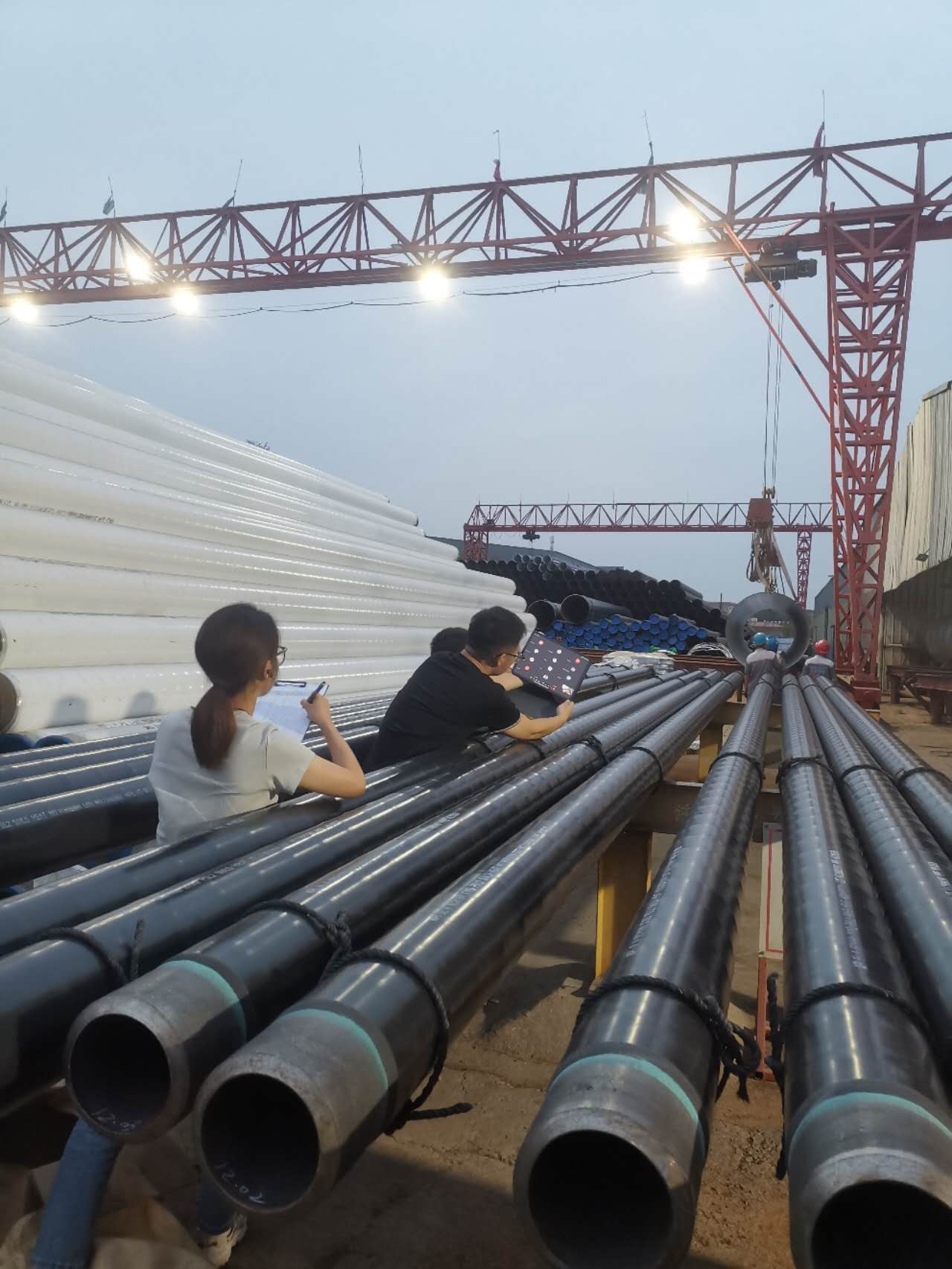 3LPE-coated X70Q line pipe on the coating-yard racks at dusk under a red gantry — a ZC project shipment for Africa.
| OD (inches) | OD (mm) | Wall Range (mm) | Pipe Type |
|---|---|---|---|
| 6 – 16 | 168.3 – 406.4 | 5.6 – 19.1 | Seamless / ERW |
| 16 – 24 | 406.4 – 609.6 | 7.9 – 25.4 | LSAW / Seamless |
| 24 – 48 | 609.6 – 1219.2 | 9.5 – 31.8 | LSAW |
| 48 – 56 | 1219.2 – 1422.4 | 12.7 – 38.1 | LSAW |
ZC supplies X70 PSL2 across the full LSAW range from 16 inches to 56 inches, and seamless X70 to 16 inches. The 36-inch to 48-inch range in 14–20 mm wall is where most of our transmission line orders fall. For pipe schedule references and dimensional verification, see the ASME B36.10M pipe schedule chart →
X70 is not only a large-diameter LSAW grade: Transmission-line orders dominate the tonnage, but a steady share of our X70 order book is small-bore heavy-wall seamless. We have shipped X70Q at OD 168.28 mm (6⅝″) × 18.26 mm — a SCH 160 wall — with 3 mm 3LPE for high-pressure gas service in Africa, and repeat batches of the same 6″ SCH 160 X70Q to a Nigerian gas operator. At that size the pipe is seamless and quench-and-tempered — not the M-condition LSAW most engineers picture when they write "X70" on a specification.
Worked Wall Thickness Calculation — X70 vs X65
The ASME B31.8 formula for minimum required wall thickness is:
t = P × D / (2 × SMYS × F × E × T)
Where:
- P = maximum allowable operating pressure (psi)
- D = pipe outside diameter (inches)
- SMYS = specified minimum yield strength (psi)
- F = design factor (0.72 for Class 1 location)
- E = seam factor (1.0 for LSAW with 100% NDE per API 5L PSL2)
- T = temperature derating factor (1.0 for temperatures ≤ 120°C)
Example: 48-inch OD X70 PSL2 LSAW, onshore Class 1, MAOP = 1,200 psi (8.3 MPa)
X70 SMYS = 70,300 psi (from API 5L, confirmed above).
Required wall: t = 1,200 × 48 / (2 × 70,300 × 0.72 × 1.0 × 1.0) = 57,600 / 101,232 = 0.569 in (14.5 mm)
Applying the standard −12.5% undertolerance (÷ 0.875): 14.5 / 0.875 = 16.6 mm → order 17.0 mm nominal
Same pipeline in X65 (SMYS = 65,300 psi):
t = 1,200 × 48 / (2 × 65,300 × 0.72 × 1.0 × 1.0) = 57,600 / 94,032 = 0.613 in (15.6 mm)
Nominal ordered: 15.6 / 0.875 = 17.8 mm → order 18.0 mm nominal
Wall saving: 18.0 − 17.0 = 1.0 mm per pipe length.
For a 500 km transmission line using 48-inch pipe at 17 mm nominal wall, the approximate steel weight is:
- At 17 mm: ~52,600 tonnes
- At 18 mm: ~55,700 tonnes
- Steel saving: ~3,100 tonnes for 500 km
At a typical structural steel price of USD 800–1,000/tonne ex-mill, 3,100 tonnes represents USD 2.5–3.1 million in material cost alone, before accounting for the freight savings from lower gross weight, the reduction in welding consumable cost per joint, and the shorter welding cycle time per joint at thinner wall. For a project at that scale, the net economics clearly favour X70 over X65 — but only if three conditions are met: the project is onshore Class 1, the construction contractor has X70 procedure qualification, and the pipe is not going into a sour service environment. If any of those conditions is not met, the calculation changes.
The wall saving must also be weighed against any X70 material premium at the mill. In markets where X70 LSAW tonnage is constrained (fewer qualifying mills than X65), X70 may carry a 5–10% material premium. On a 500 km project that premium will often be recovered through the tonnage saving, but on shorter projects it may not be.
X70 vs X65 vs X80 — Grade Selection
| Property | X65 PSL2 | X70 PSL2 | X80 PSL2 |
|---|---|---|---|
| Min yield (MPa / ksi) | 450 / 65.3 | 485 / 70.3 | 555 / 80.5 |
| Max yield (MPa / ksi) | 600 / 87.0 | 635 / 92.1 | 705 / 102.2 |
| Wall savings vs X65 | Baseline | ~6–7% thinner | ~17–19% thinner |
| Field welding complexity | Standard | Controlled HI | Specialist |
| Large-diameter LSAW availability | Wide | Wide | Limited |
| Sour service qualification | Established | Restricted | Very restricted |
| Offshore / subsea track record | Strong | Limited | Very limited |
| Project risk level | Lower | Moderate | Higher |
The Nb + V + Ti combined limit of 0.15% applies to all three grades in their respective M- and Q-conditions. Higher grade does not mean more microalloy content by itself — it means a tighter chemistry balance to reach a higher strength target within the same CE ceiling.
Choose X65 for offshore, subsea, sour service, and any application where qualification history and mill availability outweigh wall savings. Choose X70 for large-diameter onshore gas transmission where the wall savings are material — which means projects of 200 km or more where the tonnage difference is measurable — and where welding is conducted by qualified pipeline construction spreads. Choose X80 only when project design pressure genuinely requires it, the welding and inspection capability for X80 is confirmed at the construction contractor level, and a mill with current X80 LSAW production experience has been identified. X80 is not a routine upgrade from X70; it is a step into specialist territory.
LSAW vs Seamless for X70
For X70 above 16 inches, LSAW is the manufacturing method of choice — the seamless versus welded line pipe trade-off resolves firmly toward welded at this diameter. Seamless X70 above 16 inches requires large-diameter piercing mills that are less widely available than LSAW plate mills, and the dimensional tolerances and toughness consistency achievable in seamless at large diameters are no better than LSAW — often worse, because the rolling reduction achievable in plate production is higher.
LSAW X70 is almost always supplied delivery condition M. The plate mill's thermomechanical rolling and accelerated cooling program delivers the combination of strength, toughness, and low carbon that large-diameter transmission pipe requires. The weld seam is submerged arc welded inside and outside, expanded to correct pipe roundness, and hydrostatically tested before shipment.
For small-bore X70 (under 16 inches) in high-pressure applications — compressor station piping, valve station headers, riser connections from buried transmission to above-ground metering — seamless is preferred for the absence of a weld seam. Seamless X70 in this size range is typically delivery condition Q. The Y/T ratio limit of 0.93 does not apply below 323.9 mm (12.750 in), which gives the mill more flexibility in hitting the X70 yield target for small-bore seamless.
Welding Considerations for X70
X70 field welding requires more discipline than X65, and the difference is not trivial on a long-haul construction spread.
Heat input window — X70 procedures specify a heat input window of 0.5–2.5 kJ/mm typical. This is a narrower operating range than X65 allows. Below 0.5 kJ/mm, hydrogen cold cracking risk in the HAZ increases significantly. Above 2.5 kJ/mm, HAZ grain growth degrades toughness below the project's Charpy acceptance criteria. Maintaining this window consistently on a production spread requires powered automatic welding equipment — manual SMAW cannot hold heat input within 0.5–2.5 kJ/mm across an eight-hour shift on large-diameter pipe.
Inter-pass temperature — maximum inter-pass temperature (typically 250°C for X70) must be monitored and controlled. Exceeding it causes HAZ softening and toughness loss that will show up in post-weld Charpy results.
Preheat — at ambient temperatures below 5–10°C, preheat to 50–75°C is typically required for X70. In cold-weather construction environments, maintaining preheat throughout a joint weld adds time and cost. X70M's lower carbon content does give some advantage here — X70M procedures generally require less preheat than X70Q at the same ambient temperature.
Hydrogen management — low-hydrogen consumables (H4 or H2 classification per AWS A4.3) are required for X70 to prevent hydrogen-induced cold cracking in the HAZ.
We have seen X70 welding procedure qualification add 4–6 weeks to project programmes when it was not planned at the outset. If the construction contractor does not have a current X70 WPS, budget time for procedure qualification before the first weld. The qualification itself requires a test joint welded to the proposed WPS, followed by destructive testing (tensile, bend, Charpy, macro, hardness) — this takes 2–3 weeks for testing alone, plus the time to mobilise the test setup.
The tighter heat input window also means that a spread configured and qualified for X65 cannot simply run the same passes at slightly adjusted parameters on X70. The WPS must be written for X70 specifically, covering the preheat, inter-pass temperature, heat input range, consumable classification, and hydrogen bake-out requirements for the specific wall thickness and pipe OD being welded.
X70 in Sour Service
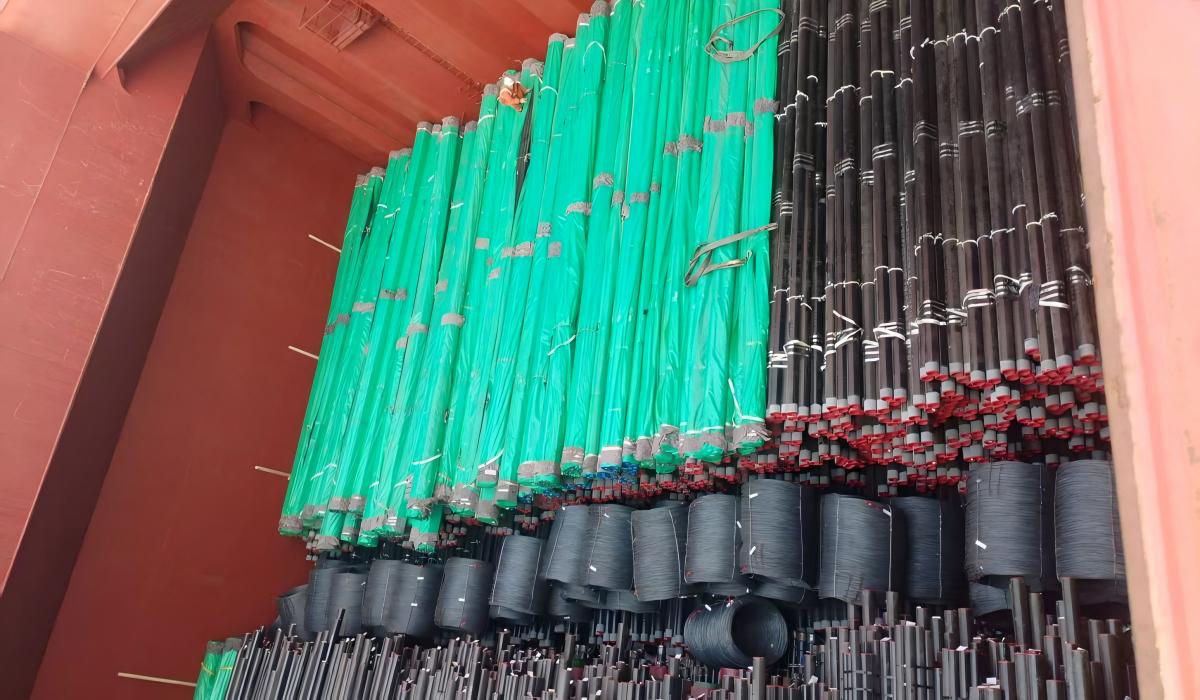 Green-wrapped X70Q line pipe bundles with red end caps loaded in a ship's hold — a real ZC sour-service shipment to Nigeria.
X70 can technically be used in mild sour service, but it is one of the more restricted grades for this application and the qualification burden is considerably higher than for X65.
The mechanism: Hydrogen-induced cracking (HIC) in line pipe occurs when atomic hydrogen — generated by the corrosion of steel in wet H₂S environments — diffuses into the steel and recombines at inclusion interfaces, building up pressure that causes planar cracking parallel to the pipe wall. The susceptibility to HIC is driven primarily by cleanliness (sulphur content, inclusion morphology) and steel microstructure. X70's higher manganese content (up to 1.80% for X70Q) creates banding in the steel microstructure that can act as HIC initiation sites — even at sulphur levels that would be acceptable for X65.
What is required for X70 sour service:
- Ultra-low sulphur: ≤ 0.002% actual (the API 5L PSL2 standard limit of 0.015% is insufficient for sour service)
- Calcium treatment for sulphide inclusion shape control (SISC)
- HIC testing per NACE TM0284, named on the order together with its CLR, CTR and CSR acceptance limits
- SSC resistance review — X70 at 485 MPa yield sits above the 448 MPa (65 ksi) threshold above which NACE MR0175 / ISO 15156-2 requires more stringent SSC qualification
Mill qualification gap: Not all mills that produce standard X70 PSL2 have the process controls to hit ≤ 0.002% sulphur routinely. Ultra-low sulphur X70 requires secondary metallurgy (ladle desulphurisation to ≤ 0.002%), calcium wire injection for SISC, and vacuum degassing. Mills with established sour-service X70 production records are a smaller subset of the X70 supply base than mills with established sour-service X65 production records.
Practical guidance: For gathering systems in sour fields where H₂S partial pressure exceeds 0.05 psia (0.34 kPa) as defined in NACE MR0175, the default recommendation is X65 PSL2 sour service over X70. The wall savings from X70 in a sour gathering system are typically modest (gathering pressure is lower than transmission pressure), and the additional qualification cost and mill selection constraint for X70 sour service pipe is rarely justified on a project-economics basis. X70 sour service is most likely to be specified for high-pressure transmission segments in fields where gathering-to-export distance is long enough that the tonnage saving is material and the construction spread is already qualified for X70 welding.
When Not to Use X70
Sour service pipelines where X65 can be made to work. The sour service qualification burden for X70 exceeds that of X65, and the wall savings in gathering system pressure ranges are marginal. Unless the pipeline design engineer has specifically concluded that X70 is required for pressure reasons in a sour environment, start with X65 PSL2 sour service.
Projects where the welding contractor is not X70 procedure-qualified. Ordering X70 before confirming WPS status creates specification risk. If the contractor discovers mid-procurement that their WPS covers X65 only, the choice is between a 4–6 week delay for X70 qualification or a grade substitution — both of which disrupt programme and cost plans.
Offshore, subsea, or deepwater applications. X70 has a smaller qualification history for offshore applications than X65. The established offshore transmission grade is X65 PSL2, with a well-developed track record for reel-lay, S-lay, and J-lay installation. X70 has been used offshore, but it is a non-standard choice that requires additional justification in most project specifications.
Short-length orders: single spool pieces, isolated fittings connections, or small valve station fabrication. The material premium for X70 over X65 and the welding qualification cost are fixed costs that are recovered on long-distance projects. On a 200-metre spool piece, there is no tonnage saving that justifies the premium.
When the project specification caps the grade at X65. A grade substitution from X65 to X70 requires a documented engineering deviation approved by the pipeline owner and operator. The deviation process is not a formality — it typically requires the construction contractor to demonstrate WPS coverage, the pipe supplier to provide mill X70 qualification records, and the design engineer to sign off on the substitution.
Cold-climate or arctic service. X70's toughness performance at very low temperatures requires careful specification of Charpy test temperature and CTOD requirements. If the project operating temperature goes below −20°C, the Charpy and CTOD requirements for X70 become demanding, and mill qualification for those requirements narrows the supplier pool further.
Procurement Trap — PSL Level and Delivery Condition
The most common specification error we see on X70 purchase orders is omitting PSL level and delivery condition.
What gets written: API 5L X70 LSAW, 48" × 17.5 mm
What the mill may ship: PSL1 pipe. API 5L allows X70 in PSL1. Without an explicit PSL2 designation, the mill is compliant shipping PSL1 — which has no mandatory Charpy impact testing, reduced NDE requirements (no mandatory automated UT of the pipe body or weld seam), and no CE requirement. The pipe will meet the strength numbers but will not meet the toughness and inspection requirements of a real high-pressure gas transmission project specification.
A second common error: Not specifying delivery condition. A purchase order for X70 LSAW that does not specify delivery condition M may be filled with Q-condition pipe at some mills. X70Q has 0.18% carbon maximum versus 0.12% for X70M — the difference is significant for HAZ toughness and field welding behaviour.
What to write instead: API 5L / ISO 3183, Grade L485 / X70, PSL2, Delivery Condition M, LSAW, 48" OD × 17.5 mm wall, bevelled end, Random Length 3, SR4A Charpy V-notch at −10°C, 100% automated UT pipe body and weld seam, EN 10204 3.2 MTC
That 40-word specification is the minimum that a serious X70 LSAW order requires. Every element serves a purpose: PSL2 triggers mandatory NDE and Charpy; delivery condition M specifies the metallurgical route; SR4A sets the toughness requirement; the MTC level controls inspection documentation.
How to Specify X70 on a Purchase Order
- Standard — API Specification 5L, 46th Edition / ISO 3183
- Grade — L485 / X70 (use dual designation)
- PSL level — PSL2 (always explicit)
- Delivery condition — M for LSAW; Q for seamless small-bore
- Pipe type — LSAW or seamless (do not leave ambiguous)
- OD and nominal wall thickness — in mm; confirm undertolerance applies (−12.5%)
- End finish — bevelled end; confirm bevel geometry and root face dimension for automated welding equipment used by the construction contractor
- Length — Random Length 3 (typical for transmission line) or exact project-specified length
- Supplementary requirements — SR4A (Charpy at project-specified test temperature and minimum energy); add SR4B if full CVN transition curve is needed
- CTOD requirements — if required by the project fracture mechanics assessment, state before mill scheduling begins; adding CTOD mid-order delays shipment
- Coating — bare, single-layer FBE, 3LPE, or 3LPP; state application standard and adhesion requirements separately
- MTC level — EN 10204 3.2 for all X70 LSAW; 3.1 is insufficient for large-diameter onshore gas transmission projects that intend any form of third-party inspection at the mill
References
- API Specification 5L, 46th Edition — Specification for Line Pipe
- ISO 3183 — Steel Pipe for Pipeline Transportation Systems
- ASME B31.8 — Gas Transmission and Distribution Piping Systems
- NACE MR0175 / ISO 15156 — Materials for Use in H₂S-Containing Environments
- NACE TM0284 — Evaluation of Pipeline and Pressure Vessel Steels for Resistance to Hydrogen-Induced Cracking
- EN 10204 — Metallic Products — Types of Inspection Documents
Frequently Asked Questions
What is API 5L X70 line pipe?
API 5L X70 is a high-strength line pipe grade with a minimum yield strength of 485 MPa (70,300 psi) and a minimum tensile strength of 570 MPa (82,700 psi), defined in API Specification 5L, 46th Edition / ISO 3183. X70 is primarily used for large-diameter, high-pressure onshore gas transmission pipelines where its yield advantage over X65 enables wall thickness reductions that generate significant cost savings at scale. It is produced predominantly by LSAW for large-diameter applications and by seamless rolling for smaller diameters.
Is X70 always PSL2?
Yes in practice. X70 is exclusively used in high-pressure gas transmission and demanding pipeline applications that require PSL2's mandatory impact testing, NDE, chemistry controls, and dimensional tolerances. PSL1 X70 is not a meaningful commercial product. Every X70 order should specify PSL2 explicitly — if a supplier offers PSL1 X70 at a lower price, treat this as a qualification gap, not a cost saving.
What is the difference between X70 and X65?
X70 delivers 485 MPa minimum yield versus X65's 450 MPa — approximately 8% more strength. For a 48-inch high-pressure pipeline, this translates to roughly 1 mm wall savings per pipe. Across 500 km, that difference is approximately 3,100 tonnes of steel — meaningful freight, welding, and material cost. The trade-off is that X70 requires more controlled welding procedures with tighter heat input limits and sometimes preheat, and field welding contractors must hold a current X70 procedure qualification.
What welding considerations apply to X70?
X70's higher microalloy content requires more controlled heat input during field welding compared to X65. The typical heat input window is 0.5–2.5 kJ/mm — narrower than the range allowed for X65. This tighter window means a production pipeline spread generally needs powered automatic welding equipment to maintain consistency. X70 procedures also require low-hydrogen consumables (H4 or H2 classification), inter-pass temperature limits of approximately 250°C, and preheat at ambient temperatures below 5–10°C. Confirm that the construction contractor has a current X70 WPS before committing to the grade — procedure qualification takes 4–6 weeks if it needs to be done from scratch.
What sizes are available for X70 line pipe?
API 5L X70 in LSAW is available from approximately 16 inches to 60 inches OD (406.4 mm to 1524 mm) with wall thickness typically 8 mm to 32 mm. Seamless X70 is available up to approximately 16 inches OD for high-pressure small-bore applications. ERW X70 is produced up to approximately 20 inches for moderate-pressure applications. The most common X70 application sizes are 24 to 48 inches LSAW for long-distance gas transmission trunk lines.
Can X70 be used in sour service pipelines?
X70 can be used in mild sour service with careful chemistry control, but it is more restricted than X65 or X52 for this application. The higher microalloy content and manganese levels of X70 increase HIC susceptibility at standard sulphur levels. If X70 is required in a mildly sour environment, order PSL2 to Annex H with the HIC test per NACE TM0284 and its acceptance criteria written out, ultra-low sulphur (≤ 0.002%), and calcium treatment — the standard PSL2 sulphur limit of 0.015% is insufficient. Most pipeline engineers default to X65 for sour service pipelines even when X70 wall savings look attractive, because the sour service qualification pathway for X65 is better established at most mills.
What is the LSAW process and why is it used for X70?
LSAW (Longitudinal Submerged Arc Welding) forms large-diameter pipe by rolling steel plate into a cylinder and welding the seam using submerged arc welding — a high-energy process that produces a deep, narrow weld bead with good mechanical properties. LSAW is the preferred manufacturing method for X70 above 16 inches because the plate-based process allows tighter control of chemistry, rolling reduction, and cooling rate than spiral welding. The result is a more consistent microstructure and better toughness than SSAW (spiral SAW) for the same wall thickness — which is critical for high-pressure X70 applications.
What delivery condition should I specify for X70 LSAW pipe?
For LSAW X70, specify delivery condition M (thermomechanically rolled). X70M has a maximum carbon content of 0.12%, which is significantly lower than X70Q's 0.18%. This lower carbon produces better HAZ toughness and easier field welding. X70Q (quenched and tempered) is used for seamless small-bore pipe where thermomechanical rolling is not practical, but for LSAW large-diameter transmission pipe, M is the industry standard delivery condition. A purchase order that does not specify M may be filled by the mill with Q-condition pipe — always state delivery condition explicitly.