The choice between BTC and premium connections is one of the most consequential decisions in OCTG procurement — and one of the most frequently misunderstood. Specifying BTC where premium is required risks well integrity failure, gas migration, and remedial workover costs that dwarf the cost of the upgrade. Over-specifying premium across every string adds cost with no engineering benefit. The decision belongs in the well programme at the design stage — not on a purchase order revision that arrives after the string is running. ZC Steel Pipe manufactures and supplies both BTC and premium connections across the full API 5CT grade range to operators and EPC contractors in Africa, the Middle East, and South America.
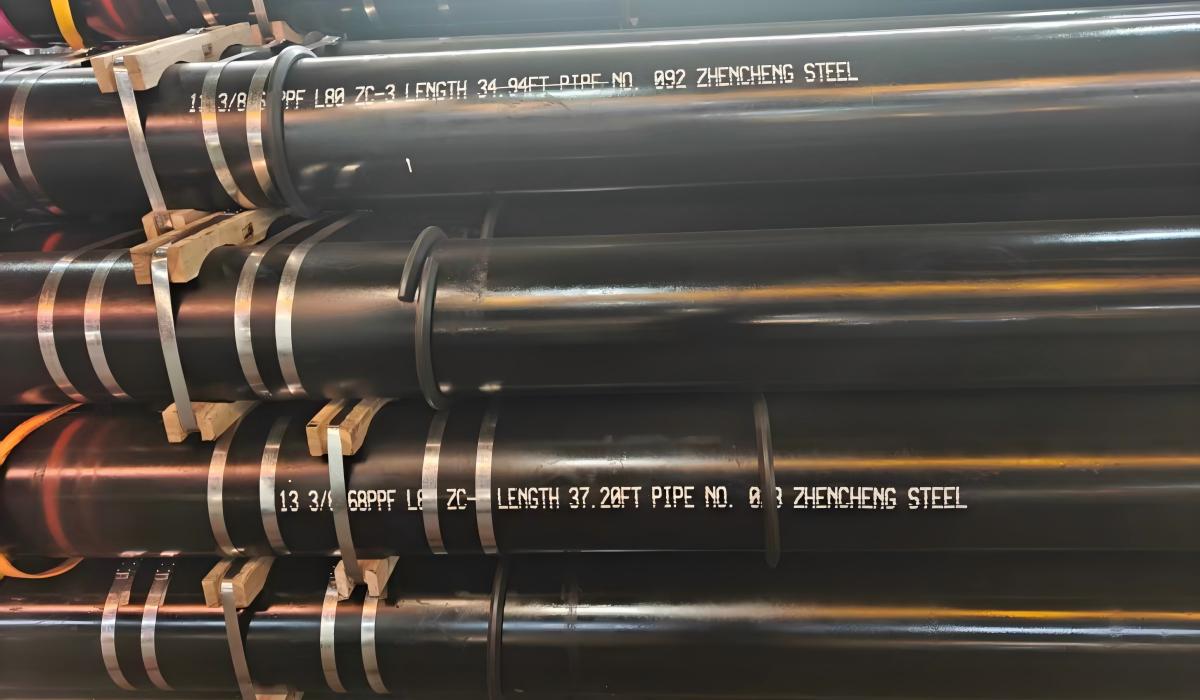 Pipe-body stencil on a real ZC premium casing shipment to Nigeria — 13-3/8" 68 lb/ft L80, marked with the ZC premium connection designation and the Zhencheng Steel maker's name.
Quick Answer
Use standard BTC for vertical, sweet, moderate-pressure casing strings whose job is formation isolation — its trapezoidal thread and shoulder give high tensile and compression efficiency with a liquid-tight seal. Move to a premium metal-to-metal connection whenever gas-tight integrity, HPHT, high combined load, sour service, or a project specification governs. BTC is not gas-tight by design; a premium seal holds independent of thread compound and is the only connection qualified to API 5C5 under combined axial, pressure, and bending load.
| If the well has… | Specify |
|---|---|
| Vertical, sweet, moderate pressure, oil-producing | BTC |
| Gas production or injection (gas-tight seal required) | Premium — metal-to-metal |
| HPHT (above 150 °C or 690 bar) | Premium — API 5C5 CAL IV |
| Deviation above 30° / significant bending | Premium — combined-load rated |
| C110 or Q125 grade | Premium — mandatory |
| H₂S / sour service | Premium recommended |
| IOC or NOC specification mandating premium | Premium — specification governs |
Premium typically adds 15–35% to per-joint cost. Set against a workover to remediate a failed connection seal, that premium is the cheap side of the decision — the detailed comparison and cost cases follow below.
API Standard Connections — The Baseline
API Specification 5CT defines three standard thread and coupling types for casing, with threading tolerances governed by API 5B. They form a hierarchy of connection performance, not just a price ladder — for a full side-by-side of all four common types, see the casing connection types guide: STC / LTC / BTC / premium →:
STC — Short Round Thread Casing — the lightest API connection by thread engagement length. Tensile efficiency is the lowest of the three types, and gas-tight performance is not achievable. STC is used for surface casing and conductor pipe in shallow, low-pressure applications where tensile load is modest and formation gas is absent.
LTC — Long Round Thread Casing — higher tensile efficiency than STC from longer thread engagement. Not gas-tight. LTC is used for intermediate casing at moderate depths where tensile load governs over pressure and liquid-tight performance is acceptable.
BTC — Buttress Thread Casing — the highest-performance standard API connection. The trapezoidal thread form (defined in API 5B) provides high tensile and compression efficiency, better collapse resistance than STC or LTC, and a shoulder seal that can achieve liquid-tight performance with correct thread compound application and makeup. BTC is the industry default for N80, L80, T95, and moderate-depth P110 casing strings in vertical sweet wells. Understanding BTC's failure modes is what separates engineers who use it correctly from those who over-trust it.
BTC Failure Modes
Jump-out failure — BTC threads disengage under axial tension when the connection is insufficiently made up or subjected to bending that exceeds the thread flank engagement capacity. Mechanism: trapezoidal thread flanks on the pin lose contact with the box when the combination of axial tension and bending moment overcomes the thread make-up pre-load. In deviated wells, the bending load superimposed on string weight tension amplifies this risk dramatically. Diagnostic: the pin backs out of the coupling and the triangular position mark migrates back below the triangle base — the rig crew sees the triangle has "travelled." Fix: verify makeup torque was achieved on the torque-turn chart; inspect both pin and coupling thread flanks for galling before re-running. A galled BTC thread that has backed out cannot be re-made reliably.
Standoff creep — after initial makeup to the correct torque, the coupling's axial position migrates under repeated pressure cycling or thermal load. Mechanism: thread compound in the thread helix is partially extruded during initial makeup, and the remainder migrates further under subsequent pressure load and thermal expansion, allowing slight coupling rotation. The tell is that the triangle has moved down from the initial makeup position without any deliberate breakout. "Paint marks move" is the rig floor warning — if the white paint mark you drew across the coupling-to-pipe body interface has shifted, standoff creep has occurred. Fix: correct thread compound application — the API 5A3 compound must cover the full thread length without excess; verify the torque achieved at initial makeup against the published API 5C1 table for that size and weight. Standoff creep is largely a makeup quality problem, not a design flaw.
Box ovalizing — large-OD coupling boxes (13⅜" and above) can deform into an oval cross-section during power tong makeup under high torque. Mechanism: large-diameter, thin-wall couplings act as a thin ring under the lateral force applied by the power tong dies, and the bending moment across the coupling diameter causes lateral distortion. Diagnostic: run an ID gauge through the coupling — a non-round bore indicates ovalizing. Visible coupling body distortion is the severe case. Fix: position the backup tong correctly across the coupling body (not on the pipe body below the coupling), limit die length to avoid the full coupling width, and verify the power tong's lateral load is not concentrated at the coupling mid-point. Once a coupling is ovalized, it must be replaced.
Helical leak path — under sustained gas pressure, BTC connections are vulnerable to gas migration along the thread helix through the thread compound interface. Mechanism: gas molecules are small enough to migrate through the compound film in the thread helix under sustained pressure differential, even when the compound appears fully applied and the connection is correctly made up. This is not a defective makeup — it is a fundamental limitation of the seal mechanism. Diagnostic: visible as annular pressure buildup at the wellhead; confirms that the thread compound interface has been breached under sustained gas load. Fix: this failure mode cannot be remedied with improved makeup technique or compound specification. The only fix is to upgrade to a premium connection with a metal-to-metal seal, which does not rely on thread compound for gas containment.
All three API connection types share this fundamental limitation on gas-tight performance. Understanding that BTC's seal is a compound-dependent interface — not a metal-to-metal interface — is the starting point for correct connection selection. For field make-up, gauging, and running practice on buttress thread, see the BTC buttress thread casing field guide →.
What Premium Connections Add
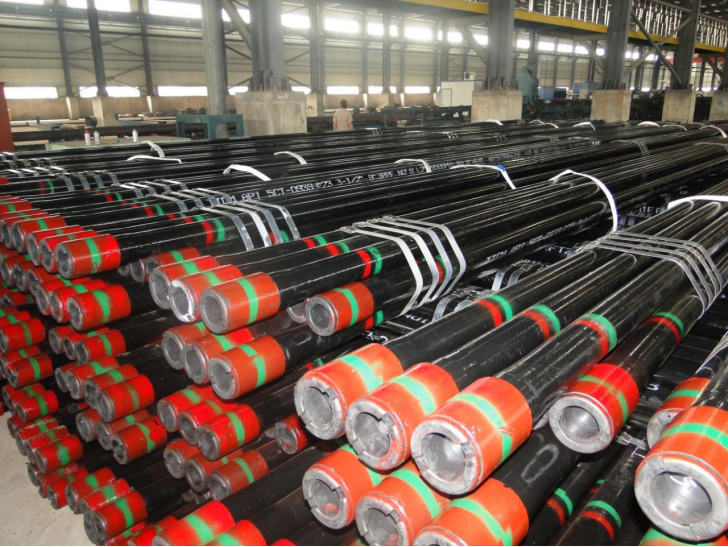 L80 premium casing bundled for a South American operator — red and green thread-protector caps guard the machined connections, with the API stencil visible along the pipe body.
Premium connections address BTC's seal limitation through metal-to-metal contact geometry machined to tolerances tighter than API 5B. Four engineering differences define what you are paying for:
Metal-to-metal seal — precision-machined pin and box surfaces make direct steel-to-steel contact at a defined seal point under make-up torque. The contact stress generated by elastic deformation of the steel at the seal zone maintains gas-tight integrity independent of thread compound. Temperature cycling, pressure reversal, and running loads that degrade thread compound have no effect on a properly engaged metal-to-metal seal. This is the primary reason premium connections are specified for gas service.
Proprietary thread profile — premium connections use thread forms optimised for combined load (axial + pressure + bending) rather than the API trapezoidal form designed primarily for tensile load. Thread flank angle, helix, and root radius are typically held to tighter tolerances than API 5B allows, producing more consistent make-up behaviour and more predictable load distribution around the connection circumference.
Positive torque shoulder — premium connections have a machined torque stop that defines the final make-up position precisely and provides a secondary compressive load path. BTC has a shoulder contact at full makeup, but it is not designed as a primary load-bearing element and does not provide a repeatable make-up position reference. For premium connections, the make-up target is defined by a torque-turn curve from the connection manufacturer — not by "burying the triangle." Paint marks move; the torque-turn chart does not.
API 5C5 qualification — premium connections are evaluated under a structured performance test programme defined in API Standard 5C5. The test applies combined axial, bending, internal pressure, and external pressure loads simultaneously. BTC is not evaluated under API 5C5 — it has no combined load performance envelope from a qualification test.
What we see on orders: About 30% of the connection upgrade inquiries we receive come after BTC has been specified on a project PO and the company man has reviewed the well programme. The upgrade request arrives when the drilling engineer notices gas production is expected. The cost to upgrade at PO stage is the connection premium — 15–35% on joint cost. The cost to discover the issue after the string is in the hole is a workover. We flag expected gas service at the initial inquiry stage; not every supplier will.
BTC vs Premium — Engineering Comparison
| Property | BTC | Premium |
|---|---|---|
| Thread form | API trapezoidal (API 5B) | Proprietary optimised profile |
| Seal mechanism | Thread compound + shoulder | Metal-to-metal — no compound dependency |
| Gas-tight | No — liquid-tight at best | Yes — with metal-to-metal seal |
| Combined load rating | Not API 5C5 evaluated | API 5C5 CAL I–IV |
| Tensile efficiency | 60–80% of pipe body | Up to 100% of pipe body |
| Compression efficiency | Good | Good to excellent |
| Bending resistance | Moderate | High — optimised thread geometry |
| Thermal cycling integrity | Moderate — compound can migrate | High — metal seal unaffected |
| Torque control | Moderate — triangle position | Precise — positive shoulder stop |
| Cost vs BTC | Baseline | 15–35% premium over BTC |
| Makeup/breakout cycles | Limited — compound refresh needed | Higher — metal seal more durable |
| Applicable grades | H40 through P110 | L80 through Q125 |
The table reads as a clean premium-wins comparison, but that is not the correct interpretation. BTC is the right connection for the majority of casing strings run globally — it is optimised for the conditions it was designed for. The engineering question is whether your well conditions fall inside BTC's reliable performance envelope. The rows that matter for that decision are the gas-tight, thermal cycling, combined load, and bending resistance rows.
For the complete grade and connection-class specification tables, see the API 5CT specification tables →
To match a connection type to your well conditions, use the Pipe Grade Selector →. To rate a connection's tensile capacity against your string loads, use the joint-strength calculator →.
When BTC Is the Right Choice
BTC is the correct connection for the majority of standard casing strings:
- Vertical sweet oil wells at moderate depth where the primary fluid is oil and gas production is incidental — BTC's compound seal holds liquid without difficulty.
- Surface and intermediate casing in conventional wells where gas-tight performance is not required and the string's function is formation isolation rather than production containment.
- N80 and L80 production casing in oil wells where wellhead gas-oil ratio is low and sustained casing pressure is not expected.
- T95 sour service at moderate depth and pressure where combined loads are within BTC's published ratings and gas production is not the primary drive mechanism.
- Cost-sensitive development projects where well conditions have been evaluated against BTC's performance envelope and the analysis confirms BTC is adequate — not because BTC is cheaper, but because the well does not require what premium adds.
BTC should not be specified on the assumption that it is adequate. It should be specified after confirming that the conditions above apply.
When NOT to Use BTC
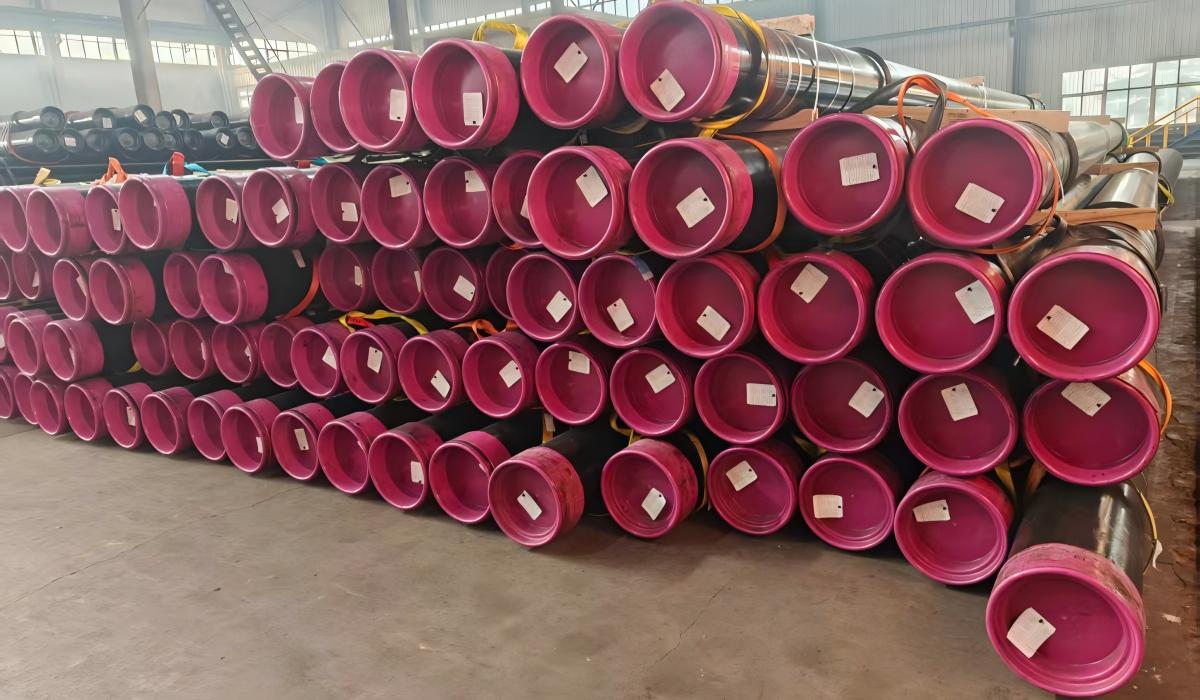 ZC-2 gas-tight S-95 casing ends bound for Nigeria — the distinctive pink thread-protector caps and joint tags mark a sour-service, gas-tight string run on a metal-to-metal premium connection rather than buttress.
These six conditions each have a specific engineering rationale for excluding BTC. None of them is a guideline — in each case BTC has a documented failure mode under the stated condition.
Gas-tight service — gas molecules migrate through thread compound seal interfaces under sustained pressure. BTC is not a gas-tight connection by design, and no amount of correct makeup technique changes that. Any well producing or injecting gas where annular seal integrity is required needs premium connections. This is not a conservative recommendation — it is the fundamental behaviour of a compound-dependent seal against gas.
HPHT wells (above 690 bar / 150°C) — high-pressure high-temperature wells impose combined axial, thermal, and pressure loads that exceed BTC's reliable performance envelope. Temperature cycling in HPHT wells causes repeated thermal expansion and contraction — a 7" P110 production string can thermally grow several metres across a production cycle. That growth load, superimposed on axial tension and burst pressure, is not a load combination BTC was designed or tested to handle. API 5C5 CAL IV qualification is the required evidence that a connection can sustain this load combination.
Deviated and horizontal wells (inclination above 30°) — bending adds a cyclic load component at the connection that the BTC trapezoidal thread form cannot efficiently resist. The bending moment from dog-leg severity acts on the connection simultaneously with axial string weight and internal pressure. Above 30° inclination in the production string, the combined load point typically falls outside what BTC's thread engagement can sustain reliably over well life. The DLS threshold for premium connection evaluation in the intermediate string is lower — typically above 3°/30m.
P110 and Q125 in deep wells — at 110 ksi and 125 ksi yield, the pipe body's collapse and burst capacity is high enough that a BTC connection at 60–80% tensile efficiency becomes the weakest element in the string under combined loading. See the P110 casing specifications and HPHT service guide → for where the pipe body outruns the connection. For deep P110 strings where design factors are tight, the connection must be rated to full pipe body performance. BTC cannot provide that. All Q125 strings should be run on premium connections — no exception.
C110 in sour HPHT service — C110 is specified for severe sour HPHT environments where H₂S, high pressure, and temperature combine over the producing life of the well. BTC thread compound integrity in an H₂S environment under sustained thermal cycling cannot be guaranteed. The cost of the C110 material already reflects the severity of the application — running it on a BTC connection introduces the weakest element into the most demanding environment.
IOC and NOC project specifications — Shell DEP, TotalEnergies GS EP PVV 142, Petrobras N-2634, and NNPC project specifications mandate premium connections for specific well categories regardless of individual well analysis. We see this most often on deep-water tenders from West African operators and on HPHT projects in the Middle East. Always read the applicable project specification before assuming BTC is acceptable — the specification governs, not the engineering analysis alone.
Where the upgrade actually lands: The clearest BTC-to-premium cases on our POs are corrosive-gas and gas-tight strings. We shipped 4½″ L80-13Cr casing with our ZC-2 metal-to-metal connection — a VAMTOP-equivalent — to a Libyan operator for a CO₂/H₂S string: the 13Cr handled corrosion, but the reason it was not run on BTC was thread-compound seal breakdown under thermal cycling. The same driver shows up on our 577 joints of 11¾″ 65 ppf S-95 gas-tight casing to a Nigerian operator: S-95 is a 95 ksi sour-service grade held to the NACE MR0175 hardness limits, and the 11¾″ string ran a ZC-2 metal-to-metal connection because the well combined high pressure with H₂S — precisely the case where a buttress thread-compound seal is the wrong choice. Where formation gas is the concern, the connection decision is settled before grade. See more in our project records.
API 5C5 Qualification Levels
API Standard 5C5 defines four Connection Assessment Levels (CAL) that test progressively more complex combined load conditions:
| Level | Loads Tested | Typical Application |
|---|---|---|
| CAL I | Internal pressure + axial tension only | Shallow, low-pressure; non-gas |
| CAL II | Internal pressure + tension + compression | Moderate wells, near-vertical |
| CAL III | Full combined: tension, compression, internal pressure, external pressure | Most production casing |
| CAL IV | Full combined + bending | HPHT, deviated wells, gas-tight service |
CAL IV is the highest qualification level. For any HPHT well, deviated string, or gas-tight application, specify CAL IV-qualified connections — CAL I or II qualification is not adequate for combined load conditions in demanding wells. For how these CAL levels map to the ISO 13679 test envelope and real well loads, see the premium connection CAL ratings guide →.
CAL IV does not test a more severe environment than CAL III — it tests a more complex load combination. A connection with CAL III qualification has been tested under combined tension, compression, internal pressure, and external pressure. CAL IV adds bending to that combination. For purely vertical wells without significant torque-and-drag, CAL III qualification is often adequate. The requirement for CAL IV typically comes from the well's trajectory — not from the pressure or grade.
Procurement Trap
This is the connection selection error we see most often on purchase orders, and the one with the clearest financial consequence.
Wrong PO language: "7" N80 BTC casing, 200 joints" — specified on a well that will produce gas from a sandstone reservoir at 2,400 m TVD.
What happens: The mill ships standard BTC, fully compliant with API 5CT and API 5B. The connection makeup is correct. The string is run correctly. On first gas production, annular pressure begins building at the wellhead. Gas has migrated through the thread compound interface in the BTC helix — the mechanism described in the helical leak path failure mode above. The BTC connection did not fail. It performed exactly as designed. The mistake was specifying it for a gas well.
Correct PO language: State explicitly — "Connection type: premium, metal-to-metal seal, minimum API 5C5 CAL III qualification. Thread compound: per manufacturer-approved compound list. Full connection qualification documentation required with order." If the well is deviated above 30° or HPHT, specify CAL IV.
Cost calculation: Premium connection upgrade on a 100-joint 7" N80 string: approximately $150/joint additional = $15,000 total upgrade cost. A fishing and re-run operation to address a connection seal failure — 5 days at $40,000/day rig rate = $200,000 in remedial costs, not including lost production time or formation damage from the remedial operation. The connection upgrade is 7.5% of the avoided remedial cost. This is not a conservative scenario — it is a routine workover rate for deepwater-adjacent operations in West Africa and the Middle East.
The PO stage is the only point at which this upgrade costs $15,000. After the string is in the hole, it costs $200,000.
ZC Steel Pipe Premium Connections
ZC Steel Pipe holds independent patents on premium connection design. We are not a licensee of a third-party thread system — VAM, TenarisHydril, or otherwise. This matters for procurement because it means we can accommodate project-specific requirements for seal geometry, torque specifications, and load ratings without licensing constraints or third-party approval cycles.
Key procurement facts:
API 5C5 CAL IV qualified — all ZC premium connections are tested and qualified to the highest API 5C5 level, covering the full combined load envelope including bending. Qualification documentation is available with every order.
Grade range — ZC premium connections are available for casing and tubing from L80 through Q125, covering sour service grades (L80, T95, C110) and high-strength HPHT grades (P110, Q125). For sour service applications, the connection material is produced to the same hardness controls as the pipe body.
Documentation — full connection qualification records, torque-turn curves, make-up data sheets, and EN 10204 3.1 or 3.2 MTC are available on every order. For IOC projects requiring third-party witnessed inspection of connection manufacturing, we can accommodate SGS, Bureau Veritas, or TÜV at the Hai'an City facility.
Supply markets — we supply premium connections to operators and EPC contractors across West Africa, the Middle East (Saudi Arabia, UAE, Iraq), South America (Brazil, Colombia), and Southeast Asia. Regional project specifications — Shell DEP, TotalEnergies, Petrobras, NNPC, Saudi Aramco — are familiar documents in our order review process.
Procurement Checklist — BTC vs Premium Decision
Before specifying a connection type, work through this decision sequence:
| Question | If Yes → |
|---|---|
| Does the well produce or inject gas? | Premium with metal-to-metal seal — stop here |
| Is the grade C110 or Q125? | Premium mandatory — stop here |
| Is the well HPHT (BHT > 150°C or BHSP > 690 bar)? | Premium mandatory — stop here |
| Is maximum DLS above 30° in the production string? | Evaluate premium — combined load analysis required |
| Is the grade P110 in a deep well (design factors tight)? | Premium recommended |
| Is H₂S partial pressure moderate to high? | Premium recommended |
| Does the project specification mandate premium? | Premium — specification governs |
| Is the well shallow, vertical, sweet, oil-producing? | BTC is likely the correct choice |
The first three conditions are non-negotiable — they each represent a well condition where BTC has a documented failure mechanism and premium provides the correct engineering solution. The remaining conditions require engineering judgement, but the default should be to verify rather than to assume BTC is adequate.
References
- API Specification 5CT, 11th Edition — Specification for Casing and Tubing
- API Specification 5B — Threading, Gauging and Thread Inspection of Casing, Tubing, and Line Pipe Threads
- API Standard 5C5 — Evaluation Procedures for Casing and Tubing Connections
- API Recommended Practice 5C1 — Recommended Practice for Care and Use of Casing and Tubing
- API Specification 5A3 — Specification for Thread Compounds for Casing, Tubing, and Line Pipe
- NACE MR0175 / ISO 15156 — Materials for Use in H₂S-Containing Environments
Frequently Asked Questions
What is the difference between BTC and premium connections?
BTC (Buttress Thread Casing) is a standard API thread connection defined in API 5B. It uses a trapezoidal thread form with a metal-to-metal shoulder but relies on thread compound and an elastomeric seal for gas tightness. Premium connections use proprietary thread profiles with one or more metal-to-metal seals that maintain gas tightness independent of thread compound or elastomers. Premium connections are qualified to API 5C5, which defines performance envelopes under combined axial, bending, and pressure loads. BTC is not evaluated under API 5C5.
When should I specify premium connections instead of BTC?
Specify premium connections when any of these conditions apply: the well produces or injects gas and gas-tight seal integrity is required; operating pressure exceeds 70% of BTC connection rating; the string carries combined high axial load and pressure (deep wells, deviated or horizontal wells); wellhead temperature exceeds 150°C (HPHT); the well contains H2S and the connection must maintain integrity in a corrosive environment; or the operator's well programme or IOC specification mandates premium connections. BTC is suitable for vertical sweet wells with moderate pressure and purely casing-function strings.
What is API 5C5 CAL IV and why does it matter?
API 5C5 is the standard for evaluating the performance of casing and tubing connections. CAL IV is the highest qualification level — it requires the connection to be tested under the full combined load envelope: axial tension, axial compression, internal pressure, external pressure, and bending, all applied simultaneously. A CAL IV-qualified connection has demonstrated performance at the most severe combined loading conditions. CAL I through III test progressively simpler load combinations. For HPHT wells where combined loads govern connection design, specify CAL IV qualification.
Can BTC be used in gas wells?
BTC can be used in gas wells with care, but it is not a gas-tight connection by design. BTC achieves its seal through a combination of thread compound and the interface between the pipe shoulder and coupling face. Under thermal cycling, pressure reversals, and running loads, BTC connections can lose their thread compound seal — particularly in high-pressure gas wells. For gas-tight applications, premium connections with metal-to-metal seals are the correct specification. Many operators specify premium connections for all gas wells as a standard policy regardless of pressure level.
What is a metal-to-metal seal in a premium connection?
A metal-to-metal seal is a contact interface between the pin and box of a premium connection where the steel surfaces are machined to precise tolerances and make direct metal-to-metal contact under the make-up torque. The seal is maintained by the elastic deformation of the steel at the contact point — it does not rely on thread compound, elastomers, or O-rings to maintain pressure integrity. Metal-to-metal seals maintain their integrity under thermal cycling, pressure reversals, and long-term load, making them the correct specification for gas service and HPHT wells.
Does ZC Steel Pipe manufacture its own premium connections?
Yes. ZC Steel Pipe holds independent patents on premium connection design — we are not a licensee of a third-party thread system. Our premium connections are manufactured at our Hai'an City facility and qualified to API 5C5 CAL IV. ZC supplies premium connections for casing grades from L80 through Q125, for both casing and tubing applications, across a range of OD and weight combinations. Because ZC designs and manufactures the connection rather than licensing it, we can accommodate project-specific seal geometry and torque specifications for demanding well conditions.
What is the cost difference between BTC and premium connections?
Premium connections typically add 15–35% to the per-joint cost of casing and tubing versus BTC, depending on OD, weight, and the specific premium thread system. For a complete casing string, the premium connection premium is meaningful but rarely the largest cost driver — the pipe body, freight, and inspection costs are typically larger. The economic case for premium connections is rarely about saving money on the connection itself; it is about avoiding the cost of a well integrity failure, a workover, or a completion that cannot be run due to connection seal failure. For gas-tight or HPHT applications, premium connections are a design requirement, not a cost option.