All four L80 variants in API Specification 5CT, 11th Edition (December 2023) share the same mechanical property table. Minimum yield 552 MPa (80 ksi). Maximum yield 655 MPa (95 ksi). Minimum tensile 655 MPa (95 ksi). Maximum hardness 23.0 HRC / 241 HBW. Q+T heat treatment required for all. The corrosion environment — not the mechanical spec — is what separates them, and getting the selection wrong means either a grade that corrodes in service or one that cracks under H2S.
ZC Steel Pipe supplies L80-1, L80-3Cr, and L80-13Cr PSL2 production tubing and casing across grades and sizes for gas and oil projects in Africa, the Middle East, and South America, including premium ZC-2 connections for applications requiring metal-to-metal gas-tight seals.
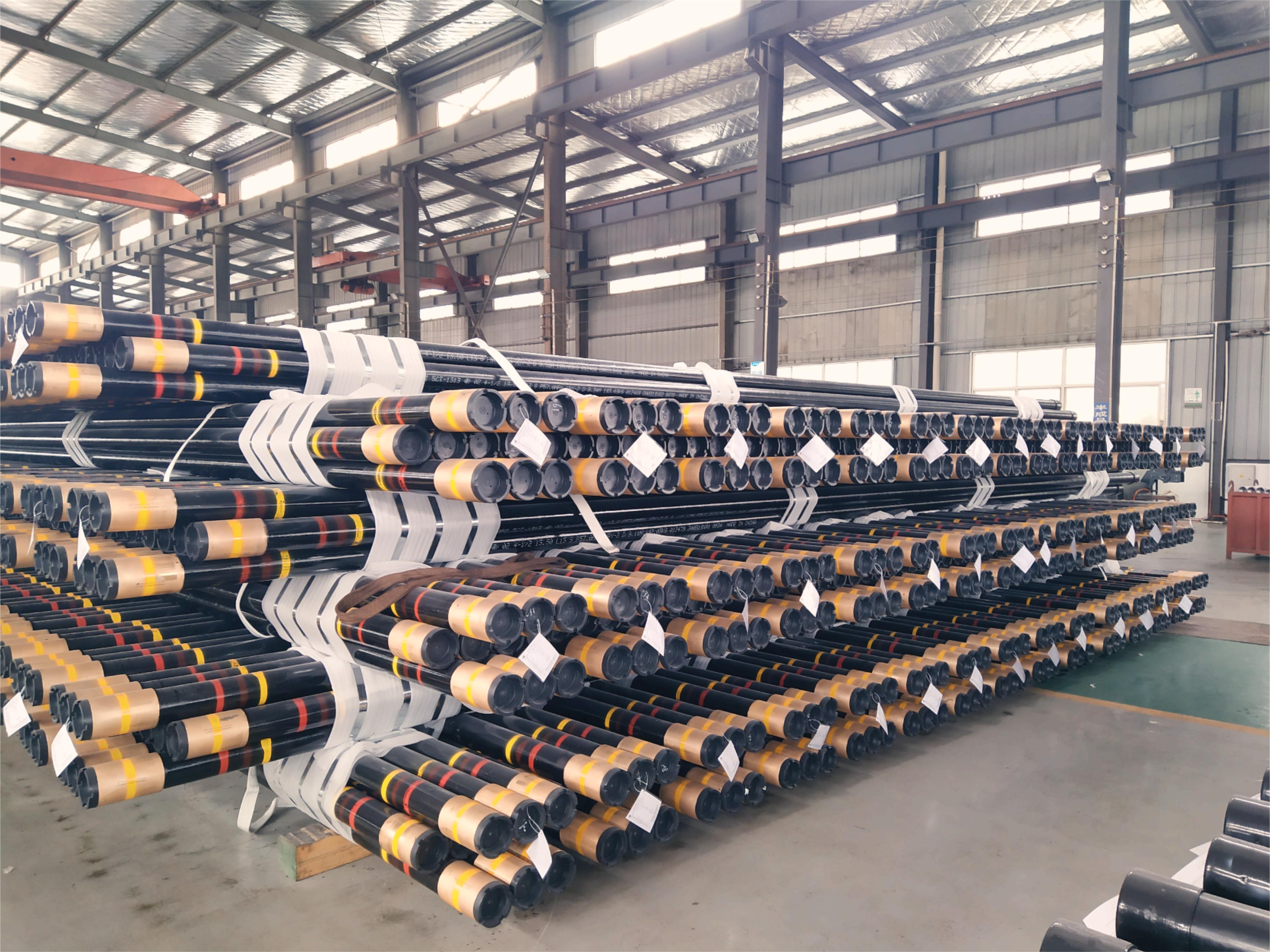 L80-13Cr premium casing with copper coupling bands and black thread protectors, carrying the English "MADE IN CHINA" mill stencil, from a ZC ZC-2 premium casing supply.
The L80 Grade Family — One Mechanical Spec, Four Corrosion Environments
API 5CT places all L80 variants in Group 2 — the group defined by a hardness ceiling rather than a minimum yield floor. That 23.0 HRC / 241 HBW maximum is the engineering reason L80-1 qualifies for sour service: hardness control limits susceptibility to sulfide stress cracking (SSC) under NACE MR0175 / ISO 15156-2. The chromium variants (3Cr, 9Cr, 13Cr) carry the same hardness limit but were not developed for H2S — they were developed for CO2. The hardness limit is inherited from the group, not a sour service qualification for those types.
The table below shows all four variants side by side using API 5CT 11th edition values.
| Property | L80-1 | L80-3Cr | L80-9Cr | L80-13Cr |
|---|---|---|---|---|
| Chromium % | None | 2.5–3.9% | 8.0–10.0% | 12.0–14.0% |
| Min Yield | 552 MPa / 80 ksi | 552 MPa / 80 ksi | 552 MPa / 80 ksi | 552 MPa / 80 ksi |
| Max Yield | 655 MPa / 95 ksi | 655 MPa / 95 ksi | 655 MPa / 95 ksi | 655 MPa / 95 ksi |
| Min Tensile | 655 MPa / 95 ksi | 655 MPa / 95 ksi | 655 MPa / 95 ksi | 655 MPa / 95 ksi |
| Max Hardness | 23.0 HRC / 241 HBW | 23.0 HRC / 241 HBW | 23.0 HRC / 241 HBW | 23.0 HRC / 241 HBW |
| Heat Treatment | Q+T | Q+T | Q+T | Q+T |
| Sour Service (H2S) | Yes — NACE MR0175 | No | No | No |
| CO2 Corrosion Resistance | None | Mild | Moderate | High |
| NDT Surface Method | MT or PT | MT or PT | PT only | PT only |
| Density Correction | 1.000 | 1.000 | 0.989 | 0.989 |
| Color Code | Red + Brown | Red + White | Red + Brown + 2 Yellow | Red + Brown + Yellow |
| Relative Cost | Low | Low–Medium | Medium–High | High |
Read this table from right to left for chromium content and CO2 resistance, and from left to right for H2S suitability. The only column where L80-1 leads is sour service — and that is the only column that matters when H2S is present.
For the complete API 5CT grade ladder with tensile, hardness, and chemistry data, see the API 5CT specification tables →
To match an L80 variant to your well fluid conditions, use the Pipe Grade Selector →
L80 Type 1 — The Sour Service Grade
L80 Type 1 is a carbon-manganese steel. There is no chromium addition. The sour service qualification comes entirely from hardness control: the Q+T heat treatment ensures that no material in the pipe body, coupling, or weld-affected zone exceeds 23.0 HRC. Hardness above that threshold increases susceptibility to SSC under H2S partial pressure, and NACE MR0175 / ISO 15156-2 defines L80-1 as a permissible material for sour service within its temperature and H2S partial pressure limits. For the full L80-1 sour-service envelope and hardness rationale, see the API 5CT L80 sour-service grade specifications.
L80-1 does not resist CO2 corrosion. Carbon-manganese steel corrodes in the presence of dissolved CO2 at rates that depend on temperature, pressure, flow velocity, and water cut. In a sweet CO2 environment, L80-1 typically requires chemical inhibition — corrosion inhibitor injection into the tubing string — to manage metal loss over well life.
What we see on orders: Most L80 purchase orders we receive from West African and Middle East operators do not specify a type. Under API 5CT, that defaults to L80 Type 1. This is correct when the well is sour — but we have received orders where the customer's well fluid analysis showed CO2 as the primary corrosion driver, not H2S, and they wanted 13Cr. The PO read "L80 sour service," which is the wrong description for a 13Cr application and would have resulted in Type 1. We flag the mismatch before production. The time to catch a type designation error is on the PO, not on the MTC.
L80-13Cr — The CO2 CRA Workhorse
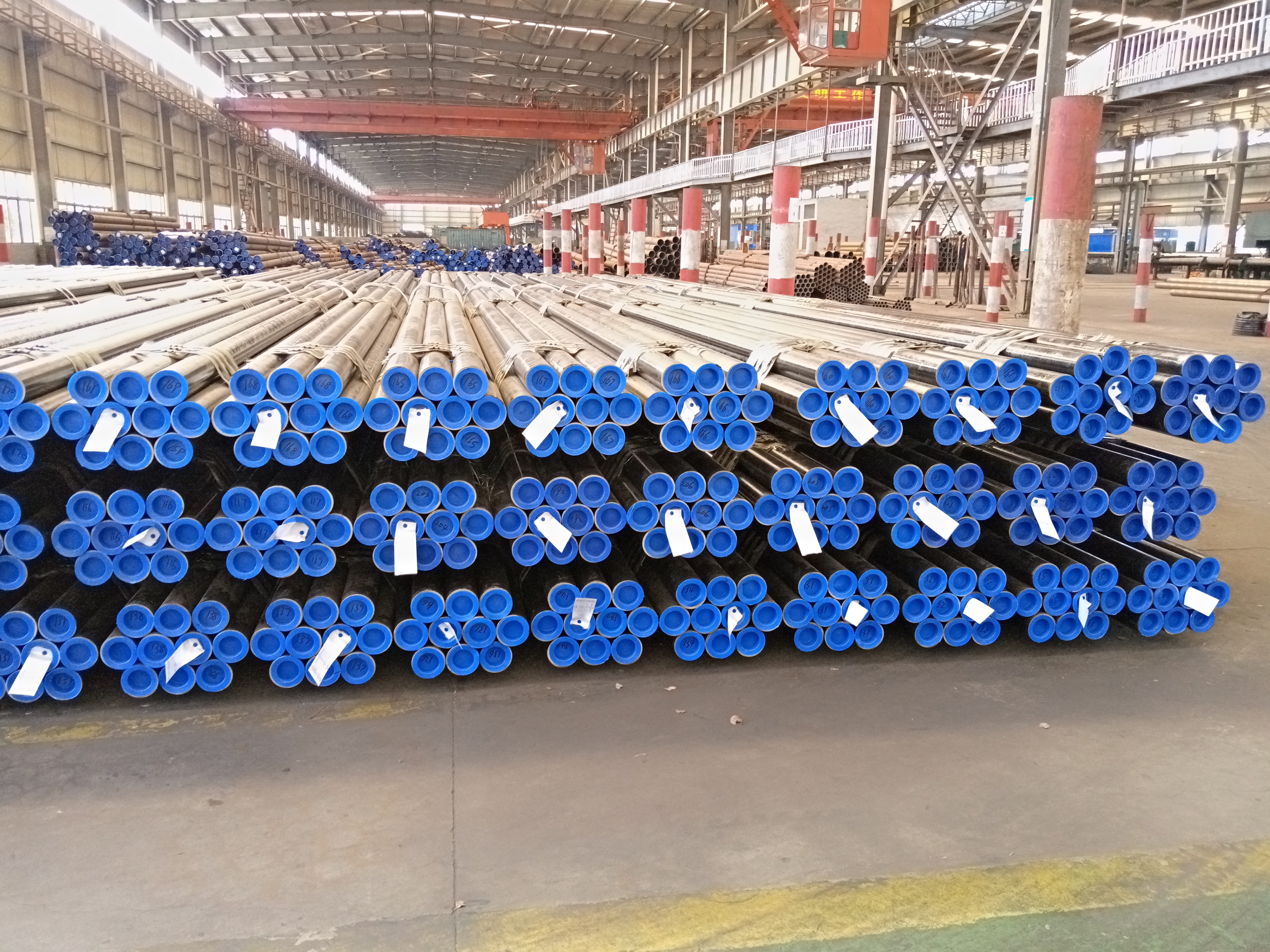 Seamless L80-13Cr bundles with blue end caps in the ZC warehouse, staged for a West Africa gas flowline order.
L80-13Cr is a martensitic stainless steel with 12.0–14.0% chromium. The chromium content forms a passive oxide film on the steel surface that resists dissolution by CO2 and carbonic acid. It is the standard tubing grade for gas condensate wells with high CO2 partial pressure, and it is the most commercially available of the chromium L80 variants. For full dimensional, chemistry, and burst data on this grade, see the L80 13Cr casing and tubing specifications.
We supplied 3,800 joints of 4½" L80-13Cr PSL2 flowline pipe with ZC-2 premium connections to an African gas project. The environment was high CO2 with trace H2S well below the NACE MR0175 partial pressure threshold — L80-13Cr was the correct selection for that well fluid. Before production, we confirmed the H2S partial pressure against the NACE MR0175 / ISO 15156 limit for 13Cr martensitic steel because if H2S exceeded that threshold, the entire order would need to be revised to L80-1 or a higher CRA. At CO2-dominated well conditions with controlled chlorides, L80-13Cr significantly outperforms inhibited L80-1 over well life — the inhibitor cost alone on a 15-year well producing 500 bbl/day can exceed the material premium of the 13Cr order.
Two physical differences from L80-1 require attention at the procurement stage. First, density: L80-13Cr and L80-9Cr have a density slightly below carbon steel. API 5CT specifies a weight correction factor of 0.989 for these grades — meaning nominal weights quoted from carbon-steel tables overstate actual weight by approximately 1.1%. Apply the correction factor before calculating string weight or shipping tonnage. Second, surface inspection: L80-13Cr is not ferromagnetic. Magnetic particle testing (MT) cannot be performed on this material. Liquid penetrant testing (PT) is required for all surface inspection of 13Cr and 9Cr grades.
L80-9Cr and L80-3Cr
L80-9Cr carries 8.0–10.0% chromium and targets moderate CO2 environments with elevated chloride concentrations where L80-13Cr may be over-specified on cost but L80-1 is underperforming on corrosion. The same 0.989 density correction and PT-only NDT requirement that apply to L80-13Cr also apply to L80-9Cr. Mill availability for 9Cr is limited compared to 13Cr — fewer mills produce it as a stock item, and lead times are typically longer.
L80-3Cr was introduced in API 5CT 11th edition (December 2023) for mild CO2 corrosion service in sweet wells. With 2.5–3.9% chromium, it provides measurable corrosion resistance above carbon steel without the cost premium of 9Cr or 13Cr. On a South America oil drilling project, we supplied L80-1Cr and L80-3Cr production tubing at 3½" OD with ZC-2 premium connections. The L80-3Cr was selected for mild CO2 in a sweet well — no H2S present, confirmed by well fluid analysis prior to grade selection. This is exactly the application the 11th edition added L80-3Cr for: mild CO2 without the cost premium of 9Cr or 13Cr. L80-3Cr remains a carbon-steel-class material and does not require PT — MT is still applicable.
The H2S Trap — Why L80-13Cr Is Not Always Safer
The most consequential misunderstanding in L80 grade selection is the belief that L80-13Cr, being an alloy steel with a hardness limit, is "more qualified" for corrosive service than L80-1. Under NACE MR0175 / ISO 15156, it is not — specifically where H2S is present.
H2S causes sulfide stress cracking (SSC) in martensitic stainless steels through a hydrogen embrittlement mechanism. The 13% chromium microstructure that provides excellent CO2 resistance is vulnerable to SSC at H2S partial pressures that L80-1 (with controlled hardness) can handle. NACE MR0175 / ISO 15156 defines maximum H2S partial pressure limits for 13Cr martensitic steels that are substantially lower than those for L80-1. When a well fluid contains both CO2 and H2S — as many gas condensate wells do — the H2S partial pressure must be assessed against the NACE limits for the selected grade before specifying L80-13Cr.
If H2S partial pressure at operating conditions exceeds the ISO 15156 threshold for 13Cr, the correct upgrade path is not L80-13Cr — it is Super 13Cr (modified 13Cr with higher Mo and Ni), duplex stainless steel, or a nickel-base alloy. These grades are engineered for combined CO2/H2S environments and are qualified under NACE MR0175 / ISO 15156-3. To work through combined CO2/H2S grade selection, see the CRA grade selection guide for CO2 and H2S, or run the well conditions through the sour service grade selector.
The L80-13Cr hardness limit of 23.0 HRC is a Group 2 inheritance, not a sour service qualification. The hardness limit was designed to prevent SSC in carbon-manganese steel (L80-1). When applied to 13Cr martensitic steel, the same hardness ceiling does not confer the same H2S resistance — the failure mechanism in 13Cr under H2S is different from SSC in carbon steel at the same hardness. Engineers who see "23.0 HRC max" on both grades and assume equivalent sour service performance are reading the spec without understanding the metallurgy behind it.
When NOT to Use Each Variant
Do not use L80-13Cr when:
- H2S partial pressure exceeds the NACE MR0175 / ISO 15156 limit for 13Cr martensitic steel at the operating temperature and chloride concentration
- Welding is required in the field — 13Cr requires controlled preheat and post-weld heat treatment; field welding without qualified procedure qualification risks cracking
- The inspection protocol calls for MT only — the ITP must be revised to include PT before L80-13Cr is procured
- Well temperature exceeds approximately 150°C combined with chlorides — Super 13Cr or duplex is the correct grade above that threshold
Do not use L80-1 when:
- CO2 partial pressure is the primary corrosion driver in a sweet well with no H2S — inhibitor injection is a running cost, not a one-time cost, and for wells with >15-year design life in a high CO2 environment, chromium-alloy tubing typically has lower total cost of ownership
- The operator's well integrity program prohibits inhibitor injection (e.g., subsea completions with no injection capability)
Do not use L80-9Cr or L80-3Cr when:
- A confirmed supply chain exists for the required size and quantity — check mill availability before specifying these grades on a project timeline; delivery risk on 9Cr is real
Purchase Order Guidance
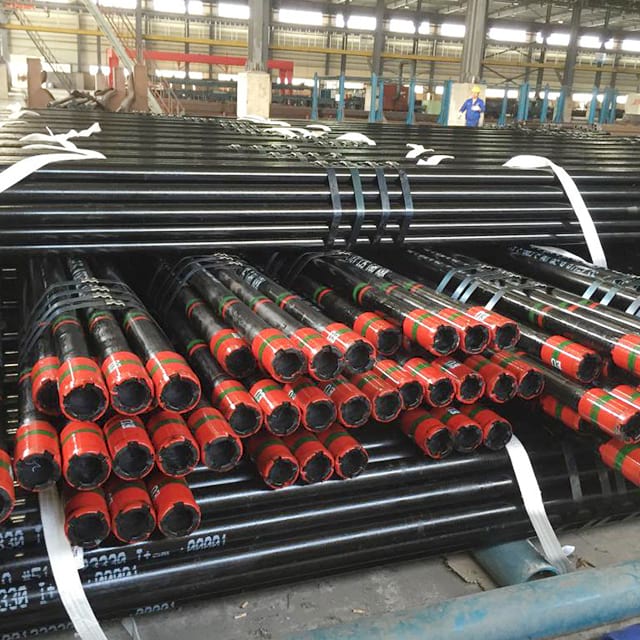 Casing and tubing with colour-banded pin ends and thread protectors — grade and type must be named on the PO and confirmed against these markings on receipt.
A PO that reads "API 5CT L80" without a type designation is compliant with the standard but ambiguous — a mill can and will ship Type 1. Every L80 order for a corrosion-specific application must name the type explicitly.
Minimum PO line items for L80-13Cr:
- "API Specification 5CT, 11th Edition, Grade L80 Type 13Cr, PSL2"
- "Q+T heat treatment"
- "EN 10204 3.2 MTC (third-party witnessed)" — West African and Middle East deepwater operators routinely specify 3.2 for CRA grades; treat it as the default unless the project specification says otherwise
- "PT for all surface inspection (MT not applicable)"
- "Premium connection: [designation]" — specified as a separate line item from the grade
- "Weight correction factor 0.989 applied to nominal weights for 13Cr"
The procurement trap: We see purchase orders where the customer writes "L80 sour service" intending to order L80-13Cr because they associate L80 with the sour-service hardness limit. "L80 sour service" means L80 Type 1 — the carbon-manganese steel that is actually qualified for H2S. If you need CO2-resistant 13Cr tubing, the PO must read "L80 Type 13Cr." These are opposite grades for opposite environments, and both are API-compliant as shipped when the type is unspecified.
MTC verification before acceptance:
- Confirm grade marking includes type designation (Type 1, 13Cr, 9Cr, or 3Cr) — grade designation without type is not sufficient for CRA grades
- For 13Cr and 9Cr: verify chromium content is within the API 5CT range (12.0–14.0% and 8.0–10.0% respectively)
- For PSL2: verify Charpy V-notch impact test records are included — PSL2 requires notch toughness documentation that PSL1 does not
- Verify heat treatment records show Q+T (quench and temper) — normalising alone does not meet Group 2 requirements
- For EN 10204 3.2 orders: confirm inspector signature and witness stamp are present, not just the manufacturer's declaration
Frequently Asked Questions
Is L80-13Cr a sour service grade under NACE MR0175?
No. Despite carrying the L80 hardness limit of 23.0 HRC / 241 HBW, L80-13Cr is not a sour-service grade under NACE MR0175 / ISO 15156. The 13% chromium martensitic microstructure is susceptible to sulfide stress cracking when H2S partial pressure exceeds trace levels. L80 Type 1 (carbon-manganese steel) is the NACE-qualified sour-service L80 variant.
What is the difference between L80 Type 1 and L80-13Cr mechanically?
There is no mechanical difference. Both grades share identical API 5CT 11th edition limits: minimum yield 552 MPa (80 ksi), maximum yield 655 MPa (95 ksi), minimum tensile 655 MPa (95 ksi), and maximum hardness 23.0 HRC / 241 HBW. The distinction is entirely in corrosion environment: L80-1 resists H2S through hardness control; L80-13Cr resists CO2 through chromium content.
Can L80-13Cr be used in a mixed CO2 and H2S environment?
Only if H2S partial pressure remains below the NACE MR0175 / ISO 15156 threshold for 13Cr martensitic stainless steel, which is very low — typically below 0.01 psia partial pressure depending on temperature and chloride. If H2S is present in meaningful concentrations, L80-13Cr is disqualified. Super 13Cr, duplex, or higher CRA grades are required for mixed CO2/H2S service.
Does L80-13Cr weigh the same as L80 Type 1 in the same size?
No. L80-13Cr is a martensitic chromium steel with a density slightly lower than carbon steel. API 5CT applies a weight correction factor of 0.989 for 13Cr and 9Cr grades. For a 4½" 12.6 lb/ft string, the actual weight per joint is approximately 1.1% lighter than the nominal carbon-steel figure. This matters for string weight calculations and shipping estimates.
What NDT method is required for L80-13Cr vs L80 Type 1?
L80-13Cr and L80-9Cr are martensitic stainless steels and are not ferromagnetic, so magnetic particle testing (MT) cannot be used for surface inspection. Liquid penetrant testing (PT) is required instead. L80 Type 1 is carbon-manganese steel and responds normally to MT. ITPs for mixed L80 orders must specify PT for 13Cr joints and MT for Type 1 joints — a single-method specification leaves one grade improperly inspected.
What does L80-3Cr cover and when was it added?
L80-3Cr was added in API Specification 5CT 11th Edition (December 2023) for mild CO2 corrosion service in sweet wells — environments with CO2 present but negligible H2S. With 2.5–3.9% chromium, it sits between L80 Type 1 (no CO2 resistance) and L80-9Cr (moderate CO2), at a cost significantly below 13Cr. It is not a sour-service grade.
What should a purchase order say to specify L80-13Cr correctly?
The PO must read: 'API Specification 5CT, 11th Edition, Grade L80 Type 13Cr, PSL2, Q+T heat treatment.' Writing only 'L80' or 'L80 sour service' defaults to Type 1 under the standard. If a premium connection is required, add the connection designation separately — the grade and the connection are independent line items.
Is L80-9Cr widely available?
No. L80-9Cr is a specialty grade produced by a limited number of mills. Lead times are typically longer than L80-13Cr, and minimum order quantities apply. Most procurement teams sourcing a chromium L80 go directly to L80-13Cr, which has better mill availability and more established field track record. L80-9Cr fills a niche for moderate CO2 with chloride sensitivity where 13Cr is over-specified.