Super 13Cr is one of the most effective and cost-efficient corrosion resistant alloys (CRA) for CO2-corrosive oil and gas wells. But it has a hard limit that engineering teams sometimes underestimate or overlook: it is a martensitic stainless steel with meaningful susceptibility to sulphide stress cracking (SSC). In wells where both CO2 and H2S are present — a common combination in gas condensate and deep gas fields — the question of whether Super 13Cr is still appropriate is not answered by the CO2 corrosion data alone.
ZC Steel Pipe supplies Super 13Cr tubing and casing alongside duplex 2205 and super duplex 2507 stainless steel, and we regularly work with operators making the CO2-H2S boundary selection. This guide covers how Super 13Cr fails in mixed CO2-H2S environments, what the relevant qualification limits are, and when to escalate to duplex or higher-alloy CRA.
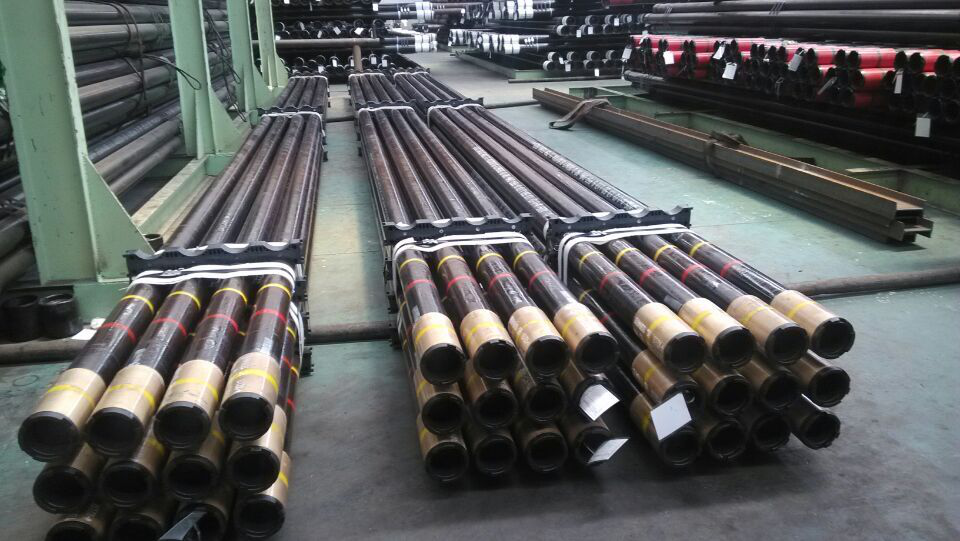 13Cr casing bundles on green storage racks with couplings and thread protectors fitted, staged in the ZC yard ahead of a premium casing shipment.
Quick Answer
Super 13Cr is a CO2 grade, not a sour-service grade. In a mixed CO2-H2S well the controlling parameter is H2S partial pressure, not CO2 — a CO2 number well inside the Super 13Cr envelope does not make the grade safe if H2S is present. Specify against the H2S ceiling first:
| H2S partial pressure | Grade to specify |
|---|---|
| < 0.003 bar (0.04 psi) | Super 13Cr may qualify — mill NACE data required |
| 0.003–0.010 bar | Duplex 2205 preferred; 13Cr only on mill data |
| 0.010–0.100 bar | Duplex 2205 (UNS S31803) |
| 0.100–1.0 bar | Super duplex 2507 (UNS S32750) |
| > 1.0 bar | Nickel CRA — Alloy 825 or Alloy 625 |
Above roughly 0.01 bar H2S, Super 13Cr's sulphide stress cracking (SSC) susceptibility — it is a 110 ksi martensitic stainless — makes it the wrong grade no matter how comfortable the CO2 figure looks. Temperature, chloride, and in-situ pH move every threshold downward, so a mill corrosion qualification report is mandatory before specifying any 13Cr grade in H2S service. The full ladder is in the CRA grade selection guide for CO2-H2S service; to size the escalation for your exact H2S, temperature, and chloride, use the sour-service selector.
What we see on material requisitions: Mixed CO2-H2S environments are frequently specified with a CO2 partial pressure and an H2S partial pressure listed separately — but the corrosion review sometimes focuses only on the CO2 number when the grade is a 13Cr family material. We have reviewed MRs where Super 13Cr was specified for a well with 8 bar CO2 and 0.05 bar H2S: the CO2 number is within the Super 13Cr qualification envelope, but 0.05 bar H2S is above the SSC qualification limit for most Super 13Cr grades. The specification had been written by matching CO2 partial pressure to the mill's CO2 qualification data, with H2S treated as a trace contaminant. At 0.05 bar H2S and 130°C with 20,000 ppm chloride, it is not a trace contaminant — it is the controlling design parameter. We flag this before the order reaches the mill, but it requires the operator's corrosion engineer to revise the material class.
Why Super 13Cr Is Not a Universal CO2-H2S Solution
Super 13Cr's corrosion resistance comes from a passive chromium oxide film that forms on the alloy surface in CO2-bearing environments. This film is highly stable in pure CO2 and CO2-water acidic environments, providing excellent resistance to weight-loss corrosion, pitting, and crevice corrosion under the conditions for which the grade is qualified — see the Super 13Cr tubing specifications and CO2 corrosion envelope for the full CO2 story.
H2S disrupts this mechanism in two ways:
1. Film stability. H2S reacts with the chromium oxide passive film, forming chromium sulfide compounds that are less stable than the oxide under some conditions. At sufficiently high H2S partial pressure, the passive film cannot maintain itself and localised corrosion initiates at pits.
2. Sulphide stress cracking. Atomic hydrogen is generated at the steel surface as a cathodic product of H2S reduction. This hydrogen diffuses into the steel lattice. In high-strength martensitic microstructures — the same tempered martensite that gives Super 13Cr its 110 ksi yield strength — hydrogen embrittles grain boundaries and promotes cracking under sustained tensile stress. SSC initiates at stress concentrations: connection thread roots, machine marks, surface defects, corrosion pits, or areas of high residual stress from straightening.
Both effects operate simultaneously in mixed CO2-H2S environments. The passive film disruption creates pits that act as stress concentrators; SSC then propagates cracks from those pits under the tensile loads of the tubing string.
The Yield Strength — SSC Susceptibility Relationship
SSC susceptibility in the 13Cr family is directly related to yield strength. This is a well-established metallurgical principle: higher yield strength means higher dislocation density and more susceptibility to hydrogen embrittlement. The three relevant grade tiers illustrate this clearly:
| Grade | Min Yield (MPa / ksi) | SSC Susceptibility | Approx H2S Tolerance |
|---|---|---|---|
| L80-13Cr (API 5CT) | 552 MPa / 80 ksi | Lowest in 13Cr family | ~0.003–0.010 bar pH2S (qualification required) |
| Super 13Cr (110 ksi variant) | 758 MPa / 110 ksi | Moderate | ~0.003–0.010 bar pH2S (lower than L80-13Cr at same conditions) |
| Super 13Cr (125 ksi variant) | 862 MPa / 125 ksi | Highest in 13Cr family | Even lower; frequently not qualified at any H2S |
The H2S tolerance ranges above are indicative — the actual qualified limit for any specific grade comes only from the mill's ISO 15156-3 qualification documentation. These are not absolute limits that apply uniformly; temperature, chloride content, in-situ pH, and the specific alloy chemistry all shift the boundary.
The important conclusion: Super 13Cr at 110 ksi is less H2S tolerant than L80-13Cr at 80 ksi, which is itself less tolerant than duplex at equivalent yield strength. Upgrading from L80-13Cr to Super 13Cr for better CO2 resistance simultaneously reduces H2S tolerance. In a well where H2S is marginal for L80-13Cr, it may be below the qualification envelope for Super 13Cr.
A counterintuitive selection scenario: a well with 3 bar CO2 and 0.008 bar H2S at 140°C. Super 13Cr handles the CO2 comfortably. L80-13Cr handles the CO2 at the margin. But 0.008 bar H2S may put both grades at or beyond their SSC qualification envelope at 140°C, because temperature accelerates the SSC mechanism and reduces the H2S threshold. The correct answer is duplex stainless steel — which handles both the CO2 and the H2S — not a comparison between the two 13Cr grades. Framing the selection as "which 13Cr" misses the escalation to duplex that the H2S level actually requires.
NACE MR0175 / ISO 15156-3 Qualification for 13Cr in H2S
NACE MR0175 / ISO 15156-3 is the governing standard for the use of CRA materials in H2S-containing petroleum production environments. Part 3 covers CRA alloys, which includes the 13Cr martensitic family.
For Super 13Cr grades, ISO 15156-3 qualification typically requires:
Stress Corrosion Cracking testing: Four-point bend or C-ring specimens tested per NACE TM0177 Method A (tensile bar) or Method D (double cantilever beam) at conditions representing the well environment. The test must bracket the intended service conditions, not just meet them exactly.
Environmental limits: The documented qualified envelope must specify maximum H2S partial pressure, maximum temperature, maximum chloride concentration, and minimum in-situ pH. If any of these parameters in the actual well exceeds the qualified limit — even if only one parameter is out of range — the grade is not qualified for that service.
Hardness control: API 5CT already limits hardness to 23 HRC (241 HBW) for L80-13Cr. Super 13Cr at 110 ksi is above the L80-13Cr strength level and requires the manufacturer to demonstrate that the hardness and microstructure are consistent with the SSC test results.
The critical procurement implication: the mill's corrosion qualification report is a document you must request and review before specifying Super 13Cr in any H2S-containing environment. The grade designation "Super 13Cr" alone does not constitute NACE qualification. Different mills produce Super 13Cr to different proprietary chemistries — Vallourec VM 13Cr-110, Tenaris 13Cr-110, and equivalent grades from other manufacturers have different precise Ni and Mo contents that affect their H2S tolerance. Do not assume that "Super 13Cr" from any mill is qualified to the same H2S limit.
When Super 13Cr Fails — Field Failure Patterns
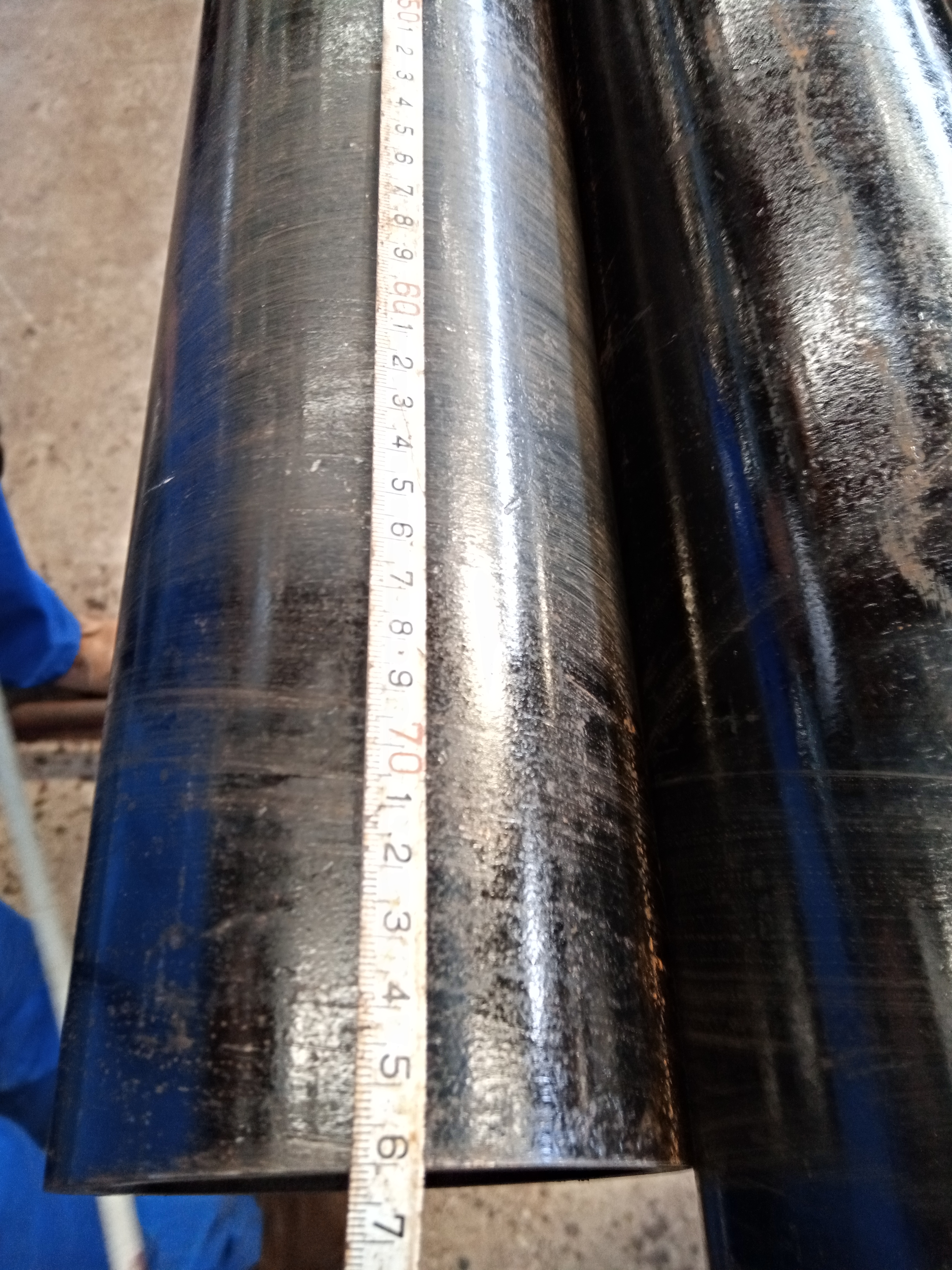 Dimensional inspection of a pipe OD with a steel tape — part of the ZC pre-shipment checks that document each joint before it leaves the yard.
SSC Cracking at Connections
The most common failure location for Super 13Cr in H2S environments is the connection — specifically at the last engaged thread of the pin, where stress concentration is highest and residual stress from makeup torque adds to service loading. Failures typically appear 3–18 months after well startup when H2S concentrations build up as the reservoir is depleted and the water cut increases (H2S levels in produced fluids often increase as the well ages).
The fracture surface shows intergranular cracking with secondary branching — characteristic of SSC — rather than the transgranular fatigue cracking or ductile overload that would result from mechanical overload alone.
Pitting Corrosion at Bend Points
In tubing strings with dog-legs or in wellbores with high inclination, H2S-initiated pitting can occur at the outer diameter of the tubing at bend apexes where the passive film is under sustained stress. These pits do not cause immediate failure but act as initiation sites for SSC under the combined bending and tensile loading. Detection by caliper or electromagnetic inspection during workover is the only way to identify these pits before they propagate to failure.
Chloride-Accelerated Pitting in Mixed CO2-H2S
Chloride ions do not cause SSC directly, but they compete with the passive film for chromium surface sites and facilitate pit initiation. In wells with high chloride (>30,000 ppm Cl⁻) combined with H2S, even trace H2S below the nominal SSC threshold can initiate pits that subsequently propagate by SSC under load. This interaction between chloride-induced pitting and H2S-driven SSC propagation is the mechanism behind many Super 13Cr failures that occur at H2S partial pressures below the mill's stated qualification limit. The failure is not SSC in isolation — it is pit-initiated SSC, which can operate at lower H2S than pure SSC initiation.
Selection Framework — What to Use When Super 13Cr Is Not Appropriate
H2S Partial Pressure as the Primary Selection Driver
| H2S Partial Pressure | CO2 Partial Pressure | Recommended Grade |
|---|---|---|
| <0.003 bar (0.04 psi) | Any | Super 13Cr may be qualified (mill data required) |
| 0.003–0.010 bar | Low–moderate CO2 | Duplex 2205 preferred; evaluate mill data for 13Cr |
| 0.010–0.100 bar | Any | Duplex 2205 (UNS S31803) |
| 0.100–1.0 bar | Any | Super duplex 2507 (UNS S32750) |
| >1.0 bar | Any CO2 | High-alloy CRA: Alloy 825 or Alloy 625 |
| Any H2S | >30 bar CO2 + high temp | High-alloy CRA or evaluate internally clad pipe |
These ranges are guidance, not limits. Temperature, chloride concentration, and in-situ pH shift every threshold. A formal corrosion assessment using NORSOK M-506 or an equivalent model, checked against material qualification data, is required for any final material selection.
Duplex 2205 as the Primary Alternative
Duplex stainless steel 2205 (UNS S31803 / UNS S32205) is the standard step up from Super 13Cr for mixed CO2-H2S environments. Its austenitic-ferritic microstructure provides:
- Higher strength than austenitic stainless steels without the high-strength martensitic microstructure that makes 13Cr family grades SSC-susceptible
- Better H2S resistance: duplex 2205 is qualified under NACE MR0175 / ISO 15156-3 for H2S partial pressures up to approximately 10 kPa (1.5 psi / 0.10 bar) at temperatures up to 232°C (450°F) for FPREN between 30 and 40 with Mo ≥ 1.5% — per the environmental limits in Table A.24 of ISO 15156-3
- Excellent CO2 corrosion resistance, superior to both L80-13Cr and Super 13Cr
- Usable yield strength around 448–517 MPa (65–75 ksi) in tubular products, adequate for typical intermediate production strings
The trade-off: duplex 2205 costs approximately 2–3× Super 13Cr and requires premium metal-to-metal seal connections. The tubular range is also narrower — duplex is primarily available in 2⅜ inch to 4½ inch OD for production tubing and 5 inch to 9-5/8 inch for casing.
Super Duplex 2507 for Higher H2S
Super duplex 2507 (UNS S32750) extends the H2S tolerance further: qualified under ISO 15156-3 Table A.24 for FPREN > 40, up to 20 kPa (3 psi) H2S partial pressure at temperatures up to 232°C (450°F). Its higher Cr, Mo, and N content (FPREN = %Cr + 3.3×%Mo + 16×%N ≈ 42–43 for 2507) provides better pitting resistance in chloride environments combined with H2S than duplex 2205.
Super duplex 2507 costs approximately 4–5× Super 13Cr and has a more limited supplier base. It is specified for wells where duplex 2205 is insufficient — typically H2S > 0.1 bar combined with high chloride and moderate-to-high temperatures.
Alloy 825 and Alloy 625 for the Most Aggressive Conditions
For H2S above 1.0 bar, or for combinations of high H2S + high temperature + high CO2 + high chloride, nickel alloys provide the most reliable performance. Alloy 825 (UNS N08825, ~21% Cr, 3% Mo, 42% Ni) and Alloy 625 (UNS N06625, ~22% Cr, 9% Mo, balance Ni) are both qualified without environmental limits for most realistic oil and gas production conditions under NACE MR0175. They are used in the most aggressive HPHT sour wells and in tubing strings where Super Duplex is not adequate.
The practical limitation is cost (typically 8–15× carbon steel OCTG) and the very limited supplier base for large-diameter sizes. Most alloy 825 and 625 OCTG orders are for production tubing in the 2⅜ inch to 3½ inch range; casing in these alloys is custom and long lead time.
Connection Considerations for Mixed CO2-H2S Service
Super 13Cr in any H2S environment must use premium metal-to-metal seal connections. BTC buttress thread connections rely on thread compound to achieve gas-tight seal performance — these are not appropriate for H2S-containing service where sustained leakage risk is unacceptable.
Premium connections for 13Cr/Super 13Cr in H2S service carry specific requirements beyond standard premium selection:
Galling risk: Martensitic stainless steels have higher galling susceptibility than carbon steel at equivalent surface finish. Premium connection running procedures for 13Cr grades specify copper-based or PTFE-based thread compounds rather than standard API modified thread compound, and reduced make-up speed. Galling during make-up creates surface damage that becomes an SSC initiation site — a galled connection in H2S service is a failure waiting to happen.
Material compatibility: The coupling or box must be made from the same or a higher alloy than the pin. Using a carbon steel or L80 coupling on a Super 13Cr tubing string is not acceptable — galvanic corrosion at the coupling/pin junction is accelerated by H2S, and the coupling material may not be NACE-qualified.
Test certificates: For H2S service, the premium connection qualification should include testing at the actual H2S partial pressure in the well design envelope per ISO 13679 (the OCTG connection testing standard). Connection-level gas qualification testing is separate from material qualification testing — both are required.
Purchase Order Guidance
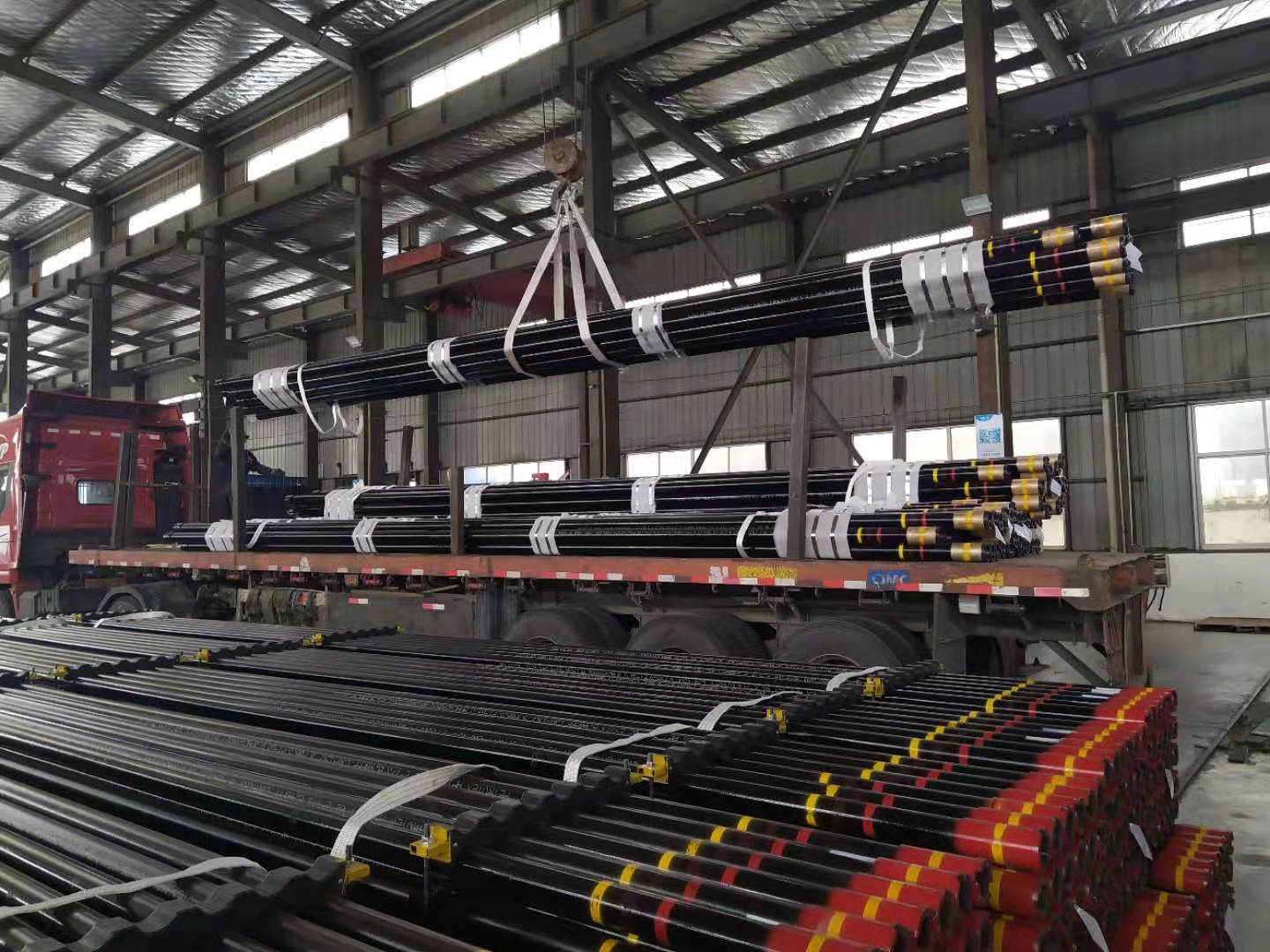 An overhead crane loading a 13Cr casing bundle onto a flatbed for dispatch — the point at which the grade, type, and qualification called out on the PO must already be locked in.
Specifying Super 13Cr for H2S-containing service
If any H2S is present in the well stream, the PO for Super 13Cr must include:
- Reference to the mill's specific corrosion qualification report number and revision for the grade being ordered
- Maximum H2S partial pressure the grade is qualified for, stated explicitly as a contract requirement
- Maximum temperature the grade is qualified for at that H2S partial pressure
- Maximum chloride concentration the grade is qualified for
- NACE MR0175 / ISO 15156-3 compliance stated as a contract requirement
- Third-party witnessed SSC testing at the qualified envelope (or reference to existing qualification data from an independent laboratory)
The H2S trace-concentration trap
The most common procurement error in Super 13Cr orders for CO2-dominant wells is treating low H2S as a non-issue. A PO that specifies Super 13Cr for "CO2 corrosion service per well fluids report" without referencing the H2S partial pressure listed in the same fluids report creates a situation where the mill manufactures to CO2 service standards only — no SSC qualification is invoked. If the well's H2S is 0.005 bar and the grade is not qualified for that H2S level, the equipment is non-conforming for its intended service environment, even if the CO2 qualification is fully in order.
The correct approach: review the full well fluids report before writing the material specification. Any detected H2S — even "trace" levels — should trigger a formal material qualification review against the applicable NACE MR0175 / ISO 15156 limits for the proposed grade.
For grade selection and the full CRA ladder from L80-13Cr through duplex and nickel alloys, see the API 5CT specification tables →
Use the Pipe Grade Selector → to evaluate grade options for wells with mixed CO2-H2S environments.
Frequently Asked Questions
Can Super 13Cr be used in wells with both CO2 and H2S?
Super 13Cr can be used in wells with trace H2S provided the H2S partial pressure remains below the threshold specified in NACE MR0175 / ISO 15156-3 for the specific mill's qualified grade. In practice, that threshold is often cited around 0.003–0.010 bar (0.04–0.15 psi) depending on temperature and chloride content — a very low limit. Wells with H2S partial pressure above 0.01 bar in combination with CO2 generally require duplex stainless steel or a higher-alloy CRA, not Super 13Cr. The exact qualifying limit is grade- and mill-specific and must be verified against the manufacturer's corrosion qualification data.
What failure mode affects Super 13Cr in H2S environments?
The primary failure mode is sulphide stress cracking (SSC) — a form of hydrogen embrittlement caused by atomic hydrogen generated at the metal surface by the H2S reduction reaction. SSC initiates at stress concentrations (thread roots, notches, surface defects) and propagates under sustained tensile stress. Super 13Cr at 110 ksi yield strength is significantly more susceptible to SSC than L80-13Cr at 80 ksi, because SSC susceptibility increases with yield strength in martensitic stainless steels. A secondary failure mode in mixed CO2-H2S environments is pitting corrosion: H2S disrupts the passive chromium oxide film that provides CO2 corrosion resistance, allowing localised pits to initiate under conditions where the grade would otherwise perform adequately.
At what H2S partial pressure does Super 13Cr typically fail?
There is no universally fixed H2S limit for Super 13Cr because the threshold depends on temperature, in-situ pH, chloride concentration, and the specific mill's alloy chemistry and heat treatment. Published guidance from ISO 15156-3 and mill qualification data typically places the usable limit between 0.003 bar and 0.030 bar H2S partial pressure for Super 13Cr grades. Above 0.030 bar, duplex stainless steel is generally required. Below 0.003 bar, some Super 13Cr variants are qualified under NACE MR0175, but the corrosion qualification report from the mill is required before specifying use in any H2S-containing environment.
What should I use instead of Super 13Cr in mixed CO2-H2S service?
For wells with moderate H2S (0.01–1.0 bar) combined with CO2, duplex 2205 (UNS S31803) is the standard step up from Super 13Cr. For high H2S or aggressive CO2-H2S combinations, super duplex 2507 (UNS S32750) provides higher FPREN and better resistance to both pitting and SSC. For ultra-deep HPHT wells with significant H2S and CO2, Alloy 825 (UNS N08825) and Alloy 625 (UNS N06625) provide reliable service but at a significant cost premium. The selection depends on H2S partial pressure, CO2 partial pressure, temperature, chloride level, and the mechanical loads required.
Does CO2 partial pressure change the H2S failure limit for Super 13Cr?
Yes — CO2 and H2S interact in ways that complicate the corrosion envelope. High CO2 partial pressure tends to lower the in-situ pH of the water phase, which accelerates H2S-driven cathodic reactions and increases SSC risk. A Super 13Cr grade qualified at very low H2S partial pressure under low-CO2 conditions may not be qualified at the same H2S level when CO2 partial pressure is also elevated. Well corrosion modelling software (such as NORSOK M-506 or proprietary mill tools) can simulate the combined CO2-H2S environment, but the output must be cross-referenced against the mill's specific corrosion qualification data for the Super 13Cr variant being specified.
What documentation is required to use Super 13Cr in H2S service?
At minimum: the mill's corrosion qualification report for the specific Super 13Cr product variant, showing the tested H2S partial pressure range, temperature range, chloride content, and in-situ pH for which the grade is qualified; ISO 15156-3 compliance documentation demonstrating the grade meets Part 3 requirements for CRA tubulars in H2S service; SSC testing per ISO 15156-3 (or equivalent NACE TM0177 Method A or Method D) at conditions envelope-bracketing the well design; and a formal corrosion assurance review signed off by a corrosion engineer confirming the grade is within its qualified envelope for the proposed well conditions.
Is L80-13Cr a better choice than Super 13Cr in mixed CO2-H2S environments?
L80-13Cr at 80 ksi (552 MPa) yield has lower SSC susceptibility than Super 13Cr at 110 ksi, so it tolerates slightly higher H2S partial pressure in practice. However, L80-13Cr's CO2 corrosion resistance is also lower — it is typically qualified to 150°C and lower CO2 partial pressures than Super 13Cr. For wells where H2S partial pressure is at the margin for 13Cr grades, neither L80-13Cr nor Super 13Cr is the right choice — the appropriate grade is duplex stainless steel. Substituting L80-13Cr for Super 13Cr to gain H2S tolerance while accepting lower CO2 resistance is rarely the correct tradeoff; it simply trades one limit for another.
What premium connection should be used with Super 13Cr in sour service?
In any environment with H2S present, premium metal-to-metal seal connections are required for Super 13Cr. Thread compounds and elastomer ring seals in standard BTC-type connections are not reliable seals for H2S-containing gas. VAM Top, Tenaris Blue, and similar gas-tight metal-to-metal connections are the standard for Super 13Cr in CO2-H2S mixed environments. The connection selection must also account for galling risk — martensitic stainless steels gall more readily than carbon steel, and premium connections for 13Cr grades typically require specific anti-galling coatings or copper-based thread compounds applied carefully at the rig.