The decision to upgrade from L80 13Cr to Super 13Cr is consequential in both directions. Under-specify and you risk premature passive film dissolution in a hotter, more aggressive well — the kind of corrosion failure that does not announce itself until tubing wall loss triggers a well integrity incident or a workover. Over-specify and you add 40–80% to the tubing string cost for a well that L80 13Cr could handle without difficulty. Getting this decision right depends on accurate reservoir data and a clear understanding of where each grade's corrosion envelope ends.
ZC Steel Pipe supplies both L80 13Cr and Super 13Cr tubing to operators in West Africa, the Middle East, and Southeast Asia, with EN 10204 3.2 MTC and mill corrosion qualification data. This guide covers the engineering basis for the selection — the specific parameters that drive the upgrade, the failure modes associated with each grade, H₂S constraints, mixed-string design, and the procurement language that separates the two grades on a purchase order.
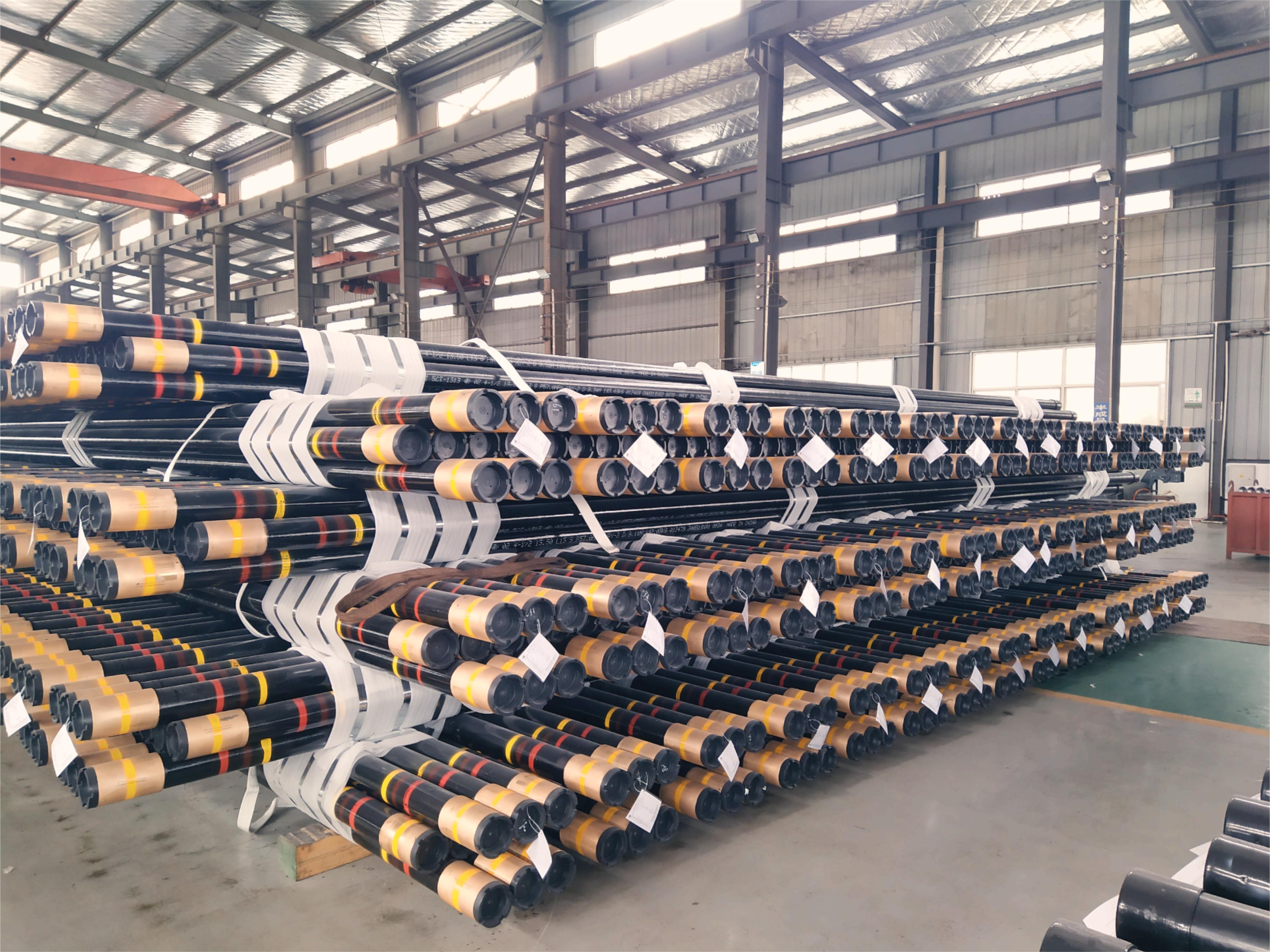 Premium L80-13Cr casing with copper-plated pin threads and "MADE IN CHINA" stencil — from a ZC premium-casing order.
Quick Answer
Use L80 13Cr for CO₂-corrosive sweet wells that stay inside its envelope: bottomhole temperature at or below 150°C, moderate CO₂ partial pressure, chloride below roughly 50,000 mg/L, and required yield at or below 95 ksi. Upgrade to Super 13Cr the moment any one of those limits is exceeded — it extends reliable CO₂ resistance to roughly 175–200°C, tolerates higher chloride through its molybdenum addition, and raises yield to 110 ksi, at a 40–80% cost premium per tonne. Neither grade is a sour-service grade — meaningful H₂S disqualifies both, and the correct step-up is duplex or a higher CRA.
| Trigger | Stay on L80 13Cr | Move to Super 13Cr |
|---|---|---|
| Bottomhole temperature | ≤ 150°C | > 150°C |
| CO₂ partial pressure | Low–moderate | High, with elevated temperature |
| Chloride concentration | ≤ 50,000 mg/L | > 50,000 mg/L + elevated temperature |
| Required yield strength | ≤ 95 ksi (655 MPa) | > 95 ksi (Super 13Cr at 110 ksi) |
Any single trigger in the right-hand column is sufficient to upgrade. The full envelope detail and selection matrix are below.
What we see on CO₂ completion workovers: The most costly mistake we encounter in CO₂ completions is not over-specification — it is under-specification followed by a workover. When a tubing string has corroded past acceptable wall-loss limits, the intervention cost — rig mobilisation, pull, replacement, re-run — routinely exceeds the price difference between L80 13Cr and Super 13Cr for the entire string. We have seen operators spend several times the alloy premium to correct a grade selection that was made to save money. If the well temperature is borderline, the correct decision is to pay for Super 13Cr upfront.
Grade Overview — What Sets Them Apart
Both L80 13Cr and Super 13Cr are martensitic stainless steels whose CO₂ corrosion resistance depends on a passive chromium oxide film on the tube surface. That film prevents CO₂-saturated brine from reaching the steel substrate and driving the electrochemical reactions that produce rapid corrosion and pitting in plain carbon steel.
The fundamental difference between the two grades is the stability of that passive film under progressively demanding conditions. L80 13Cr achieves its corrosion resistance with a standard martensitic microstructure — 12–14% Cr, carbon at 0.15–0.22% (API Specification 5CT, 11th Edition, Table C.2), and no specified molybdenum or significant nickel. Super 13Cr reaches beyond that envelope through a specific microstructural change: carbon is reduced to ≤ 0.03%, which modifies the martensitic phase to a low-carbon form with fundamentally different corrosion behaviour. Nickel (4–6%) and molybdenum (1.5–2.5%) are then added as the enabling alloys.
The carbon reduction is the essential change, not just the alloy additions. Near-zero carbon alters the carbide precipitation behaviour at grain boundaries, reduces susceptibility to sensitisation during heat treatment, and allows the nickel and molybdenum to function effectively in the passive film. Without the carbon reduction, adding Ni and Mo to standard 13Cr would not produce the same corrosion performance improvement.
| Property | L80 13Cr | Super 13Cr-110 |
|---|---|---|
| API 5CT grade designation | Yes — standardised | No — proprietary mill specification |
| Minimum yield strength | 552 MPa (80 ksi) | 758 MPa (110 ksi) typical |
| Maximum yield strength | 655 MPa (95 ksi) | ~965 MPa (140 ksi) — mill-specific |
| Minimum tensile strength | 655 MPa (95 ksi) | Mill-specified |
| Maximum hardness | 23 HRC / 241 HBW (API 5CT) | Mill-specific — verify data sheet |
| Carbon content | 0.15–0.22% (API 5CT C.2) | ≤ 0.03% |
| Chromium content | 12–14% | 12–14% |
| Nickel content | ≤ 0.50% | 4–6% |
| Molybdenum content | Not restricted by API 5CT | 1.5–2.5% |
| Heat treatment | Q+T only (API 5CT) | Q+T — low-carbon martensitic |
| Maximum operating temperature | ~150°C | ~175–200°C |
| H₂S service | Not qualified — CO₂ grade only | ISO 15156-3 qualified within limits |
| Relative cost | Baseline | +40–80% per tonne |
| Supply availability | Wide | More restricted — specialist production |
The yield range for L80 13Cr (552–655 MPa, 80–95 ksi) and hardness limit (23 HRC / 241 HBW max) are verified from api-5ct-spec.json and API 5CT Table C.1. For the full API 5CT grade ladder with tensile, hardness, and chemistry limits, see the API 5CT specification tables.
To match a CRA grade to your well's H₂S partial pressure and temperature, use the Pipe Grade Selector.
The Four Upgrade Triggers
Upgrade from L80 13Cr to Super 13Cr when any one of these four conditions applies. Each condition is independently sufficient — if two or more apply, the upgrade is unambiguous.
1. Operating temperature above 150°C
This is the hard boundary. Above approximately 150°C, L80 13Cr's passive chromium oxide film becomes unstable and begins to dissolve, shifting the corrosion mechanism from general passivation to localised pitting. The dissolution temperature is not a sharp transition — degradation begins before 150°C and accelerates above it — but 150°C is the industry-standard threshold below which L80 13Cr is reliably effective.
Super 13Cr's low-carbon microstructure, combined with the molybdenum and nickel additions, extends reliable passive film stability to approximately 175–200°C, depending on CO₂ partial pressure and chloride concentration.
2. CO₂ partial pressure above 3–5 bar combined with elevated temperature
Higher CO₂ partial pressure increases carbonic acid activity in the formation brine, which attacks the passive film more aggressively. At temperatures below 120°C, L80 13Cr typically handles CO₂ partial pressures up to 5 bar without difficulty. At 140–150°C, the threshold drops. Evaluate CO₂ partial pressure and temperature together, not independently — a well at 130°C with 6 bar CO₂ may be within L80 13Cr's envelope; the same CO₂ partial pressure at 160°C would not be.
3. Chloride concentration above approximately 50,000 mg/L at elevated temperature
Chloride ions penetrate the passive film at defect sites and cause pitting initiation. L80 13Cr tolerates moderate chloride concentrations — typically below 50,000 mg/L — at temperatures below 100°C. As temperature rises, the threshold falls. Super 13Cr's molybdenum content significantly improves pitting resistance in chloride-containing environments, which is why it maintains a larger safety margin at high-temperature, high-chloride conditions.
4. Required yield strength above 95 ksi
L80 13Cr is limited to 80–95 ksi yield (552–655 MPa) by API 5CT. Deep wells with high collapse, burst, or axial load requirements may exceed this range — check the string against the collapse calculator before assuming a grade change is the only option. Super 13Cr at 110 ksi provides the mechanical performance of P110 with the CO₂ corrosion resistance appropriate for the well environment, making it the correct selection when the well demands both.
Temperature is the dominant selection parameter — not CO₂ partial pressure. Most L80 13Cr failures we are aware of from industry sources occurred in wells where the operating temperature exceeded 150°C, regardless of CO₂ partial pressure. The passive film dissolution mechanism is thermally driven; once temperature exceeds the threshold, the film destabilises whether CO₂ partial pressure is 2 bar or 8 bar. CO₂ partial pressure matters at the margin — it shifts the effective temperature limit slightly — but temperature is the hard limit. A well at 160°C with low CO₂ partial pressure is not safe for L80 13Cr. A well at 130°C with moderate CO₂ partial pressure generally is. When engineers ask us whether their well is borderline, the first question we ask is the bottomhole temperature. Almost every borderline case resolves from there.
When NOT to Use L80 13Cr
Temperature above 150°C. The passive film dissolves. No amount of reduced CO₂ partial pressure or corrosion inhibitor injection compensates for thermal instability of the passive film at these temperatures. Super 13Cr is the minimum appropriate grade.
H₂S present at any significant partial pressure. L80 13Cr has no NACE MR0175 / ISO 15156 qualification for H₂S service. The grade's carbon content (0.15–0.22%) and martensitic microstructure make it susceptible to sulphide stress cracking (SSC). Do not specify L80 13Cr for any well where H₂S is present — even at low partial pressure — without confirming it is outside the NACE MR0175 / ISO 15156-2 SSC region for the well's pH and temperature conditions. For most practical purposes, if H₂S is present, L80 13Cr is not the correct grade.
Chloride concentration above 50,000 mg/L combined with temperature above 100°C. The combination of high chloride and elevated temperature exceeds L80 13Cr's pitting resistance envelope. Isolated high chloride at low temperature, or isolated elevated temperature with low chloride, may still be manageable — but the combination requires Super 13Cr or a higher CRA.
Required yield strength above 95 ksi. API 5CT caps L80 13Cr at 655 MPa (95 ksi) maximum yield. If the well design requires a higher-strength corrosion-resistant grade, L80 13Cr cannot provide it. Super 13Cr at 110 ksi is the standard upgrade path.
When NOT to Use Super 13Cr
The argument against Super 13Cr is straightforward: if L80 13Cr's corrosion envelope covers your well conditions, Super 13Cr adds 40–80% to the tubing string cost with no engineering return.
Do not specify Super 13Cr when the well is sweet or near-sweet (trace CO₂ at low partial pressure), the operating temperature is below 120°C throughout the tubing string, chloride concentrations are low, and no yield strength above 80 ksi is required. Many gas condensate wells in moderate-depth, moderate-temperature fields — common in West and North Africa, the Middle East shelf, and Southeast Asian basins — fall well within L80 13Cr's envelope.
Super 13Cr also carries handling complexity that L80 13Cr does not. If the rig crew does not have CRA tubular experience, the risk of contamination, connection damage, or incorrect makeup torque is higher. Specifying it in a well that does not need it introduces risk as well as cost.
Finally, Super 13Cr at 110 ksi yield is not appropriate for wells with significant H₂S above the very low threshold qualified under ISO 15156-3. Engineers sometimes believe that Super 13Cr's better CO₂ performance also implies better general sour service tolerance — it does not. For moderate to high H₂S, duplex stainless steel or a higher CRA is required regardless of the CO₂ partial pressure. Where the well needs a sour-service carbon-steel casing grade alongside the CRA production string, see the T95 sour-service casing specifications, or screen the conditions with the sour service grade selector.
Selection Matrix
The table below summarises which grade applies for combinations of the four key parameters. Where a parameter falls in the middle column, evaluate that parameter in combination with the others before deciding.
| Parameter | L80 13Cr | Evaluate together | Super 13Cr |
|---|---|---|---|
| Operating temperature | ≤ 120°C | 120–150°C | > 150°C |
| CO₂ partial pressure | ≤ 2 bar | 2–5 bar | > 5 bar |
| Chloride concentration | ≤ 30,000 mg/L | 30,000–50,000 mg/L | > 50,000 mg/L + elevated T |
| H₂S partial pressure | Absent / negligible | — | Any H₂S (low limit per ISO 15156-3) |
| Required yield | ≤ 80 ksi (552 MPa) | 80–95 ksi | > 95 ksi |
When all parameters fall in the L80 13Cr column, L80 13Cr is correct. When any single parameter falls in the Super 13Cr column, upgrade. When one or more parameters fall in the middle column and none in the Super 13Cr column, request corrosion qualification data from the mill for the specific well conditions before deciding.
Mixed-Grade Strings
Wells with temperature gradients along the tubing string are candidates for mixed-grade design — L80 13Cr in the upper, cooler section and Super 13Cr in the lower, hotter section, with the grade transition point set at the 150°C isotherm in the wellbore temperature profile.
This approach limits Super 13Cr footage to only the section of the string where it is genuinely needed. For a deep well where the bottom 1,500 m of a 4,000 m tubing string exceeds 150°C, the cost saving from running L80 13Cr in the upper 2,500 m is substantial — potentially 15–25% of the total tubing string cost depending on alloy premium at the time of order.
Mixed-grade strings require two things to be managed carefully. First, the connection type must be compatible between the two grades at the interface joint — confirm this with the connection supplier before specifying a mixed string. Second, marking and handling procedures on the rig must prevent grade mixing during running — the two grades look identical and require clear tubular tallying to ensure the correct grade is run at each depth.
Procurement Trap and Correct PO Language
The most common procurement error we encounter with 13Cr tubing is a purchase order that reads "13Cr tubing" without specifying the grade. Under this language, the mill is fully compliant shipping L80 13Cr — the standard API 5CT grade. If the well requires Super 13Cr and the PO does not say so, the engineer may receive L80 13Cr for a hot well and not discover the error until the MTC is reviewed — at which point the pipe may already be at the port.
Super 13Cr is a proprietary grade and is not designated in API 5CT. It must be specified by the mill's product name or by reference to ISO 13680 (CRA Seamless Tubes for Use as Casing, Tubing and Coupling Stock) with the specific alloy type. The PO must explicitly state, for example: "Super 13Cr per [Mill Name] proprietary specification [reference number] — 110 ksi min yield, Cr 12–14%, Ni 4–6%, Mo 1.5–2.5%, C ≤ 0.03% — corrosion qualification data required for BHT [°C] and CO₂ partial pressure [bar]."
A PO that specifies only "13Cr, 110 ksi" is ambiguous. Some mills offer 13Cr-110 (standard 13Cr cold-worked to higher yield) which is not the same material as Super 13Cr. The chemistry — particularly the near-zero carbon and the nickel and molybdenum content — must be specified explicitly, not inferred from the yield strength designation.
Rig Handling for CRA Tubulars
Super 13Cr requires handling discipline that is different from standard carbon steel or even L80 13Cr tubulars. The key differences:
Connection makeup: Premium connections used on Super 13Cr must be made up to the manufacturer's specified torque range using calibrated power tongs with a torque turn monitoring system. Under-torqued connections on CRA tubulars are a common cause of connection leaks in gas service.
Thread compound: The thread compound must be compatible with the stainless steel chemistry. Standard copper-based API compounds are not recommended for CRA threads — use the connection manufacturer's specified compound.
Carbon steel contamination: Stainless steel surfaces must not contact carbon steel tongs, slips, elevators, or storage racks without protection. Carbon steel contact deposits iron particles on the stainless surface, which then corrode and can initiate crevice corrosion at the deposit site. Use stainless or non-marring equipment for all handling.
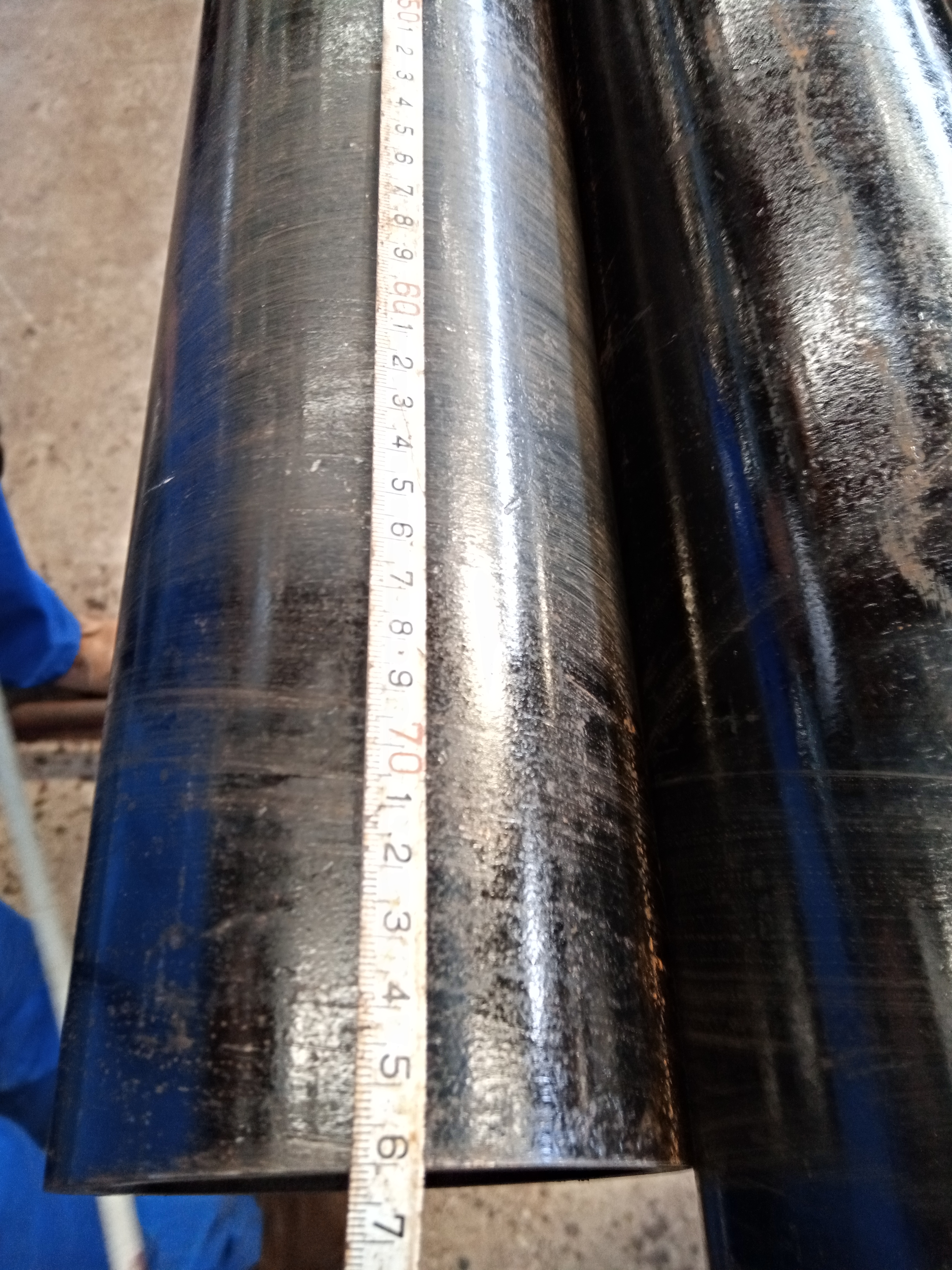 Dimensional check of pipe OD with a steel tape during pre-shipment inspection.
Inspection: Inspect the tube surface for mechanical damage, pitting, and crevice corrosion sites before running. Stainless steel is more susceptible to crevice corrosion at damage sites than carbon steel is to general corrosion — a surface defect that would be inconsequential on J55 can be a corrosion initiation site on Super 13Cr in a corrosive environment.
These handling requirements apply to L80 13Cr as well, but they are more critical for Super 13Cr because the higher yield strength makes it more sensitive to surface-initiated stress corrosion in the presence of unexpected H₂S.
Supply and Documentation
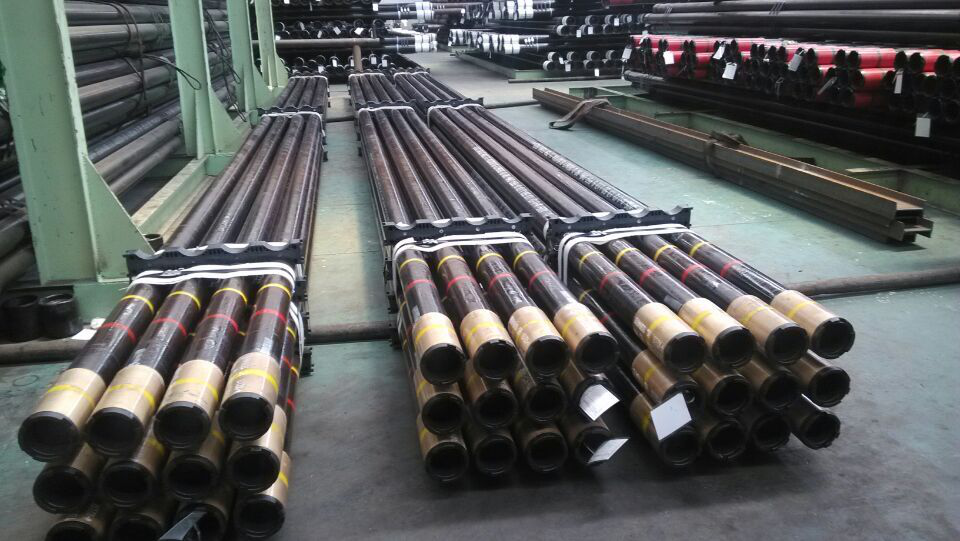 13Cr casing bundled on green storage racks, couplings and thread protectors fitted — staged for despatch on a ZC premium-casing order.
L80 13Cr is an API 5CT standardised grade with wide mill availability. Super 13Cr is a proprietary grade manufactured by a smaller number of specialist mills with CRA tube production capability. Lead time for Super 13Cr is typically longer — plan 16–24 weeks for mill production plus inspection, compared to 10–16 weeks for L80 13Cr from the same size and weight range.
For both grades, specify EN 10204 3.2 MTC (inspection by a third party independent of the manufacturer). For Super 13Cr, 3.2 MTC is effectively mandatory on most project specifications, and we treat it as the default regardless of what the project specification states. Request the following documentation at order:
- Full chemical composition per heat (C, Mn, Si, Cr, Ni, Mo, P, S as minimum)
- Heat treatment records for each heat and lot
- Mechanical test results (yield, tensile, elongation, hardness) per test unit
- Corrosion qualification data for conditions that bracket the well temperature, CO₂ partial pressure, and chloride concentration
- Third-party inspection certificate with inspector name and certificate number
For L80 13Cr specifications and the complete grade ladder, see the linked article. For Super 13Cr detailed specifications, see Super 13Cr tubing specifications.
Frequently Asked Questions
What is the main difference between L80 13Cr and Super 13Cr?
L80 13Cr is an API 5CT grade with 13% chromium and minimal alloying, providing CO₂ corrosion resistance up to approximately 150°C and moderate chloride concentrations at 80 ksi yield. Super 13Cr adds nickel (4–6%) and molybdenum (1–2%) to the base chemistry and reduces carbon to near-zero, extending CO₂ resistance to 175–200°C and higher chloride concentrations while raising yield strength to 110 ksi. The choice between them is determined by well temperature, CO₂ partial pressure, chloride concentration, and required pressure containment.
When should I upgrade from L80 13Cr to Super 13Cr?
Upgrade to Super 13Cr when any of these conditions apply: operating temperature exceeds 150°C; CO₂ partial pressure exceeds 3–5 bar; chloride concentration is high (above approximately 50,000 ppm) combined with elevated temperature; or the required yield strength exceeds L80 13Cr's 80 ksi limit. If only one parameter is borderline, review the specific mill corrosion qualification data for the exact well conditions before deciding. Super 13Cr carries a significant cost premium — only specify it when L80 13Cr genuinely cannot provide adequate corrosion resistance.
Is Super 13Cr better than L80 13Cr for H2S service?
Super 13Cr has marginally better H₂S tolerance than L80 13Cr, but neither grade is suitable for significant H₂S service. L80 13Cr is a CO₂ corrosion grade only — it has no NACE MR0175/ISO 15156-3 qualification for H₂S service and should not be selected for any well where H₂S is present. Super 13Cr can be qualified under ISO 15156-3 for H₂S service at very low partial pressure within specific temperature and pH limits, though its higher yield strength (110 ksi) still makes it susceptible to SSC under more demanding conditions. For combined CO₂/H₂S service, Super 13Cr is the appropriate 13Cr-family grade. For wells with meaningful H₂S, duplex stainless steel or higher CRA grades are required.
What is the cost difference between L80 13Cr and Super 13Cr?
Super 13Cr typically costs 40–80% more than L80 13Cr on a per-tonne basis, reflecting the higher alloy content (nickel and molybdenum are significantly more expensive than chromium alone) and the more complex heat treatment required for low-carbon martensitic stainless steel. The premium is justified when well conditions genuinely exceed L80 13Cr's envelope — specifying Super 13Cr as a precaution in wells where L80 13Cr is adequate adds cost with no engineering benefit.
Can L80 13Cr and Super 13Cr be used in the same well string?
Mixed-grade strings are used in some well designs — for example, L80 13Cr in the shallower, cooler section of a tubing string where temperatures are below 150°C, and Super 13Cr in the deeper, hotter section. This approach optimises cost while meeting the corrosion resistance requirements at each depth. However, mixed-grade strings require careful engineering to ensure compatibility at the connection interface and consistent handling procedures on the rig. Always confirm the connection type is compatible between the two grades before specifying a mixed string.
Does Super 13Cr require different handling than L80 13Cr on the rig?
Yes — Super 13Cr requires more careful handling than L80 13Cr or carbon steel tubulars. Key differences: premium connections must be made up to precise torque specifications using calibrated equipment; thread compound must be compatible with the stainless steel chemistry; pipe must not be allowed to contact carbon steel surfaces that could cause galvanic corrosion or iron contamination; and inspection for pitting or mechanical damage is more critical because stainless steel is more susceptible to crevice corrosion at damage sites. Ensure the rig crew has CRA tubular handling experience before running Super 13Cr.