Super 13Cr tubing occupies a specific and important position in the CRA (corrosion resistant alloy) selection framework for oil and gas wells: it is the step up from L80 13Cr when CO₂ partial pressure, temperature, or chloride concentration exceed what standard 13Cr can handle, without requiring the significant cost and procurement complexity of duplex stainless steel or nickel alloys. For gas condensate wells with high CO₂ and moderate temperatures, Super 13Cr is frequently the most cost-effective CRA solution — providing meaningfully better corrosion resistance than L80 13Cr at a fraction of the cost of higher CRA grades.
ZC Steel Pipe supplies Super 13Cr tubing and casing to project-specific material requirements, with full corrosion qualification data, EN 10204 3.2 MTC, and third-party inspection. We supply CRA tubulars to operators and EPC contractors working in CO₂-corrosive gas and gas condensate fields across Africa, South America, and Southeast Asia. This guide covers Super 13Cr specifications, its corrosion resistance envelope, comparison against L80 13Cr, H2S limitations, and purchase order guidance.
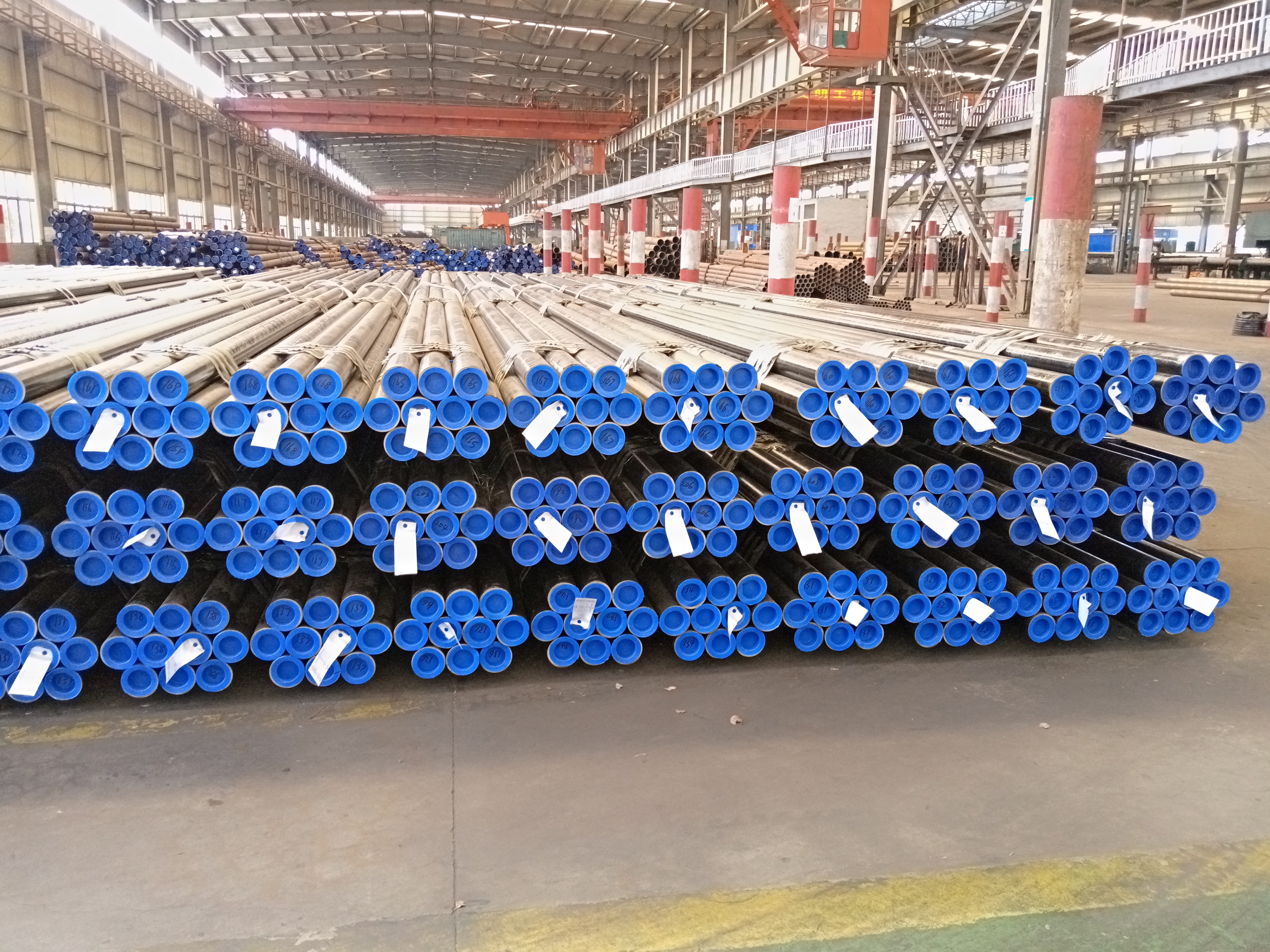 Seamless 13Cr pipe bundled with blue protective end caps in the ZC warehouse, staged for export.
A Middle East gas condensate well was completed with L80-13Cr tubing at 165°C wellhead flowing temperature, 7 bar CO₂ partial pressure, and 14,000 ppm chloride. L80-13Cr is typically qualified to approximately 150°C — 15°C below this service temperature. Within 8 months, severe pitting corrosion perforated two tubing joints in the upper completion. The pull-and-replace operation cost 2× the original tubing string value. The replacement specification was Super 13Cr-110, which remained in service for 3 years without measurable corrosion. The selection error was a 15°C temperature margin — a gap that exists in well design spreadsheets that use round-number temperature limits rather than the specific mill qualification envelope.
What Is Super 13Cr?
Super 13Cr — also called modified 13Cr, 13Cr-110, or Super 13Cr-110 depending on the mill — is a martensitic stainless steel tubular grade that builds on the 13% chromium base of L80 13Cr with significant additions of nickel and molybdenum. These alloying additions do two things simultaneously: they extend the corrosion resistance envelope to higher temperatures and chloride concentrations, and they raise the achievable yield strength from L80 13Cr's 80 ksi ceiling to 110 ksi or higher.
Super 13Cr is not a defined API 5CT grade. Each mill produces it to a proprietary specification — Vallourec's VM 13Cr-110, Tenaris's 13Cr-110, and similar designations from other producers all fall under the "Super 13Cr" category but may have different exact chemistries and qualified corrosion envelopes. This makes mill selection and corrosion qualification data more important for Super 13Cr than for standard API grades.
Typical Chemical Composition
| Element | L80 13Cr (API 5CT) | Super 13Cr (typical) |
|---|---|---|
| Chromium (Cr) | 12.0–14.0% | 12.0–14.0% |
| Nickel (Ni) | ≤ 0.50% | 4.0–6.0% |
| Molybdenum (Mo) | Not specified by API 5CT | 1.0–2.0% |
| Carbon (C) | ≤ 0.22% | ≤ 0.03% |
| Manganese (Mn) | ≤ 1.00% | ≤ 1.00% |
| Silicon (Si) | ≤ 1.00% | ≤ 0.50% |
The key chemistry differences — higher Ni and Mo, much lower C — are responsible for Super 13Cr's improved performance:
Nickel (4–6%) stabilises the austenite phase during heat treatment and improves toughness and corrosion resistance in chloride-containing environments. It also allows the very low carbon content without sacrificing hardenability.
Molybdenum (1–2%) significantly improves resistance to pitting and crevice corrosion in chloride environments, and extends the temperature range over which the passive chromium oxide film remains stable.
Very low carbon (≤ 0.03%) prevents chromium carbide precipitation at grain boundaries during welding and heat treatment — a critical improvement over L80 13Cr (≤ 0.22% C) that makes Super 13Cr far more resistant to sensitisation-induced intergranular corrosion.
Super 13Cr is not a single defined material — it is a category containing multiple proprietary mill grades that can differ significantly in nickel content (4% vs 6%), molybdenum content (1% vs 2%), and qualified temperature limits. Two products both labelled "Super 13Cr-110" from different mills can have corrosion envelopes that differ by 25°C or more at the same CO₂ partial pressure. The mill's proprietary corrosion qualification data — not a generic "Super 13Cr" specification — is the controlling document for material selection. Always request the specific mill's corrosion resistance envelope (temperature, CO₂ partial pressure, chloride concentration, pH) before confirming Super 13Cr for a specific well.
Mechanical Properties
| Property | L80 13Cr | Super 13Cr-95 | Super 13Cr-110 | Super 13Cr-125 |
|---|---|---|---|---|
| Min yield strength | 552 MPa (80 ksi) | 655 MPa (95 ksi) | 758 MPa (110 ksi) | 862 MPa (125 ksi) |
| Max yield strength | 655 MPa (95 ksi) | 758 MPa (110 ksi) | 965 MPa (140 ksi) | 1034 MPa (150 ksi) |
| Min tensile strength | 655 MPa (95 ksi) | 724 MPa (105 ksi) | 862 MPa (125 ksi) | 931 MPa (135 ksi) |
| Heat treatment | Q+T | Q+T | Q+T | Q+T |
| Hardness limit | 23 HRC | Mill-specific | Mill-specific | Mill-specific |
Super 13Cr-110 is by far the most common designation, providing 110 ksi yield strength that matches P110 while delivering significantly better CO₂ corrosion resistance. The 95 ksi variant is used when L80 13Cr lacks sufficient pressure containment but full 110 ksi yield is not required.
For the complete grade ladder with tensile, hardness, and chemistry limits, see the API 5CT specification tables → and the NACE MR0175 / ISO 15156 hardness limits.
To match a CRA grade to your H₂S partial pressure and temperature, use the Pipe Grade Selector →
CO₂ Corrosion Rate Comparison — L80-13Cr vs Super 13Cr at 165°C
Corrosion rates for martensitic 13Cr steels in CO₂ service depend strongly on temperature, partial pressure, and flow velocity. The following illustrates the temperature-boundary effect — it is qualitative, based on published industry data. Always use the mill's specific qualification data for design.
Step 1 — Establish service conditions: Temperature = 165°C, CO₂ partial pressure = 7 bar, Cl⁻ = 14,000 ppm
Step 2 — L80-13Cr performance at this temperature: L80-13Cr passive film is typically stable to ~150°C at moderate CO₂ partial pressure. Above 150°C, particularly above 5 bar CO₂, the passive film breaks down. Published data indicates localised corrosion rates in this regime can reach 2–8 mm/year, compared to <0.1 mm/year in the passive regime. At 165°C and 7 bar CO₂, L80-13Cr is well into the active corrosion zone.
Step 3 — Super 13Cr-110 performance at this temperature: Super 13Cr (4–6% Ni, 1–2% Mo) extends passive stability to approximately 175–200°C at moderate CO₂/Cl⁻ conditions. At 165°C and 7 bar CO₂ with 14,000 ppm Cl⁻, the grade is within the passive regime for most qualified mill products. Typical corrosion rate remains <0.1 mm/year.
Step 4 — Implication for 25-year design life:
- L80-13Cr at 8 mm/year × 25 years = 200 mm total corrosion — pipe perforates within months, not years
- Super 13Cr at 0.1 mm/year × 25 years = 2.5 mm total corrosion — well within wall thickness
Conclusion: The temperature boundary between L80-13Cr and Super 13Cr at 7 bar CO₂ is not a gradual performance shift — it is a cliff edge. A 15°C margin above the L80-13Cr limit converts a 25-year pipe into a 1-year pipe. Super 13Cr provides the temperature margin required for this service condition.
Corrosion Resistance Envelope
Super 13Cr's corrosion resistance advantage over L80 13Cr is real but bounded. Understanding those bounds is critical to correct material selection.
CO₂ partial pressure: Super 13Cr is effective at CO₂ partial pressures up to approximately 10 bar, depending on temperature and chloride content. At lower temperatures and lower chloride concentrations, the tolerable CO₂ partial pressure is higher.
Temperature: Super 13Cr extends the upper temperature limit from L80 13Cr's approximately 150°C to 175–200°C, depending on CO₂ partial pressure and chloride concentration. Above 200°C, localised pitting risk increases significantly.
Chloride concentration: Super 13Cr tolerates higher chloride concentrations than L80 13Cr, particularly at elevated temperature. The Ni and Mo additions stabilise the passive film against chloride attack.
pH: Both 13Cr grades perform poorly at very low pH (below approximately 3.5). In-situ pH in the wellbore, calculated from CO₂ partial pressure and water chemistry, should always be confirmed against the mill's qualified envelope.
Super 13Cr Corrosion Envelope vs L80 13Cr
| Condition | L80 13Cr | Super 13Cr-110 |
|---|---|---|
| Max operating temperature | ~150°C | ~175–200°C |
| CO₂ partial pressure limit | ~3–5 bar | ~7–10 bar |
| Chloride tolerance | Moderate | Good |
| H2S tolerance | Very low | Very low — slightly better |
| pH minimum | ~3.5 | ~3.5 |
| Elemental sulphur | Not suitable | Not suitable |
| Strong acids | Not suitable | Not suitable |
H2S Limitations
This is the most important constraint on Super 13Cr selection. Martensitic stainless steels — including both L80 13Cr and Super 13Cr — are susceptible to sulphide stress cracking in H2S environments. Super 13Cr's higher yield strength (110 ksi) makes it more susceptible to SSC than L80 13Cr (80 ksi).
NACE MR0175 / ISO 15156-3 permits Super 13Cr in H2S service only within specific environmental limits — typically very low H2S partial pressure (often below 0.003 bar) combined with temperature and pH conditions that fall within the qualified envelope for the specific alloy and heat treatment. Standard L80 13Cr is not NACE MR0175 qualified — it is a CO₂ corrosion resistance grade and should not be selected where H₂S is present at any partial pressure. (The sour-service L80 Type 1 grade is a different, carbon-steel product; see the API 5CT L80 sour-service grades, and for a higher-strength sour carbon-alloy option the T95 sour-service specification.)
For wells with meaningful H2S alongside CO₂:
| Condition | Recommended material |
|---|---|
| CO₂ dominant, H2S < 0.003 bar | Super 13Cr — verify mill envelope |
| CO₂ + moderate H2S | Duplex stainless steel (22Cr or 25Cr) |
| High H2S + high pressure + high temperature | 25Cr duplex or nickel alloys |
Do not specify Super 13Cr for wells where H2S partial pressure exceeds the mill's qualified limit. SSC failure in a production tubing string is a well integrity event with significant safety and commercial consequences. To match a grade to a specific H2S partial pressure, temperature, and chloride level, use the sour-service selector.
When NOT to Use Super 13Cr
| Scenario | Risk | Correct Approach |
|---|---|---|
| H2S partial pressure > 0.003 bar | SSC risk increases sharply with yield; Super 13Cr-110 at 758 MPa is more susceptible than L80-13Cr at 552 MPa | For wells with meaningful H2S, use duplex 2205 (22Cr) or 25Cr super duplex depending on H2S level |
| Operating temperature > 200°C | Above 200°C, Super 13Cr passive film destabilises; pitting risk increases rapidly | Evaluate 25Cr duplex or nickel-based alloys for wells above 200°C |
| Elemental sulfur service | Polythionic acid attack on martensitic stainless steel under shutdown condensation | Use duplex or nickel alloys; both L80-13Cr and Super 13Cr are not suitable for elemental sulfur |
| CO₂ partial pressure above mill's qualified limit | Corrosion occurs above the mill-specific qualified envelope | Confirm specific mill's CO₂/temperature/chloride envelope; upgrade to duplex if outside limits |
| In-situ pH below 3.5 | Both 13Cr grades lose passive film below pH 3.5; active corrosion occurs | Confirm in-situ pH from CO₂ partial pressure and water chemistry before specifying any 13Cr grade |
| API BTC connections at 110 ksi yield | BTC tensile efficiency inadequate for deep wells at 110 ksi; thread compound traps corrosive fluid | Specify premium metal-to-metal seal connections for all Super 13Cr applications |
Connection Types for Super 13Cr
Standard API connections — STC, LTC, BTC — are not appropriate for Super 13Cr tubing in most applications. The reasons are both mechanical and corrosion-related:
Mechanical: Super 13Cr at 110 ksi yield requires a connection rated to full body yield for deep wells. BTC's tensile efficiency is inadequate for 110 ksi strings at typical gas well depths.
Corrosion: The thread compound used in API connections can trap corrosive fluids at the thread interface. Premium metal-to-metal seal connections eliminate this risk and provide gas-tight integrity required for gas condensate production.
Premium connections are the standard specification for Super 13Cr tubing in all but the shallowest, lowest-pressure applications. ZC Steel Pipe supplies Super 13Cr with premium connections qualified for CRA service.
Standard Sizes
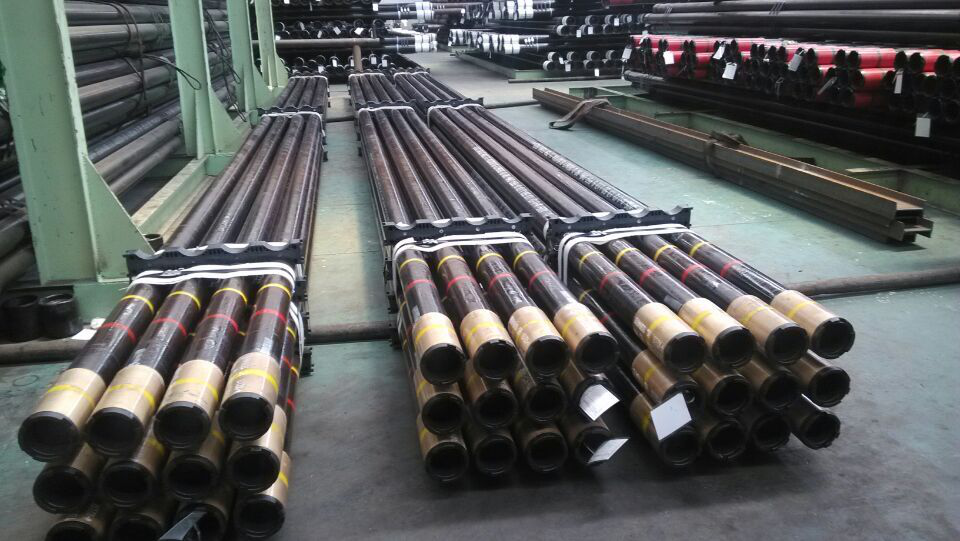 13Cr casing bundled on green storage racks with couplings and protectors fitted — staged for despatch on a ZC premium-casing order.
| OD (inches) | OD (mm) | Common Weights (lb/ft) | Typical Application |
|---|---|---|---|
| 2⅜ | 60.3 | 4.00–6.40 | Tubing — small-bore gas condensate wells |
| 2⅞ | 73.0 | 6.40–10.40 | Tubing — most common Super 13Cr size |
| 3½ | 88.9 | 7.70–12.95 | Tubing — high-rate gas condensate |
| 4 | 101.6 | 9.50–14.00 | Tubing — large-bore production |
| 4½ | 114.3 | 9.50–15.10 | Tubing / small production casing |
| 5 | 127.0 | 11.50–18.00 | Production casing |
| 7 | 177.8 | 17.00–29.00 | Intermediate casing (less common) |
How to Specify Super 13Cr on a Purchase Order
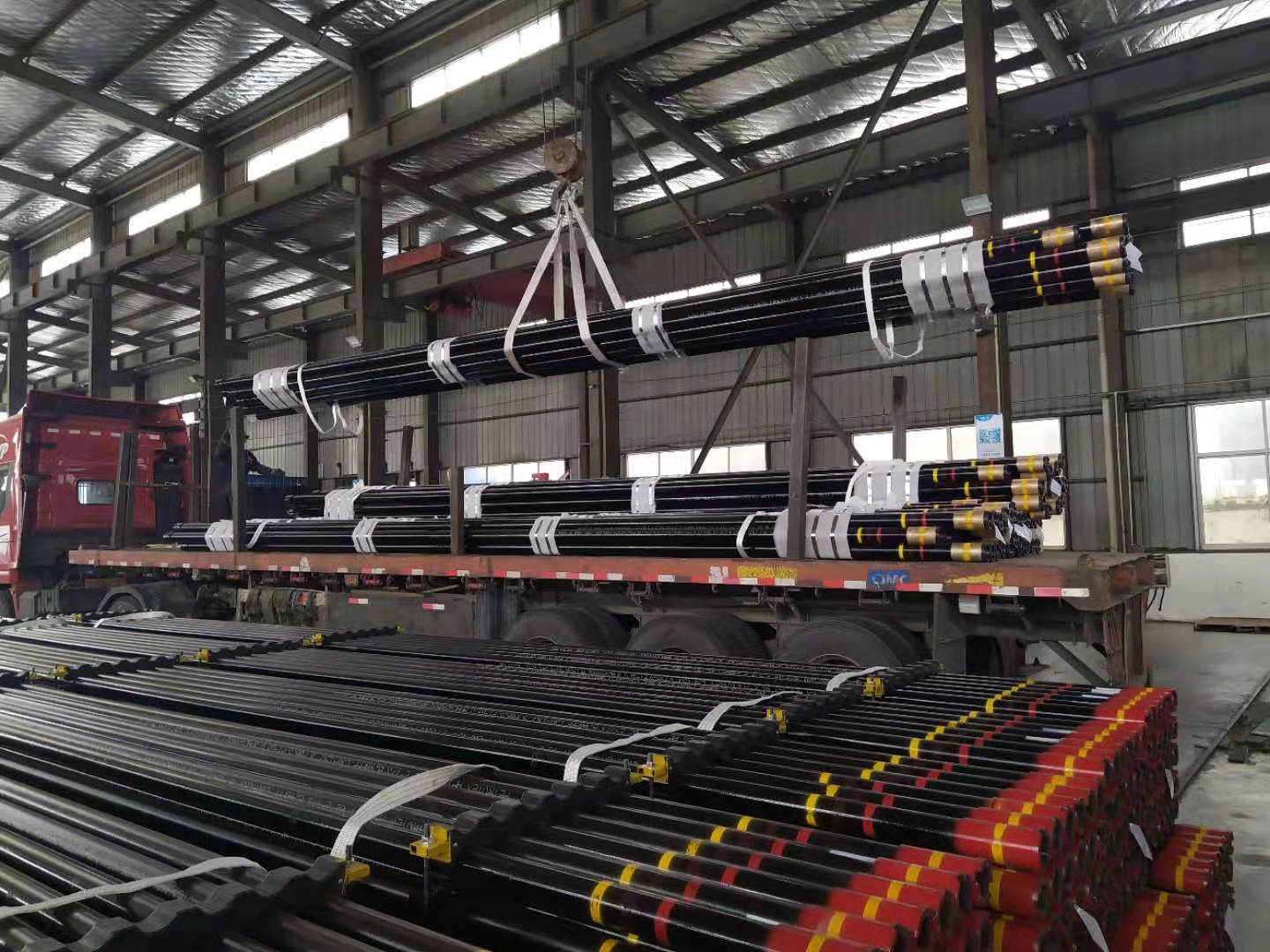 Overhead crane loading a 13Cr casing bundle onto a flatbed for despatch from a ZC premium-casing order.
- Grade designation — Super 13Cr, 13Cr-110, or mill-specific designation
- Minimum yield strength — 110 ksi (758 MPa) standard; specify 95 or 125 ksi if required
- OD and nominal weight
- Connection type — premium connection designation (mandatory for most applications)
- Range — typically R2 for tubing
- Corrosion qualification data required — temperature, CO₂ partial pressure, chloride concentration, pH for the specific well
- H2S partial pressure — confirm within mill's NACE MR0175 qualified envelope
- Charpy impact testing — temperature per project specification
- Quantity — in joints or metric tonnes
- MTC level — EN 10204 3.2 (third-party witnessed)
- Third-party inspection scope — mill visit, witness mechanical and corrosion testing
Procurement Trap
Procurement trap — corrosion qualification data not requested:
Wrong PO: "Super 13Cr-110 tubing, 2⅞ inch 6.40 lb/ft, premium connection, EN 10204 3.2, 120 joints."
What ships: Super 13Cr-110 from a mill whose qualified corrosion envelope extends only to 155°C and 5 bar CO₂. The well operating temperature is 168°C and CO₂ partial pressure is 7 bar — outside the mill's qualified range. The tube is mechanically correct, the MTC is valid, the premium connection is properly made up. The CO₂ corrosion failure occurs within 14 months because the material was used outside its qualified range.
Correct PO: "Super 13Cr-110 tubing, 2⅞ inch 6.40 lb/ft, premium connection [state designation], EN 10204 3.2, 120 joints. Mill to provide corrosion qualification data confirming suitability for: temperature 175°C, CO₂ partial pressure 8 bar, chloride 15,000 ppm, pH 3.8 minimum. Qualification data to accompany MTC. Material will be rejected if well conditions fall outside the mill's qualified envelope."
Failure Modes
Failure Mode 1 — L80-13Cr above temperature limit, Super 13Cr not specified
Mechanism: The well is designed with L80-13Cr tubing at 158°C flowing wellhead temperature. L80-13Cr's CO₂ corrosion resistance is generally effective up to approximately 150°C — the 8°C exceedance is considered marginal in the design review. The passive chromium oxide film becomes unstable above ~150°C in the presence of 6 bar CO₂ and 12,000 ppm chloride, leading to pitting corrosion in the upper completion joints within 6–10 months of production startup.
Diagnostic: Anomalous pressure loss followed by liquid recovery confirms tubing perforations. Pull-and-inspection finds pitting on the upper 4–6 joints. Temperature log confirms flowing temperature of 156–162°C at the wellhead. MTC review confirms L80-13Cr grade — within API 5CT specification but outside the grade's CO₂ corrosion resistance envelope at the actual service temperature.
Fix: For all wells where flowing temperature exceeds 145°C, evaluate Super 13Cr rather than L80-13Cr. The 5°C margin below the nominally accepted L80-13Cr temperature limit provides a conservative buffer for production variability. Re-specify the replacement string as Super 13Cr-110 with the mill's corrosion qualification envelope confirmed for the actual well conditions.
Failure Mode 2 — H2S exceeds Super 13Cr SSC limit
Mechanism: Super 13Cr-110 is specified for a CO₂-dominant well. Well test data shows H2S = 15 ppm in the gas phase at 280 bar total pressure. At this condition, H2S partial pressure = 15/10⁶ × 280 = 0.0042 bar — above the typical Super 13Cr NACE MR0175/ISO 15156 limit of 0.003 bar for this alloy class. During the first pressure buildup test, the high wellbore stress combined with H2S exposure initiates SSC in the heat-affected zone adjacent to a girth weld.
Diagnostic: Tubing failure at a weld-affected zone 200 m below the wellhead. Metallurgical examination shows intergranular cracking consistent with SSC. H2S partial pressure calculation from well test data confirms the NACE MR0175 limit was exceeded.
Fix: Before specifying Super 13Cr for any well, calculate H2S partial pressure from the worst-case gas analysis. If H2S partial pressure exceeds 0.003 bar, Super 13Cr should not be used. For wells with CO₂ + moderate H2S, duplex 2205 or 25Cr super duplex is the correct next step.
Failure Mode 3 — Wrong mill qualification applied
Mechanism: A project approves Super 13Cr-110 based on published corrosion data for Mill A's product (qualified to 175°C, 8 bar CO₂). The order is placed with Mill B (a different supplier offering lower pricing), whose product is also called "Super 13Cr-110" but is qualified only to 160°C and 6 bar CO₂. The well operates at 168°C and 7 bar CO₂ — within Mill A's envelope but outside Mill B's envelope. Corrosion failure occurs within 12 months.
Diagnostic: Pitting corrosion pattern consistent with a temperature-exceedance failure. MTC review confirms Mill B as supplier. Corrosion qualification data request to Mill B reveals the material was used outside their qualified envelope. The original material approval was based on Mill A's data.
Fix: For all Super 13Cr orders, require the selected mill (not a generic grade) to provide corrosion qualification data as part of the MTC package. Lock the mill selection in the purchase order and do not allow mill substitution without engineering re-approval of the replacement mill's corrosion qualification envelope for the specific well conditions.
References
- ISO 15156 / NACE MR0175 — Materials for Use in H2S-Containing Environments
- ISO 13680 — Petroleum and Natural Gas Industries: CRA Seamless Tubes for Use as Casing, Tubing and Coupling Stock
- EFC Publication 16 — Guidelines on Materials Requirements for Carbon and Low Alloy Steels for H2S-Containing Environments in Oil and Gas Production
Frequently Asked Questions
What is Super 13Cr tubing?
Super 13Cr (also called modified 13Cr or 13Cr-110) is a martensitic stainless steel tubing grade developed for oil and gas wells with high CO₂ partial pressure and moderate temperatures where standard L80 13Cr reaches its corrosion resistance limits. It contains approximately 13% chromium with additions of nickel (4–6%) and molybdenum (1–2%) that significantly extend corrosion resistance compared to L80 13Cr, particularly at temperatures above 150°C and in the presence of chlorides. Super 13Cr is not an API 5CT grade — it is supplied to proprietary mill specifications or project-specific material requirements.
What is the difference between Super 13Cr and L80 13Cr?
L80 13Cr is an API 5CT grade containing approximately 13% chromium with minimal alloying additions beyond what standard L80 requires. Its CO₂ corrosion resistance is effective up to approximately 150°C and moderate chloride concentrations. Super 13Cr adds nickel (4–6%) and molybdenum (1–2%) to the base 13Cr chemistry, significantly improving corrosion resistance at higher temperatures (up to 175–200°C), higher chloride concentrations, and moderate CO₂ partial pressures. Super 13Cr also has higher yield strength — typically 110 ksi minimum versus L80 13Cr's 80 ksi — making it suitable for deeper wells.
What CO₂ partial pressure can Super 13Cr handle?
Super 13Cr is effective at CO₂ partial pressures up to approximately 10 bar (145 psi) depending on temperature and chloride concentration. At lower temperatures (below 100°C), it can tolerate higher CO₂ partial pressures. As temperature increases toward 175–200°C, the tolerable CO₂ partial pressure decreases and the risk of localised pitting corrosion increases. The specific corrosion resistance envelope depends on the mill's proprietary chemistry — always request the mill's corrosion qualification data for the specific well conditions (temperature, CO₂ partial pressure, chloride content, pH) before specifying Super 13Cr.
Can Super 13Cr be used in H2S sour service?
Super 13Cr has limited H2S tolerance. Martensitic stainless steels are susceptible to sulphide stress cracking (SSC) in H2S environments, and Super 13Cr's higher yield strength (110 ksi) makes it more susceptible than L80 13Cr (80 ksi). NACE MR0175 / ISO 15156-3 permits Super 13Cr in H2S service only under specific conditions — typically very low H2S partial pressure (below 0.003 bar in some specifications) and temperature-dependent limits. For wells with significant H2S alongside CO₂, duplex stainless steel or CRA alloys are generally required rather than Super 13Cr.
What yield strength does Super 13Cr tubing have?
Super 13Cr tubing is typically produced to 110 ksi (758 MPa) minimum yield strength — significantly higher than L80 13Cr's 80 ksi (552 MPa). Some mills also offer Super 13Cr at 95 ksi or 125 ksi yield depending on the specific product designation. The higher yield makes Super 13Cr suitable for deeper wells where L80 13Cr's 80 ksi is insufficient for the axial and collapse load requirements, while simultaneously providing better corrosion resistance than standard P110 or T95 in CO₂ environments.
What sizes are available for Super 13Cr tubing?
Super 13Cr tubing is most commonly supplied in 2⅜ inch to 4½ inch OD — the standard production tubing size range. Casing in Super 13Cr is less common but available in 5 inch to 7 inch OD from specialist mills. Wall thickness and weight per foot follow API 5CT dimensional standards even though the grade itself is not an API 5CT designation. Most Super 13Cr orders are for tubing strings in CO₂-producing gas condensate wells. Contact ZC Steel Pipe to confirm specific OD and weight availability.
How do I specify Super 13Cr on a purchase order?
Super 13Cr is not an API 5CT grade, so the purchase order must reference the mill's proprietary specification or the project material requirement document. Key items to specify: grade designation (Super 13Cr, modified 13Cr, or 13Cr-110 depending on the mill); minimum yield strength (typically 110 ksi); OD and nominal weight; connection type (premium connections are standard for Super 13Cr); corrosion qualification data required for the specific well conditions; Charpy impact testing temperature; MTC level (EN 10204 3.2 typical for CRA grades); and third-party inspection scope.