API 5CT T95 is a quench-and-tempered casing and tubing grade with a minimum yield of 655 MPa (95,000 psi), a maximum of 758 MPa (110,000 psi), a minimum tensile of 724 MPa (105,000 psi), and a maximum mean hardness of 25.4 HRC / 255 HBW — all from API 5CT, 11th Edition, Table C.5. It has no types. Clause 1.3 assigns types to L80 and N80 only, and the Type column against T95 in Table C.4 and Table C.5 is blank.
That single fact is where most T95 specification errors start. Purchase orders arrive asking for "T95 Type 2", usually copied from a vendor datasheet, and there is nothing in the 11th Edition for a mill to build against. The second pattern is treating the 25.4 HRC figure as though it were a per-reading ceiling. It is not: footnote c to Table C.5 makes it a maximum mean, and 6.7.1 a) 2) carries a separate single-indentation reject at 27.0 HRC plus a retest band in between. Read the wrong way, the number tells you something the standard never said.
ZC Steel Pipe supplies API 5CT T95 casing and tubing in 4½ through 10¾ inch sizes, seamless, with BTC and premium connections, to operators and EPC contractors working sour and mixed-service wells across Africa, South America, and Southeast Asia. Every T95 length carries the serial number that 5.4.2 makes mandatory for C90, T95, C110 and Q125, and we report hardness means against those serial numbers as a matter of course.
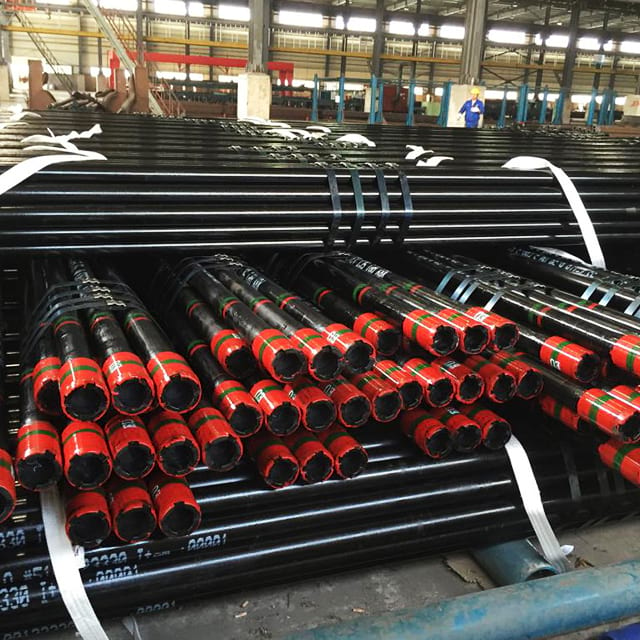
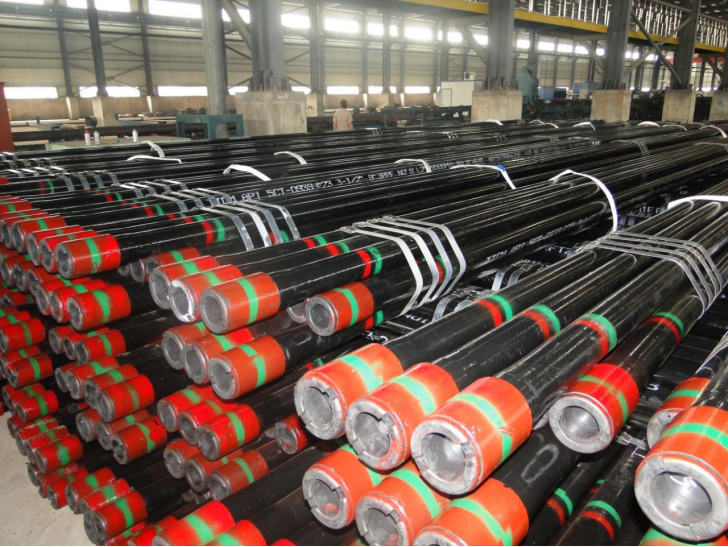 Bundled casing with colour-coded thread protectors and API stencil, from a ZC premium sour-service supply to a South American operator.
What we see on T95 sour service orders: A recurring line on inbound enquiries is "API 5CT T95 Type 2". There is no such product. We go back to the buyer with clause 1.3 and ask what the project specification actually requires, and the answer is nearly always a hardness limit tighter than API 5CT's 25.4 HRC that someone in the chain relabelled as a "type". That is a solvable conversation — it becomes a supplementary requirement and a stated number on the PO. What is not solvable is a mill quietly interpreting "Type 2" for you and certifying to plain T95, which is exactly what it is entitled to do, because plain T95 is what the standard contains.
Quick Answer — T95 Specs and the Type Trap
T95 is the 95 ksi grade that sits between L80 → (552 MPa / 80 ksi minimum) and P110 → (758 MPa / 110 ksi minimum). It is quench-and-tempered, with mandatory Cr-Mo chemistry and P/S limits well inside those of N80 and P110.
| T95 requirement | API 5CT 11th Edition value | Clause / table |
|---|---|---|
| Minimum yield | 655 MPa (95,000 psi) | Table C.5 |
| Maximum yield | 758 MPa (110,000 psi) | Table C.5 |
| Minimum tensile | 724 MPa (105,000 psi) | Table C.5 |
| Maximum mean hardness | 25.4 HRC / 255 HBW | Table C.5, footnote c |
| Single-indentation reject | above 27.0 HRC | 6.7.1 a) 2) |
| Retest band (mean) | 25.4 to 27.0 HRC | 6.7.1 a) 2), 9.6.14 |
| Type designation | none — T95 has no types | 1.3 |
| SSC test | mandatory, one specimen per lot (Method A) | 6.14, 9.10.2 a) 1) |
- The trap: "T95 Type 2" is not a product. The types belong to L80 and N80. A PO carrying that line cannot be filled against the 11th Edition.
- The fix: order plain T95, and express any tighter hardness requirement as a stated number owned by the project specification, alongside A.18 (SR 46) and A.19 (SR 47) if you want the SSC and hardness sampling raised above the API default.
- When T95: when 655 MPa minimum yield is needed at a grade that carries a hardness ceiling and a mandatory SSC test. Where neither is required, P110 gives more strength. Where the project specification calls for a severe-sour grade at P110 strength, C110.
What Is API 5CT T95?
T95 is defined in API Specification 5CT, 11th Edition as a casing and tubing grade with a minimum yield strength of 655 MPa (95,000 psi) and a maximum yield of 758 MPa (110,000 psi). It sits between L80 and P110 in the grade ladder — above L80's 655 MPa (95 ksi) yield ceiling, at P110's 758 MPa (110 ksi) floor — and it is one of the three grades, with C90 and C110, that API 5CT singles out for a mandatory sulfide stress cracking test.
Three characteristics define T95's position. First, the bridging yield band: 655 to 758 MPa, narrow by design, where L80 tops out at 655 MPa and P110 starts at 758 MPa. Second, mandatory quench and temper heat treatment — API 5CT permits no other route for T95, so non-Q+T pipe cannot carry the grade. The Q+T microstructure is what delivers high yield alongside a controlled hardness ceiling. Third, T95 carries explicit chemistry restrictions that N80 and P110 do not. Table C.4 sets molybdenum at 0.25–0.85 %, chromium at 0.40–1.50 %, carbon at 0.35 % maximum, manganese at 1.20 % maximum, nickel at 0.99 % maximum, and phosphorus and sulphur at 0.020 % and 0.010 % — against 0.030 % each for N80 and P110. The Cr-Mo combination provides the hardenability the Q+T route needs without leaning on manganese alone.
T95 has no types. API 5CT 11th Edition clause 1.3 lists the applicable grades and states: "when the symbol L80 is used alone, it is applicable to Grades L80 Type 1, L80 3Cr, L80 9Cr, and L80 13Cr; when the symbol N80 is used alone, it is applicable to Grades N80 Type 1 and N80Q." No equivalent sentence exists for T95, and the Type column against T95 is blank in both Table C.4 and Table C.5. The one surviving "T95 Type 1" in the standard is footnote d to Table C.4 — "The molybdenum content for T95 Type 1 may be decreased to 0.15 % minimum if the wall thickness is less than 17.78 mm" — a vestige of an earlier edition, not a type system. Order plain T95.
Mechanical Properties
| Property | T95 | Source |
|---|---|---|
| Minimum yield strength | 655 MPa (95,000 psi) | Table C.5 |
| Maximum yield strength | 758 MPa (110,000 psi) | Table C.5 |
| Minimum tensile strength | 724 MPa (105,000 psi) | Table C.5 |
| Maximum mean hardness | 25.4 HRC / 255 HBW | Table C.5 + footnote c |
| Single-indentation reject | above 27.0 HRC | 6.7.1 a) 2) |
| Allowable hardness variation | 3.0 HRC at wall ≤ 12.70 mm (0.500 in.), 4.0 HRC at 12.71–19.04 mm, 5.0 HRC at 19.05–25.39 mm, 6.0 HRC at ≥ 25.40 mm | Table C.5 col. 10, 6.8 |
| Total elongation under load | 0.5 % | Table C.5 |
| Heat treatment | quench and temper only, minimum tempering temperature 649 °C (1200 °F) | Table C.3 |
| Type designation | none | 1.3 |
Read the yield band both ways. A heat above 758 MPa (110 ksi) is non-conforming to T95, and so is a heat below 655 MPa (95 ksi); verify both on the certificate, not just the minimum. The hardness row is the one most often misread — 25.4 HRC is the maximum mean, and 6.8 additionally caps the spread between any two mean hardness numbers within one quadrant, so a joint sitting comfortably under the ceiling can still be rejected for variation.
For the complete grade ladder with tensile, hardness, and chemistry limits, see the API 5CT specification tables →
To match a grade to your well conditions, use the Pipe Grade Selector →
The maximum yield limit of 758 MPa (110 ksi) for T95 is as important as the minimum, and it is exactly P110's floor. That coincidence invites a bad reflex: an over-strength T95 heat gets offered as a P110 substitution. It is not one. P110 carries no hardness limit in Table C.5, no chemistry restriction beyond 0.030 % P and S, and no SSC test anywhere in API 5CT — the three things a T95 line item was almost certainly bought for. A heat that missed T95 on the high side is scrap for that order, not an upgrade.
What the T95 Hardness Limit Does and Does Not Decide
API 5CT sets the hardness numbers a mill must verify. It does not decide whether the pipe suits your well, and it says so. The NOTE to 6.14.1 reads: "The SSC test is for quality control purposes only and does not qualify the material for any specific sour service application; it is the product user's responsibility to ensure that the product is suitable for the intended application." The same clause directs the purchaser to NACE MR0175 / ISO 15156-1 and ISO 15156-2 for guidance on the usage of C90, T95 and C110. Those are two different questions answered by two different documents, and the common procurement failure is printing a number from the second one as if it were the acceptance criterion of the first.
What API 5CT does specify for T95 is precise, layered, and routinely flattened into a single figure on certificates:
| Reading | API 5CT disposition | Clause |
|---|---|---|
| Mean hardness ≤ 25.4 HRC | Acceptable | 6.7.1 a) 2) |
| Mean hardness 25.4–27.0 HRC | Retest — three more indentations in the immediate area, new mean must not exceed 25.4 HRC | 6.7.1 a) 2), 9.6.14 |
| Any single indentation > 27.0 HRC | Length or piece rejected | 6.7.1 a) 2) |
| Spread between two means in one quadrant above the Table C.5 allowance | Non-conforming | 6.8 |
Three things follow from that table that a flat "25.4 HRC max" does not tell you. A joint can be accepted with individual indentations above 25.4 HRC, provided the mean holds. A joint can be rejected outright on one indentation without any mean being computed. And a joint inside the ceiling on every reading can still fail on variation. When a certificate prints one hardness figure per length with no label, you cannot tell which of those criteria was applied to it — ask whether the figure is a mean, and how many indentations it represents.
There is also an agreement route most buyers never use. Clause 6.7.1 c) allows, for C90 and T95, the maximum mean hardness numbers to be altered from those stated "by agreement between the purchaser and the manufacturer, based on sulfide stress corrosion cracking tests specified in 6.14." If your project specification imposes a hardness limit different from API 5CT's, that is the clause under which it is placed on the order — as a stated project number tied to SSC testing, not as the word "NACE" appended to the grade.
Do not write "NACE MR0175 compliant" on a T95 line item and leave it there. It names a document without naming a requirement, and it invites the mill to certify to API 5CT — which it was going to do anyway. Write the number your project specification actually requires, attribute it to the project specification, and place it under 6.7.1 c) with the SSC testing that clause references. A limit the mill can read is a limit the mill can hold.
Chemical Composition
API 5CT specifies the following chemistry limits for T95. The Cr-Mo alloying is explicit and mandatory — this is not an optional mill practice. It is what distinguishes T95 from N80Q and P110 at the microstructural level.
| Element | API 5CT Limit | Notes |
|---|---|---|
| Carbon (C) | Max 0.35% | Controls hardenability and weldability |
| Manganese (Mn) | Max 1.20% | API 5CT sets no minimum for Mn on T95 |
| Molybdenum (Mo) | 0.25–0.85% min/max | Mandatory range; footnote d to Table C.4 allows the minimum to drop to 0.15% when wall thickness is under 17.78 mm (0.700 in.) |
| Chromium (Cr) | 0.40–1.50% min/max | Mandatory range — Cr-Mo combination drives hardenability |
| Phosphorus (P) | Max 0.020% | Significantly tighter than N80 and P110 (0.030%); sour service fracture toughness driver |
| Sulphur (S) | Max 0.010% | Significantly tighter than N80 and P110 (0.030%); low S reduces sulphide inclusion density |
| Niobium (Nb) | Not restricted | API 5CT does not restrict Nb for T95 |
| Nickel (Ni) | Max 0.99% | One of only four grades — C90, T95, C110, plus 0.50% on L80 9Cr/13Cr — where Ni is capped |
| Copper (Cu) | Not restricted | API 5CT does not restrict Cu for T95 |
| Silicon (Si) | Not restricted | The Cr-Mo alloying strategy provides adequate hardenability without Si control |
The S limit of 0.010% deserves emphasis. Compared to N80's 0.030% maximum and P110's 0.030% maximum, T95's S limit is three times tighter. This directly reflects the sour service design of the grade: low sulphur content reduces sulphide inclusion density in the steel matrix, and sulphide inclusions are preferential hydrogen-induced cracking initiation sites in H2S environments. The tight P limit serves a similar function — phosphorus segregation at grain boundaries reduces toughness and increases susceptibility to SSC.
Silicon and copper are not restricted in the API 5CT chemistry table for T95 — both columns are blank in Table C.4, which means the standard imposes no limit, not that the elements are absent or irrelevant. Nickel is restricted, at 0.99 % maximum, and that cap is shared only with C90 and C110. Many project specifications add a silicon maximum on top of API requirements; if one applies, verify it against the operator's technical addendum and carry it on the PO as a project requirement with its own number.
Standard Sizes
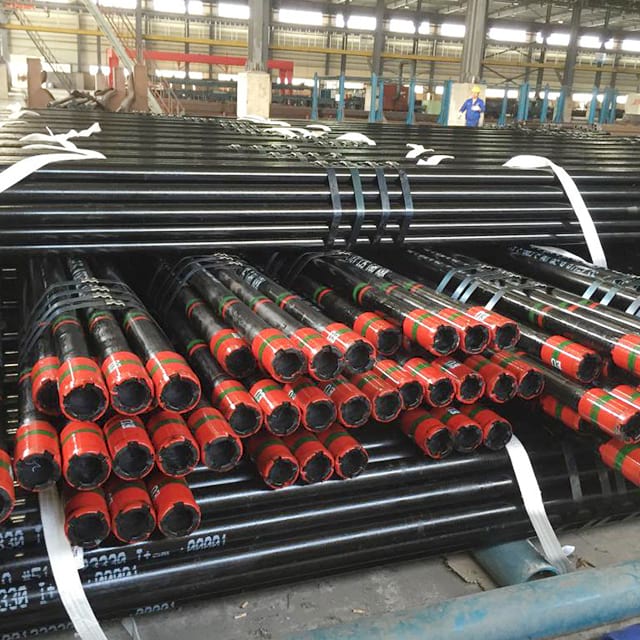 Pin ends banded red and green with thread protectors in place — end protection ZC fits to every casing joint before shipment.
T95 is produced in casing sizes from 4½" through 10¾" in common practice, with the 5½" and 7" OD ranges accounting for most of what we ship. The grade is less commonly specified in tubing sizes than L80 or N80Q.
| OD (inches) | OD (mm) | Common Weights (lb/ft) | Typical Application |
|---|---|---|---|
| 4½ | 114.3 | 9.50–13.50 | Small production casing, deep sour |
| 5 | 127.0 | 11.50–18.00 | Production casing, deep sour wells |
| 5½ | 139.7 | 14.00–23.00 | Production casing — most common T95 size |
| 7 | 177.8 | 17.00–38.00 | Intermediate and production casing |
| 7⅝ | 193.7 | 24.00–39.00 | Intermediate casing, deep sour wells |
| 9⅝ | 244.5 | 32.30–53.50 | Intermediate casing |
| 10¾ | 273.1 | 32.75–55.50 | Surface and intermediate casing |
T95 availability becomes progressively more limited at larger ODs. Above 9⅝", confirm with the mill that the size is within its T95 range before finalising the casing programme — the grade is frequently made to order rather than held at the larger ODs. For wall, ID, and drift at each weight above, see the casing sizes and weight tables →.
Product form: T95 is supplied primarily as casing. Sour-service T95 tubing in 2⅜ through 3½ inch sizes is produced for H₂S production strings but is less commonly stocked than L80 or N80Q tubing — confirm size and lead time with the mill, and see the API 5CT tubing sizes and weights guide → for the dimensional ladder.
Worked Burst Comparison — T95 vs L80
The API 5C3 burst formula (Barlow approximation with 0.875 correction factor) is:
P = 0.875 × (2 × Yp × t / D)
For a 5½" 23 lb/ft string — wall thickness 0.415 inches, OD 5.500 inches — the comparison between T95 and L80-1 at their respective minimum yield strengths is direct:
T95 (Yp = 95,000 psi): P = 0.875 × (2 × 95,000 × 0.415 / 5.500) = 0.875 × 14,345 = 12,550 psi
L80-1 (Yp = 80,000 psi): P = 0.875 × (2 × 80,000 × 0.415 / 5.500) = 0.875 × 12,073 = 10,560 psi
T95 provides approximately 19% more burst resistance than L80-1 at the same size and wall. At identical geometry, this 1,990 psi additional burst capacity is the reason T95 is specified when L80 cannot contain the wellbore pressure in a sour environment. For a sour gas well with a surface shut-in pressure of 11,500 psi, L80-1 cannot meet the design factor; T95 can.
If T95's 19 % burst advantage over L80 is still insufficient for the design case, C110 is the next grade in the same family: 758 MPa (110,000 psi) minimum yield, 828 MPa (120,000 psi) maximum, 29.0 HRC maximum mean hardness, and the tightest sulphur limit in API 5CT at 0.005 %. It carries the same mandatory SSC test under 6.14, and 6.14.1 flags it specifically — the purchaser is told to give "particular attention" to C110 usage because "this material is not suitable for all sour (hydrogen sulfide-containing) service applications." Alternatively the well design can be reframed: heavier wall at the same OD, a larger casing programme, or a string combination that keeps T95 in the sections where the pressure envelope suits it. Use the Barlow pressure calculator → to confirm burst capacity across your full size and weight range.
T95 vs L80 vs P110 — Grade Selection
| Property | L80 Type 1 | T95 | P110 |
|---|---|---|---|
| Min yield strength | 552 MPa (80 ksi) | 655 MPa (95 ksi) | 758 MPa (110 ksi) |
| Max yield strength | 655 MPa (95 ksi) | 758 MPa (110 ksi) | 965 MPa (140 ksi) |
| Min tensile strength | 655 MPa (95 ksi) | 724 MPa (105 ksi) | 862 MPa (125 ksi) |
| Max mean hardness (Table C.5) | 23.0 HRC / 241 HBW | 25.4 HRC / 255 HBW | none specified |
| Single-indentation reject | above 24.0 HRC | above 27.0 HRC | not applicable |
| Hardness test frequency | 2 tests per lot (9.6.3, Table C.35) | one per length (9.6.4 a) | none required |
| Mandatory SSC test in API 5CT | no | yes — 6.14, 9.10 | no |
| Serialisation of each length | only if specified (5.4.1) | mandatory (5.4.2) | only if specified (5.4.1) |
| Chemistry restrictions | C ≤ 0.43%, Mn ≤ 1.90%, Cr ≤ 1.50%, P ≤ 0.030%, S ≤ 0.030% | C ≤ 0.35%, Mn ≤ 1.20%, Mo 0.25–0.85%, Cr 0.40–1.50%, Ni ≤ 0.99%, P ≤ 0.020%, S ≤ 0.010% | P ≤ 0.030%, S ≤ 0.030% only |
| Relative burst capacity | Baseline | +19% vs L80 | +38% vs L80 |
The rows that decide the order are the last four, not the first. On mechanical properties alone P110 wins everything, which is why grade selection made from a yield table lands on P110 and stays there. What separates T95 is the documentation and verification regime the standard attaches to it: a hardness ceiling with a defined retest and reject structure, a hardness test on every single length rather than two per lot, mandatory SSC testing per lot, and a serial number on every joint under 5.4.2 so that test data can be traced back to individual lengths. Those are the things a sour-service project specification is usually reaching for.
Choose L80 Type 1 when 552 MPa (80 ksi) contains the pressure with an acceptable design factor and the project specification does not require per-length hardness or SSC testing. Note that L80 hardness is verified on a lot basis — two tests per lot of up to 100 or 200 lengths under Table C.35 — so a per-joint record has to be agreed under 9.6.1 before manufacture, not requested afterwards.
Choose T95 when 655 MPa (95 ksi) is needed and the project specification calls for the hardness ceiling, the SSC test and the serialised traceability that API 5CT attaches to the C90/T95/C110 family.
Choose P110 when pressure containment governs and neither the hardness ceiling nor the SSC test is a project requirement. P110 has no hardness limit in Table C.5 and no SSC test in API 5CT — that is a description of what the standard requires of the mill, not a verdict on any particular well, which is the project specification's call under ISO 15156-2.
When Not to Use T95
T95 has a specific design envelope. Outside that envelope it is the wrong grade — either insufficient for the service or unnecessarily expensive.
When no project requirement attaches to the hardness ceiling or the SSC test — T95's Cr-Mo chemistry, 0.010 % sulphur limit, per-length hardness testing and per-lot SSC testing all cost something at the mill. If the well environment does not drive any of them, P110 delivers 758 MPa (110 ksi) minimum yield against T95's 655 MPa and better collapse performance at equivalent wall. Buying T95 for a requirement nobody wrote down is paying for verification you will never look at.
When the project specification designates a severe-sour classification — API 5CT does not draw the boundary between service severities; ISO 15156-2 and the project specification do. Where the project places the well beyond what T95 is permitted for, C110 is the next grade in the family at 758 MPa (110 ksi) minimum yield, 29.0 HRC maximum mean hardness and 0.005 % maximum sulphur. Take the classification from the project's own sour service definition, not from a grade datasheet.
When the project needs a hardness limit tighter than 25.4 HRC and the mill will not commit to it — this is a real constraint, not a paperwork one. A tighter ceiling narrows the tempering window against the 655 MPa minimum yield the grade must still meet. Settle it under 6.7.1 c) before manufacture, with the number stated and SSC testing per 6.14 attached, and ask for the mill's hardness mean distribution on recent T95 heats. If the mill cannot produce that data, treat the commitment as unsupported.
When the PO says "T95 Type 2" — nothing can be shipped against that line as written. It is not a supply problem to be worked around; it is a drafting error to be corrected before the order is placed, because the mill's compliant response is to build plain T95 and certify plain T95.
When larger OD is needed than the mill runs — T95 availability thins with increasing OD, and above 9⅝″ the grade is frequently made to order rather than held. Confirm the size is within the mill's T95 range before the casing programme is fixed around it.
There Is No PSL in API 5CT — What Buyers Are Reaching For Instead
Product Specification Levels are an API 5L construct. API 5CT, 11th Edition has no PSL concept at all; the phrase does not appear anywhere in the document, and every "PSL" string in it is an end-finish code inside the dimension tables. "T95 PSL-2" on a purchase order is therefore unfillable in the same way "T95 Type 2" is — and usually it is reaching for NDE, toughness and traceability, all three of which API 5CT already provides by other names.
| What "PSL-2" is usually meant to buy | What API 5CT actually gives you for T95 |
|---|---|
| Full-body NDE | Already mandatory. Table C.37 requires, for C90/T95/C110 pipe, ultrasonic inspection of the outside and inside surface, plus at least one further method on the outside surface in addition to UT. 9.15.1 requires it full-body, full-length. Acceptance level L2 per Table C.38, including oblique orientations |
| Tighter acceptance than standard grades | Built in. T95 sits at L2 with oblique inspection, where N80Q, L80 and R95 sit at L4 and N80 Type 1 at L3 |
| Mandatory Charpy testing | Not automatic. Under 6.5.5 the manufacturer may qualify by documented procedure in lieu of testing. Specify A.9 (SR 16) and testing per 9.7 becomes mandatory |
| Per-joint traceability | Already mandatory. 5.4.2 requires each length of T95 to be uniquely numbered so that test data can be related to individual lengths, and the same applies to coupling stock, coupling blanks, pup joints and accessory material |
| Wall thickness recorded per pipe | Specify A.21 (SR 49) — full-body measurement with minimum recorded wall per pipe |
| Extra hardness sampling | Specify A.19 (SR 47) — a test ring from both ends of each pipe, against the single end required by 9.6.4 a) |
| Harder SSC acceptance | Specify A.18 (SR 46) — three specimens per lot from the front, middle and back thirds at 90 % of minimum yield, against one specimen at 80 % under 9.10.2 a) 1) |
Note what is not on that list: A.3 (SR 2), the supplementary NDE requirement, does not apply to T95 at all — its grade list is H40, J55, K55, N80, L80, R95 and P110, because T95 already receives the heavier inspection regime as standard. Asking for "SR 2 on T95" is asking to be downgraded.
Connection Types for T95
 Casing bundles in the ZC warehouse with thread protectors on every end — connections kept clean and undamaged through storage and handling.
| Connection | Suitability | Notes |
|---|---|---|
| STC | Not recommended | Low tensile efficiency — undersized for T95 string loads |
| LTC | Limited | Acceptable only for light, shallow applications |
| BTC | Standard | The working connection for most T95 casing strings |
| Premium (metal-to-metal seal) | Where gas-tightness or high combined load governs | Deep, directional and gas completions |
BTC is the working connection for T95 in the majority of strings. Where the design adds high axial load, bending through directional sections, thermal cycling, or a gas-tight sealing requirement, a premium connection with a metal-to-metal seal is the route. BTC's thread-compound seal is not intended for sustained gas pressure in deep gas completions. Note that coupling material for T95 is covered by the same hardness and SSC provisions as the pipe — 9.6.6 governs coupling blank and coupling stock hardness frequency, and Table C.37 puts C90/T95/C110 coupling stock at acceptance level L2 external with L3 internal under Table C.38 — so coupling hardness and SSC records belong on the certificate alongside the body data.
What to Check on a T95 MTR
| MTR Item | What to Verify | Why It Matters |
|---|---|---|
| Grade designation | "T95" with no type suffix | T95 has no types under 1.3 — a certificate reading "T95 Type 2" is describing something the standard does not contain |
| Yield strength | 655–758 MPa (95–110 ksi) — both limits | Above 758 MPa is non-conforming to T95, not an upgrade to P110 |
| Tensile strength | Min 724 MPa (105 ksi) | Table C.5 minimum |
| Hardness — what the figure is | Whether the printed value is a mean and how many indentations it represents | 25.4 HRC is a maximum mean under Table C.5 footnote c; the single-indentation reject is 27.0 HRC under 6.7.1 a) 2) |
| Hardness variation | Spread between means within a quadrant against Table C.5 column 10 | 6.8 rejects on variation independently of the ceiling — 3.0 HRC at wall ≤ 12.70 mm up to 6.0 HRC at ≥ 25.40 mm |
| Heat treatment | Q+T with tempering temperature recorded, minimum 649 °C (1200 °F) | T95 cannot be produced by normalising or N+T |
| Serial number per length | Present and matched to the test data | 5.4.2 makes this mandatory for T95 — its absence is a genuine non-conformance, not a formatting gap |
| SSC test record | Method, number of specimens, applied stress as a percentage of minimum yield | Default is one Method A specimen per lot at 80 % of minimum yield (524 MPa / 76,000 psi for T95); A.18 (SR 46) raises it to three at 90 % (590 MPa / 85,500 psi) |
| Sulphur | ≤ 0.010% | Table C.4 — one third of the 0.030% allowed for N80 and P110 |
| Phosphorus | ≤ 0.020% | Table C.4 — verify it is not certified at 0.030% |
| Cr, Mo and Ni | Cr 0.40–1.50%, Mo 0.25–0.85%, Ni ≤ 0.99% | Absent Cr-Mo means the steel was not made to T95 chemistry; Mo below 0.25% is only permissible under footnote d at wall under 17.78 mm |
| NDE records | UT of outside and inside surface plus a second method on the outside, full-body full-length, acceptance level L2 | Mandatory for T95 under Table C.37 and Table C.38 — not a supplementary extra |
Procurement Trap — Type Designation
This is the most common error on T95 purchase orders and the one with the most consequential downstream cost.
Wrong PO language: "API 5CT T95 Type 2, PSL-2, NACE MR0175 compliant, 5½ in × 17 lb/ft, BTC"
What the mill compliantly ships: Plain T95 to API 5CT, 11th Edition. There is no Type 2 to build and no PSL to select, so both terms are discarded. "NACE MR0175 compliant" names a document without naming a requirement, so it changes nothing at the mill. The SSC test runs at the 9.10.2 a) 1) default — one Method A specimen per lot at 80 % of minimum yield. Hardness runs at the 9.6.4 a) default — one through-wall test in one quadrant from one end of each length, with acceptance at a 25.4 HRC mean. The certificate is entirely correct and the order has bought none of the three things the buyer thought those words purchased.
What to write instead: "API 5CT, 11th Edition, Grade T95 (no type designation applies), 5½ in × 17.00 lb/ft, BTC, R3. Supplementary requirements: A.18 (SR 46) SSC test — three specimens per lot, front/middle/back thirds, 90 % Ysmin; A.19 (SR 47) hardness test ring from both ends of each pipe; A.9 (SR 16) Charpy V-notch testing per 9.7 mandatory. Individual mean hardness values to be reported against the 5.4.2 serial number of each length, stating the number of indentations per mean. Project hardness limit [state value] HRC maximum mean per [project spec reference], agreed under 6.7.1 c). EN 10204 3.2."
The cost of getting this right at the PO stage is one paragraph. The cost of getting it wrong is a shipment that is fully compliant with what you wrote and useless for what you needed — and no commercial route to reject it.
How to Specify T95 on a Purchase Order
A complete T95 sour service purchase order must include:
- Standard — API Specification 5CT, 11th Edition (or ISO 11960)
- Grade — T95, with no type suffix; T95 has no types under clause 1.3
- OD and nominal weight — e.g. 5½ inch × 17.00 lb/ft
- Connection type — BTC or premium connection designation (specify connection name and qualification standard)
- Range — R1, R2, or R3 (most casing strings are R3)
- SSC testing — A.18 (SR 46) if you want three specimens per lot from the front, middle and back thirds at 90 % of minimum yield, instead of the 9.10.2 a) 1) default of one specimen at 80 %; state the NACE TM0177-2016 method (A, B or D)
- Hardness — A.19 (SR 47) for a test ring from both ends of each pipe; and require that individual mean hardness values, with the indentation count behind each mean, are reported against the 5.4.2 serial numbers
- Toughness — A.9 (SR 16) if Charpy testing is to be mandatory rather than qualifiable by documented procedure under 6.5.5; state test temperature and specimen orientation
- Any project hardness limit differing from API 5CT — stated as a number, attributed to the project specification, and placed under 6.7.1 c) with the SSC testing that clause references
- Quantity — in joints or metric tonnes, with overage allowance
- MTC level — EN 10204 3.1 minimum; EN 10204 3.2 (third-party witnessed) where the project requires it
- Third-party inspection scope — witness hardness testing, NDE verification, dimensional inspection at the mill before shipment
References
- API Specification 5CT, 11th Edition — Casing and Tubing (American Petroleum Institute). Clauses cited: 1.3, 5.4.2, 6.5.5, 6.7.1, 6.8, 6.14, 9.6.4, 9.10.2, 9.15.1, A.9 (SR 16), A.18 (SR 46), A.19 (SR 47), A.21 (SR 49); Tables C.3, C.4, C.5, C.35, C.37, C.38
- ISO 11960 — Petroleum and Natural Gas Industries: Steel Pipes for Use as Casing or Tubing
- NACE MR0175 / ISO 15156-2 — Materials for Use in H2S-Containing Environments in Oil and Gas Production, Part 2: Cracking-resistant Carbon and Low-alloy Steels. Referenced by API 5CT 6.14.1; the environmental limits are set there and are not reproduced on this page
- NACE TM0177-2016 — Laboratory Testing of Metals for Resistance to Sulfide Stress Cracking, referenced by API 5CT 6.14.2
- API Technical Report 5C3 — Equations and Calculations for Casing, Tubing, and Line Pipe Used as Casing or Tubing
Frequently Asked Questions
What is API 5CT T95 casing pipe?
API 5CT T95 is a casing and tubing grade with a minimum yield strength of 655 MPa (95,000 psi) and a maximum yield of 758 MPa (110,000 psi), per API 5CT 11th Edition Table C.5. It is produced by quench and temper only, and it sits between L80 (552 MPa / 80 ksi minimum) and P110 (758 MPa / 110 ksi minimum) in the grade ladder. T95 is one of only three grades — with C90 and C110 — for which API 5CT mandates a sulfide stress cracking test under 6.14 and 9.10, and one of four grades carrying a maximum hardness limit under 6.7.1.
Is there a T95 Type 1 and a T95 Type 2 under API 5CT?
No. API 5CT 11th Edition clause 1.3 assigns types only to L80 (Type 1, 3Cr, 9Cr, 13Cr) and to N80 (Type 1 and N80Q). T95 has no types, and the Type column against T95 in Table C.5 and Table C.4 is blank. The phrase "T95 Type 1" survives in exactly one place in the standard — footnote d to Table C.4, which allows the molybdenum minimum to drop to 0.15 % when wall thickness is under 17.78 mm — and it is a leftover from an earlier edition rather than a type system. A purchase order line reading "T95 Type 2" cannot be filled against the 11th Edition, and a mill that accepts it is guessing at what you meant.
Can T95 casing be used in H2S sour service wells?
T95 is one of the three API 5CT grades that carry a mandatory sulfide stress cracking test, but API 5CT does not qualify it for any particular well. The NOTE to 6.14.1 is explicit: the SSC test "is for quality control purposes only and does not qualify the material for any specific sour service application; it is the product user’s responsibility to ensure that the product is suitable for the intended application." Clause 6.14.1 then directs the purchaser to NACE MR0175 / ISO 15156-1 and ISO 15156-2 for guidance on using C90, T95 and C110. The environmental envelope — H2S partial pressure, pH, temperature, chlorides — is decided in ISO 15156-2 and in the project specification, not in API 5CT.
What does the 25.4 HRC hardness limit on T95 actually mean?
It is a maximum mean, not a maximum reading. Footnote c to API 5CT Table C.5 states that for through-wall hardness tests of L80, C90, T95 and C110 the HRC figures are maximum mean hardness numbers. Clause 6.7.1 a) 2) then sets the separate single-indentation rule for C90 and T95: any mean not exceeding 25.4 HRC is acceptable, any single indentation above 27.0 HRC rejects the length or piece, and a mean falling between 25.4 and 27.0 HRC sends the piece to retest under 9.6.14. A certificate that prints one hardness number per joint with no indication of whether it is a mean or a single reading has not told you which criterion was applied.
What is the difference between T95 and P110?
T95 has a minimum yield of 655 MPa (95 ksi), a maximum of 758 MPa (110 ksi), a 25.4 HRC maximum mean hardness under 6.7.1, controlled Cr-Mo chemistry, and a mandatory SSC test under 6.14. P110 has a minimum yield of 758 MPa (110 ksi) and a maximum of 965 MPa (140 ksi), no hardness limit in Table C.5, no chemistry restriction beyond P and S at 0.030 % each, and no SSC test anywhere in API 5CT. Choose T95 when the project specification calls for a grade with a controlled hardness ceiling and SSC testing. Choose P110 when pressure containment governs and the well environment does not require either.
What connections are suitable for T95 casing?
BTC is the standard connection for T95 in most sour service applications. For deep-well T95 with high combined loads — axial, bending, and internal pressure — or for gas-tight requirements, premium connections with metal-to-metal seals should be specified. STC and LTC are generally not recommended for T95 due to lower tensile efficiency in higher-yield-string designs. ZC Steel Pipe supplies T95 with BTC and premium connections qualified to API 5C5.
How do I specify T95 on a purchase order for a sour service well?
State the standard and edition (API 5CT, 11th Edition), the grade as plain T95 with no type suffix, OD and nominal weight, connection, and range. Then name the real levers by clause: A.18 (SR 46) to raise the SSC test from one specimen per lot at 80 % of minimum yield to three specimens from the front, middle and back thirds at 90 %; A.19 (SR 47) to add a hardness test ring at the second end of every pipe; A.9 (SR 16) to make Charpy testing mandatory rather than qualifiable by documented procedure under 6.5.5; and reporting of individual hardness means against the serial numbers that 5.4.2 already requires on every T95 length. Any hardness limit tighter than API 5CT must be written as a project requirement with its own number, not as "NACE compliant".
What happens if a T95 joint returns a mean hardness of 26 HRC?
Under API 5CT 6.7.1 a) 2), a mean hardness between 25.4 and 27.0 HRC is not an automatic rejection — the piece goes to retest under 9.6.14. Three additional indentations are made in the immediate area to establish a new mean. If the new mean does not exceed 25.4 HRC the piece is accepted; if it exceeds 25.4 HRC the piece is rejected. A single indentation above 27.0 HRC rejects the piece outright with no retest. Separately, 6.8 limits the hardness variation between any two mean hardness numbers within one quadrant to 3.0 HRC at wall up to 12.70 mm, rising to 6.0 HRC at wall of 25.40 mm and above, so a joint can conform on the ceiling and still fail on spread.