Sour service OCTG selection is the most consequential material decision in well design. A wrong grade in an H₂S environment does not simply corrode slowly and give warning — it fractures under load, without visible deterioration, at stresses well below yield. Sulfide stress cracking failures in production casing and tubing have caused blowouts and well losses. The engineering and procurement decisions made before the pipe ships determine whether the well operates safely or fails catastrophically.
This article consolidates the NACE MR0175/ISO 15156-2 qualification requirements for API 5CT OCTG grades, explains what API 5CT's hardness and sulphide stress cracking clauses actually require — and what they leave to the purchase order — and provides a decision framework for selecting the correct grade across the range of H₂S partial pressures encountered in oil and gas production. ZC Steel Pipe supplies L80, C90, T95, and C110 to operators in West Africa, the Middle East, and Southeast Asia — and the procurement traps described here come from purchase orders we have reviewed, not from reading the standard.
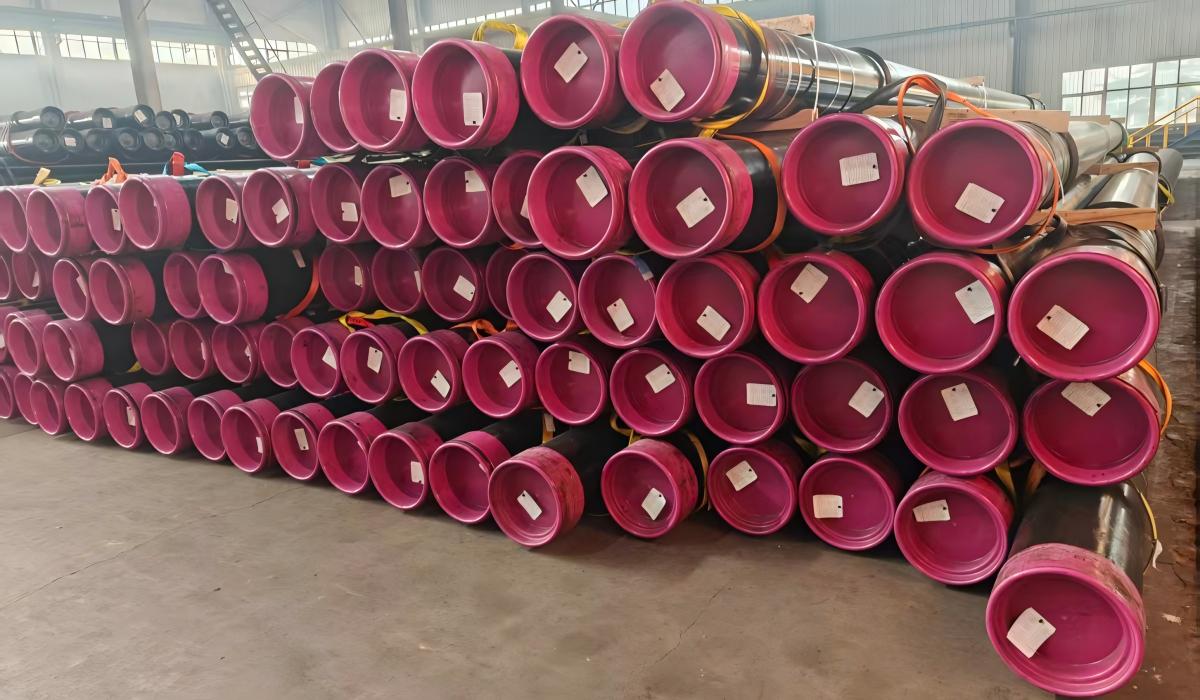
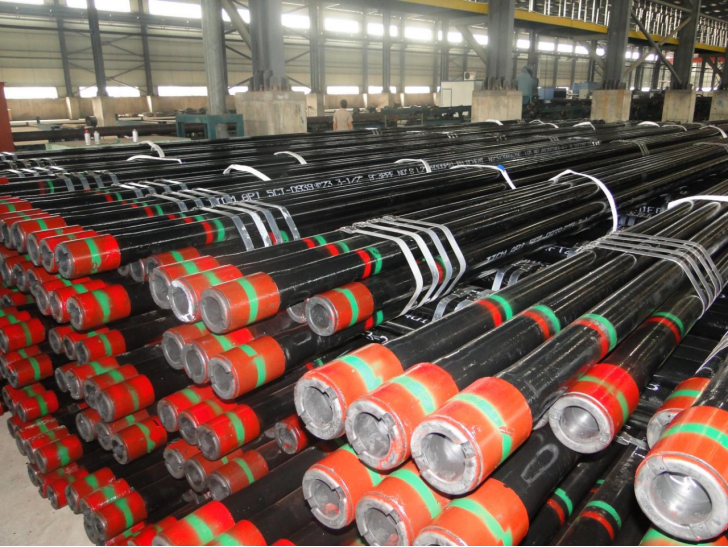 L80 premium sour-service casing staged for a South American operator, thread protectors in place ahead of loading.
Quick Answer
Four API 5CT carbon-steel grades carry the hardness ceilings and testing that H₂S service requires — L80 Type 1 at 23.0 HRC / 241 HBW, C90 and T95 at 25.4 HRC / 255 HBW, and C110 at 29.0 HRC / 279 HBW — and the three highest of those also require a sulphide stress cracking test under clauses 6.14 and 9.10. The trap is not the hardness number; it is the scope behind it. API 5CT compares the mean hardness to those limits, and the default SSC test for C90 and T95 is a single specimen per lot at 80 % of specified minimum yield. Both are widened only if the purchase order says so. N80, P110, Q125 and every chromium-bearing L80 sub-type (L80-3Cr / 9Cr / 13Cr — CO₂ corrosion grades) carry no sour-service controls at all. Environmental limits are set by NACE MR0175 / ISO 15156-2, not by API 5CT.
| Grade | Min yield | Max mean HRC / HBW (6.7.1) | Single-indentation rejection | SSC test required (6.14, 9.10) |
|---|---|---|---|---|
| L80 Type 1 | 552 MPa (80 ksi) | 23.0 / 241 | > 24.0 HRC | No |
| C90 | 621 MPa (90 ksi) | 25.4 / 255 | > 27.0 HRC | Yes |
| T95 | 655 MPa (95 ksi) | 25.4 / 255 | > 27.0 HRC | Yes |
| C110 | 758 MPa (110 ksi) | 29.0 / 279 | > 31.0 HRC | Yes |
| N80 / P110 / Q125 | — | No limit | — | No |
To screen a grade against your H₂S partial pressure, temperature, and yield requirement, use the sour-service grade selector →.
What we see on orders: The sour-service POs that reach us most often say "API 5CT T95" and nothing else, and the buyer believes that buys a sour-qualified string. It does not buy what they think it buys. Under 9.10.2 a), the default SSC test for C90 and T95 is one Method A specimen per lot, loaded to 80 % of specified minimum yield — 524 MPa (76,000 psi) for T95 per Table 12. A.18 (SR 46) is what takes that to three specimens drawn from the front, middle and back thirds of the lot at 90 % of Ysmin, or 590 MPa (85,500 psi). Same grade, same MTC heading, three times the sampling and a materially harder test — and it only happens if the SR number is on the order. The question we ask back is never "what hardness do you need"; it is "do you want SR 46 and SR 47 on this line, yes or no".
What Makes a Well "Sour" — The NACE Threshold
NACE MR0175/ISO 15156 Part 1 defines sour service as any system in which the H₂S partial pressure in the gas phase exceeds 0.0003 MPa (0.05 psia). This threshold is intentionally conservative — at the wellbore pressures common in deep or HPHT wells, trace H₂S concentrations that appear insignificant on a gas analysis report can easily exceed it.
At 10,000 psi (69 MPa) wellbore pressure, 50 ppm H₂S in the produced gas yields an H₂S partial pressure of approximately 0.5 psia — ten times the NACE trigger. A well with 5 ppm H₂S at 10,000 psi still exceeds the threshold. For liquid-dominated systems, Part 1 adds criteria based on in-situ pH and dissolved H₂S concentration; these conditions can trigger sour service requirements even at gas-phase partial pressures below 0.05 psia.
The operational rule is straightforward: if the well contains any measurable H₂S and is operated at significant pressure, design for sour service. The cost of upgrading to a NACE-qualified grade is small relative to the consequence of an SSC failure.
SSC Mechanism — Why Hardness Matters
Sulfide stress cracking proceeds through a hydrogen embrittlement mechanism. H₂S in produced water dissociates to form H⁺ and HS⁻ ions. These ions react at the steel surface, generating atomic hydrogen. Molecular hydrogen cannot penetrate the steel lattice — atomic hydrogen can. It diffuses inward and accumulates at grain boundaries, inclusions, and any region of elevated stress concentration in the microstructure.
Under applied or residual stress, brittle fracture initiates at hydrogen-enriched sites. The defining feature of SSC is that fracture occurs at stress levels far below the material's yield strength — sometimes below 50% of yield. There is no plastic deformation, no visible necking, no forewarning. The pipe performs normally under hydrostatic test and then fractures in service.
Hardness is the engineering proxy for SSC susceptibility because it correlates directly with tensile strength and with the density of high-energy microstructural sites where hydrogen can accumulate. A higher-hardness heat of T95 pipe is more susceptible to SSC than a lower-hardness heat of the same nominal grade — and NACE MR0175/ISO 15156-2 encodes this by setting maximum hardness limits that are lower, in some cases significantly lower, than the API 5CT production limits.
For the complete grade ladder with tensile, hardness, and chemistry data, see the API 5CT specification tables →
SSC is a system failure, not a material defect. The same T95 pipe at 24 HRC performs perfectly in a sweet well — within specification, full burst and collapse capacity, no corrosion concern. In an H₂S environment, that pipe can fracture. The material did not change; the environment did. This is why NACE MR0175 compliance must be specified before the order is placed, not after the pipe arrives on the wellsite. A mill that ships T95 at 24 HRC is not shipping defective pipe — it is shipping API 5CT-compliant pipe. The specification gap is in the purchase order, not the product.
Approved Grades and Their Hardness Limits
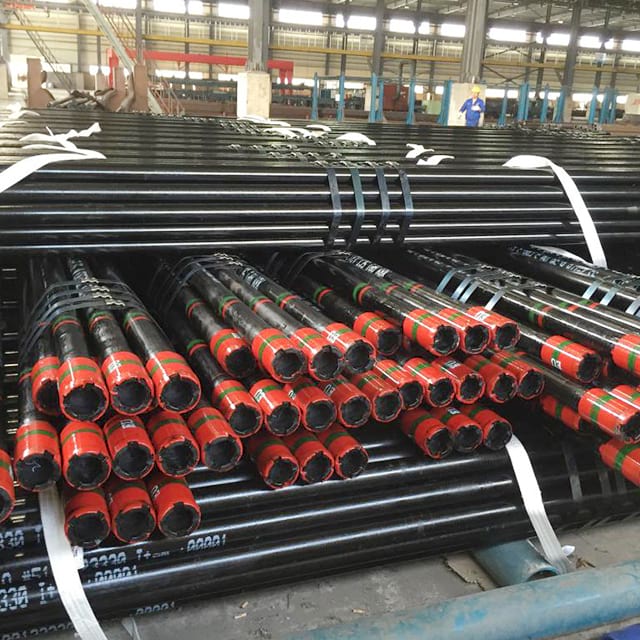 API 5CT casing pin ends colour-banded by grade, with protectors fitted to guard the threads in transit.
API 5CT 11th Edition puts hardness ceilings on four Group 2 and 3 grades — L80 Type 1, C90, T95, and C110 — and requires a sulphide stress cracking test for the upper three. Note that none of these four has a "sour" and a "non-sour" variant: clause 1.3 assigns types only to L80 (Type 1, 3Cr, 9Cr, 13Cr) and to N80 (Type 1, N80Q). There is no C90 Type 2, no T95 Type 1 or Type 2, and no C110 type.
The table below gives the full hardness envelope from clause 6.7.1 — mean limit, single-indentation rejection threshold, and retest band — because the mean is what the standard actually compares to the headline number. Mechanical values are from api-5ct-spec.json (API 5CT, 11th Edition).
| Grade | Min Yield (MPa / ksi) | Max Yield (MPa / ksi) | Max mean HRC / HBW | Single indentation rejects above | Retest band | SSC test required |
|---|---|---|---|---|---|---|
| L80 Type 1 | 552 / 80 | 655 / 95 | 23.0 / 241 | 24.0 HRC | — | No |
| C90 | 621 / 90 | 724 / 105 | 25.4 / 255 | 27.0 HRC | 25.4–27.0 HRC | Yes |
| T95 | 655 / 95 | 758 / 110 | 25.4 / 255 | 27.0 HRC | 25.4–27.0 HRC | Yes |
| C110 | 758 / 110 | 828 / 120 | 29.0 / 279 | 31.0 HRC | 29.0–31.0 HRC | Yes |
C90 and T95 share an identical hardness envelope even though T95 sits 34 MPa (5 ksi) higher at both ends of its yield window — so hardness is not the parameter that separates them, and a buyer cannot justify C90 over T95 on SSC grounds. The second column to read carefully is the retest band: a mean between 25.4 and 27.0 HRC on a C90 or T95 length does not reject the pipe, it triggers a retest under 6.7.1, and whether that retest appears on the MTC is a documentation question the purchase order has to settle.
The chemistry requirements for sour service grades are also tighter than for general service grades. C90 and T95 both carry S_max 0.010% and P_max 0.020%. C110 has the tightest sulphur limit in the entire API 5CT grade list: S_max 0.005%. These limits reflect the role of sulphide inclusions as hydrogen trapping sites — lower sulphur means fewer inclusions and lower SSC susceptibility at a given hardness level.
To match a grade to your well conditions, use the Pipe Grade Selector →
Mean Hardness vs Individual Readings — Worked Example
Most receiving inspectors compare every individual hardness reading against 25.4 HRC and reject anything above it. API 5CT 6.7.1 does not work that way, and knowing the difference decides whether a consignment is genuinely non-conforming or merely needs a retest record.
A shipment of 7" T95 casing is manufactured to API 5CT 11th Edition. Through-wall hardness testing on one length records four indentations: 24.8 HRC, 25.9 HRC, 26.4 HRC, 25.1 HRC.
Step 1 — compute the mean. (24.8 + 25.9 + 26.4 + 25.1) ÷ 4 = 102.2 ÷ 4 = 25.55 HRC.
Step 2 — apply 6.7.1 item 2). The mean hardness number is what is compared to 25.4 HRC. At 25.55 HRC the mean exceeds 25.4 but is below 27.0, which puts the length in the explicit retest band: "Products with mean hardness numbers between 25.4 HRC and 27.0 HRC shall be retested."
Step 3 — check the single-indentation rule. No individual reading exceeds 27.0 HRC, so nothing here triggers the outright rejection clause. The highest reading, 26.4 HRC, is above the 25.4 HRC mean limit but is not on its own a rejection.
The disposition is a retest, not a rejection — and if the buyer's inspector rejects on the 26.4 HRC reading alone, the mill will point at 6.7.1 and be right. The converse also holds: four readings of 25.0, 25.2, 25.3 and 26.9 average 25.6 HRC and are equally in the retest band, even though the individual figures look unremarkable. Ask for the individual indentations on the MTC, not just the reported value, because you cannot reconstruct the mean without them.
The correct PO language for T95 in a sour well:
"API 5CT T95, 11th Edition. A.19 (SR 47) hardness testing frequency — test ring from both ends of each pipe. A.18 (SR 46) sulfide stress cracking test, NACE TM0177-2016 Method A, three specimens per lot from front, middle and back thirds, at 90 % Ysmin. Individual hardness indentations and the calculated mean to appear on the MTC by heat and by length. EN 10204 3.2 certification."
Note what that language does not do: it does not invent a hardness number. API 5CT's own figure is 25.4 HRC mean; whether the well environment is one this grade can serve at all is decided by NACE MR0175 / ISO 15156-2, which sets limits by H₂S partial pressure, temperature and in-situ pH rather than by a single hardness value.
Grades NOT Approved for Sour Service
The following grades are not listed in NACE MR0175/ISO 15156-2 Table B.1 and must not be used in H₂S-containing wells under any circumstances.
N80 (Type 1 and N80Q): N80 carries no hardness limit under API 5CT — the JSON shows max_hardness_hrc: null. No hardness limit means no SSC control. N80 is a general service grade that happens to sit in the same yield range as L80; the two grades are not interchangeable in sour wells. The N80 vs L80 comparison covers this distinction in detail.
P110: P110's 758 MPa (110 ksi) minimum yield strength at the bottom of its range, combined with its unrestricted microstructure and no hardness limit (API 5CT carries no HRC limit for P110), makes it inherently unsuitable for H₂S environments. No heat treatment protocol qualifies P110 for sour service. Teams who need 110 ksi yield strength in a sour well must specify C110, not P110. C110 and P110 share the same minimum yield floor — 758 MPa / 110 ksi — but C110 is designed and tested for sour service, with a 29.0 HRC hardness limit and S_max 0.005%.
Q125: Q125 is not approved for sour service. Its minimum yield of 862 MPa (125 ksi) places it far above the hardness range that NACE MR0175/ISO 15156-2 qualifies for carbon and low-alloy steel.
All chromium-bearing L80 sub-types — L80-3Cr, L80-9Cr, L80-13Cr: These grades share the L80 mechanical property window and even the same 23 HRC hardness limit, but they are CO₂ corrosion grades, not sour service grades. The chromium content in these alloys provides electrochemical corrosion resistance to CO₂ attack in sweet wells. It provides no resistance to sulfide stress cracking in H₂S. All three sub-types are classified sour_service: false in API 5CT, and none are listed in NACE MR0175/ISO 15156-2 Table B.1.
Specifying L80-13Cr for a sour well is a non-conforming material selection — and it is a selection we have seen on purchase orders from procurement teams who confused CO₂ resistance with H₂S resistance. The two corrosion mechanisms are entirely different. For wells with both CO₂ and H₂S in the produced fluid, the correct approach is to specify L80 Type 1 with NACE hardness verification for the H₂S resistance, or escalate to Super 13Cr or a duplex CRA alloy where both mechanisms must be addressed simultaneously.
Grade Selection by H₂S Partial Pressure
No single grade fits all sour service conditions. The selection depends on the H₂S partial pressure, the required casing yield strength for the well design, and the well depth and temperature. The framework below is a starting point; the well-specific design governs.
| H₂S Partial Pressure | Recommended Grade | Key Consideration |
|---|---|---|
| < 0.05 psia (0.0003 MPa) | Any API 5CT grade | Below NACE MR0175 threshold — standard selection applies |
| 0.05–1.5 psia | L80 Type 1 (80 ksi) | Primary sour service grade; 23.0 HRC mean limit, no SSC test required by 6.14 |
| 0.05–1.5 psia (higher strength needed) | T95 with A.18 (SR 46) and A.19 (SR 47) | Higher yield for deeper strings; the SRs are what buy the sampling scope |
| 1.5–10 psia | C90 or T95, both with SR 46 and SR 47 | Identical hardness envelope; C90 gives an intermediate yield step at 90 ksi |
| > 10 psia (severe sour) | C110 | Highest NACE-approved carbon steel grade; S_max 0.005% addresses inclusion control |
| CO₂ + H₂S combined | L80 Type 1 (mild H₂S) or CRA alloy | L80-13Cr is NOT acceptable in any H₂S environment; escalate to Super 13Cr or duplex |
To run your own H₂S partial pressure, temperature, and yield inputs against this framework, use the sour-service grade selector →.
Temperature matters. SSC severity increases as temperature decreases — the same pipe in the same H₂S environment is more susceptible at 20°C wellhead temperature than at 80°C bottomhole temperature. NACE MR0175/ISO 15156-2 includes temperature-dependent restrictions for some applications; review these against the well temperature profile, not just the reservoir conditions.
Procurement Trap and Correct PO Language
The procurement trap for sour service OCTG is not complicated, but it is consistent: the purchase order specifies the API grade without specifying the NACE hardness limit. The mill ships fully API-compliant pipe. The pipe fails NACE MR0175 qualification on arrival.
Wrong PO language:
"T95 API 5CT 11th Edition, PSL-2"
Two things go wrong here. API 5CT has no PSL system at all — PSL is an API 5L construct, and the phrase means nothing to an OCTG mill. More costly is what the bare grade call-out buys: hardness reported as a mean against 25.4 HRC with the sampling frequency of Table C.35, and a single Method A SSC specimen per lot at 80 % of Ysmin under 9.10.2 a) 1). Every joint of it is fully API 5CT compliant.
Correct PO language for T95 sour service:
"API 5CT T95, 11th Edition. A.19 (SR 47) — hardness test ring from both ends of each pipe. A.18 (SR 46) — SSC test per NACE TM0177-2016 Method A, three specimens per lot from the front, middle and back thirds, 90 % Ysmin. Individual hardness indentations and calculated means to appear on the MTC by heat and by length. EN 10204 3.2, third-party witnessed."
For the other sour grades the levers differ:
- L80 Type 1: no SSC test is required by 6.14, which covers only C90, T95 and C110. The controls are the 23.0 HRC / 241 HBW mean limit and the 24.0 HRC single-indentation rejection in 6.7.1. Ask for the indentation values.
- C90: the same SR 46 and SR 47 pair as T95 — both SRs are written for Grades C90 and T95 together.
- C110: SR 47 does not extend to C110, but the default SSC sampling is already three specimens per lot from front, middle and back thirds under 9.10.2 a) 2). Add the chemistry call-out: S max 0.005 %.
Every sour service order should also state: quench and temper heat treatment (mandatory for all Group 2 and 3 sour grades), sulphur and phosphorus chemistry limits by heat analysis, and EN 10204 3.2 MTC (third-party witnessed) for projects where NACE non-compliance would delay well operations. In West African deepwater and Middle Eastern gas well projects, we treat 3.2 MTC as the default for all sour service casing.
Supply — NACE Certification Documentation
 ZC-2 gas-tight S-95 casing bound for a Nigerian sour well, shipped with hardness results and a NACE MR0175 compliance letter in the heat package.
When we supply sour service OCTG, the documentation package for each heat includes the mill test report with individual hardness readings at body and ends, the heat treatment record (time, temperature, quench method), the heat analysis and product analysis showing S and P within the grade limits, and a NACE MR0175/ISO 15156-2 compliance letter issued by the mill identifying the heat number and confirming it meets Table B.1 qualification requirements.
For severe sour service applications (H₂S partial pressure above 3 psia), we can arrange NACE TM0177 SSC testing and NACE TM0284 HIC testing by an accredited third-party laboratory. These tests are not required by API 5CT or NACE MR0175 for standard qualification, but deepwater operators and HPHT projects increasingly request them as supplementary assurance. Request these at order placement — they add lead time.
A NACE-documented sour string we shipped: For a Nigerian well with both high pressure and H₂S, we supplied 577 joints of S-95, 11¾″ 65 ppf, with our gas-tight ZC-2 connection. S-95 sits between L-80 and P-110 but, unlike P-110, has to meet the SR16 / NACE MR0175 hardness limits for sour service — that shipment went out with the hardness results and a NACE MR0175 compliance letter in the heat package. By contrast, when we ship L80-13Cr casing to Africa it is a CO₂-corrosion supply for sweet service, not a sour grade — the same distinction this article keeps drawing. See more in our project records.
The hardness limit is the controlling parameter, but it is not the only one. A sour service order without explicit NACE documentation is a sour service order that cannot be verified at the wellsite. When the company man asks for the NACE compliance letter and it is not in the documentation package, the options are: fly out replacement pipe or accept unverified material. Neither is acceptable when H₂S is present.
For the full L80 sour service grade specification, see API 5CT L80 Casing Pipe — Sour Service Guide →
For T95 sour service detailed specifications, see API 5CT T95 Casing Pipe — Sour Service Guide →
For C110 high-strength sour service specifications, see API 5CT C110 Casing Pipe →
Frequently Asked Questions
Which API 5CT grades are approved for sour service under NACE MR0175?
API 5CT itself builds sour service control into four grades: L80 Type 1 (maximum mean hardness 23.0 HRC / 241 HBW), C90 and T95 (both 25.4 HRC / 255 HBW), and C110 (29.0 HRC / 279 HBW), with clauses 6.14 and 9.10 additionally requiring a sulphide stress cracking test for C90, T95 and C110. The chromium-bearing L80 sub-types — L80-3Cr, L80-9Cr, L80-13Cr — are CO₂ corrosion resistance grades, and N80, P110 and Q125 carry no hardness limit at all. API 5CT is explicit that meeting the grade is not the same as being qualified for a well: clause 6.14.1 notes that the SSC test "is for quality control purposes only and does not qualify the material for any specific sour service application." The environmental limits for carbon and low-alloy steels live in NACE MR0175 / ISO 15156-2 and depend on H2S partial pressure, temperature and in-situ pH.
What is sulfide stress cracking and why does it matter for OCTG?
Sulfide stress cracking (SSC) is a form of hydrogen embrittlement that occurs when high-strength steel is exposed to H₂S in the presence of water. H₂S in solution produces atomic hydrogen that diffuses into the steel lattice and causes brittle fracture at stress levels well below the material's yield strength. SSC risk increases with higher steel hardness, higher H₂S partial pressure, lower temperature, and higher stress. This is why NACE MR0175 imposes hardness limits — hardness is a proxy for SSC susceptibility.
What H₂S partial pressure triggers NACE MR0175 requirements?
NACE MR0175/ISO 15156 defines sour service as any system where the H₂S partial pressure exceeds 0.0003 MPa (0.05 psia) in the gas phase. This is a very low threshold — even trace H₂S concentrations in high-pressure wells can exceed it. For liquid systems, additional criteria apply based on in-situ pH and H₂S content in solution. When in doubt, treat the well as sour and specify accordingly.
What hardness does API 5CT actually allow for T95, and is it a per-reading limit?
API 5CT clause 6.7.1 caps T95 at a maximum mean hardness of 25.4 HRC (255 HBW), not a maximum individual reading. A single indentation above 27.0 HRC rejects the length outright, and a mean falling between 25.4 and 27.0 HRC triggers a retest rather than a rejection. C90 carries the identical envelope; C110 is 29.0 HRC mean with a 31.0 HRC single-indentation rejection. Because the governing figure is a mean, ask for the individual indentation values on the MTC — the reported number alone cannot be checked.
Is L80-13Cr suitable for H₂S service?
No. L80-13Cr is a CO₂ corrosion resistance grade, not a sour service grade. Its 13% chromium content provides electrochemical resistance to CO₂ corrosion in sweet wells, NOT resistance to H₂S sulphide stress cracking. L80-13Cr is not listed in NACE MR0175/ISO 15156-2 as approved for H₂S service. Specifying L80-13Cr for a sour well is a non-conforming material selection. For wells with both CO₂ and H₂S, the correct path is to specify L80 Type 1 (with NACE hardness verification) for the H₂S resistance, or escalate to Super 13Cr or a CRA alloy for combined CO₂/H₂S service. The same applies to L80-3Cr and L80-9Cr — all chromium-bearing L80 sub-types are CO₂ grades only.
Can P110 be used with special heat treatment for sour service?
No. P110 is not listed in NACE MR0175/ISO 15156-2 Table B.1 for sour service regardless of heat treatment or hardness. The high yield strength of P110 (110 ksi minimum) combined with its microstructure makes it inherently unsuitable for H₂S environments. There is no special heat treatment or certification that qualifies P110 for sour service. If 110 ksi yield strength is required in a sour well, C110 is the correct grade — API 5CT caps its mean hardness at 29.0 HRC (279 HBW) under clause 6.7.1 and requires a sulphide stress cracking test under 6.14 and 9.10, none of which applies to P110.