A 9⅝" L80 casing string comes down to two decisions the datasheet cannot make for you: which weight, and which connection. The size is fixed by the well plan — 9⅝" is the workhorse intermediate string on most wells — and the grade is fixed by the service, because L80 is the sour-qualified carbon grade. What remains, and what a purchase order actually has to pin down, is the weight (which sets the drift and the pressure ratings) and the connection (which decides whether the string holds gas). This guide is about making those two calls; for the full dimensional ladder, it points you to the API 5CT casing sizes and weight tables →.
ZC Steel Pipe exports 9⅝" L80 casing with PSL-2 documentation to intermediate and production strings across North Africa, the Middle East, and South America, most often in the 43.5 to 53.5 lb/ft weights with BTC or premium connections. The same 9⅝" size ships in very different weight-and-connection specs depending on the string. For a Middle East operator we supplied 1,200 joints of 9⅝" 47 lb/ft K55 casing with BTC, Range 3 — an intermediate string at moderate formation pressure, where BTC's tensile efficiency was sufficient and a premium connection was not warranted. For a deep African well we supplied 580 joints of 9⅝" 53.5 lb/ft P110 with our ZC-31 full-flush premium connection — same OD, a heavier wall, and a gas-tight connection for the higher burst and collapse loads. Same size, two different specifications driven by the string. The weight-and-connection decision comes up on nearly every 9⅝" order, and the errors are consistent enough to be worth laying out.
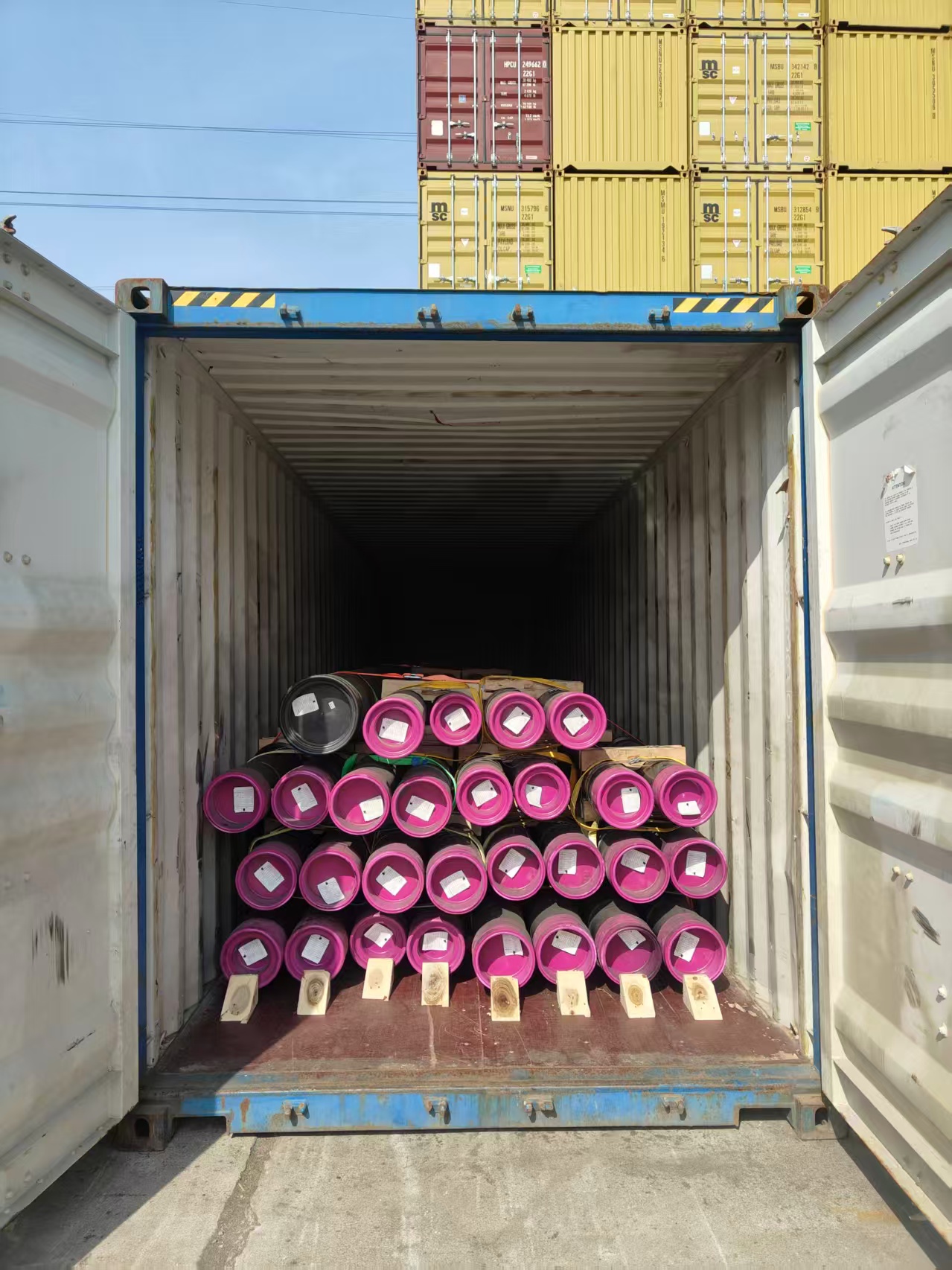 9⅝" casing loaded into a container with pink thread protectors fitted on the pin ends — a ZC P110 9⅝" casing shipment prepared for export.
What we see on orders: The most common incomplete 9⅝" L80 order omits either the weight or the connection. "9⅝" L80 BTC" leaves the wall open; "9⅝" 47# L80" leaves the connection open. Both get quoted, and the mill fills the gap with whatever it runs as standard — which is where the mismatch surfaces at the rig, when the drift is wrong for the bit programme or the completion needs a gas-tight seal that buttress cannot provide. We confirm weight and connection before quoting a 9⅝" string, because those two variables are what make one "9⅝" L80" different from another.
At a Glance — 9⅝" L80 Weight and Connection
Two decisions, both read against the 9⅝" weight ladder further down this page:
- Weight: 47.0 lb/ft is the workhorse for intermediate strings — its 8.525" API drift clears an 8½" bit, where 53.5 lb/ft (8.379" drift) does not. Pick the lightest weight that meets your burst and collapse design, then confirm its drift against the planned bit before fixing it.
- Connection: BTC (buttress) is the default and is adequate for sour oil and moderate pressure. Move to a premium metal-to-metal connection when the string must be gas-tight — sour gas, HPHT, or significantly deviated — because API buttress is not a gas-tight seal.
| Decision | Default | Upgrade when |
|---|---|---|
| Weight | 47.0 lb/ft — 8.525" drift, clears an 8½" bit | Heavier only if burst/collapse demands it — then re-check the bit |
| Connection | BTC — near-100% joint tensile efficiency | Premium for gas-tight, HPHT, or deviated strings |
| Grade | L80 — sour-qualified, 23.0 HRC max, 80 ksi min yield | P110 (sweet) or T95/C90 (sour) if the design needs more than 80 ksi |
Match grade, weight, and connection to your well with the Pipe Grade Selector →, and run each candidate weight through the Barlow pressure calculator →.
The Connection Decision — BTC or Premium
For a 9⅝" L80 string, BTC (buttress) is the default and premium is the exception you specify deliberately.
BTC is the standard choice because a 9⅝" intermediate string is long and heavy, and buttress delivers near-100% joint tensile efficiency — it carries the hang weight that a large-diameter string of this length develops, which is exactly why the API round threads (STC, LTC) are not the first choice at this size. That efficiency gap is not a marketing claim: it falls straight out of the API 5C3 joint-strength formulas, where buttress develops close to the full pipe-body yield while round thread parts at a reduced section under the last engaged thread — see the joint-strength formulas by connection type →. For sour oil service and moderate pressures, BTC on L80 is the normal, adequate specification.
Premium metal-to-metal becomes the requirement — not the option — when any of these apply:
- The string must be gas-tight. API buttress seals on thread compound, not on a metal barrier, and that seal is not rated to hold sustained gas pressure across the connection. A 9⅝" sour gas string needs premium regardless of how strong the pipe body is.
- HPHT, deviated, or horizontal. High make-up torque, bending, and pressure cycling all push past what buttress thread compound reliably holds.
- The sour service margin is tight. In an H₂S well the connection is often the weakest sulphide-stress-cracking link, because the thread roots concentrate stress. A premium connection with a controlled thread-root geometry reduces that stress concentration.
BTC is the strongest API connection, but strength is not the same as sealing. API buttress and API round threads are both not gas-tight. A 9⅝" L80 string can be perfectly adequate on pipe-body burst and still leak at the coupling if it is run with BTC on a gas well. When the string is a gas producer, or must hold pressure across the connection, the connection decision is premium — independent of the pipe-body rating. This is the single most common connection error we see on 9⅝" gas strings.
For the full connection theory, see casing connection types: STC, LTC, BTC and premium → and BTC vs premium connections →.
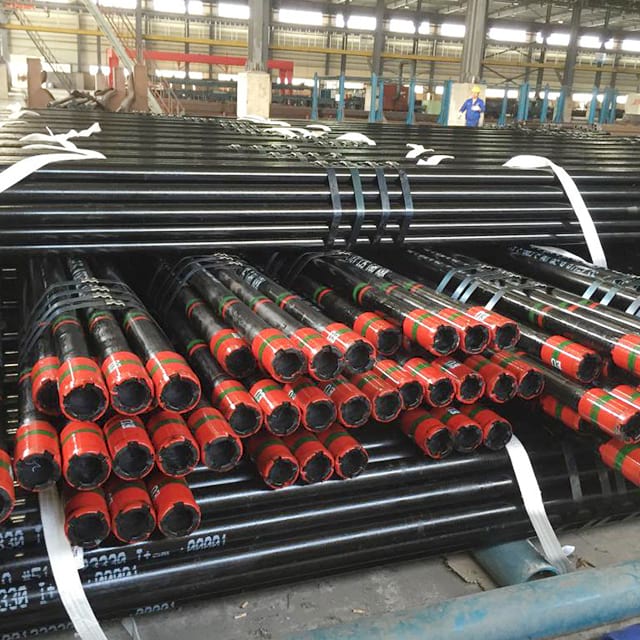 Casing pin ends with red-and-green paint bands and thread protectors fitted — the protected connection ends that a premium versus BTC decision ultimately hangs on.
Standard Sizes — The 9⅝" L80 Weight Ladder
9⅝" is a fixed 244.48 mm (9.625") OD; the weight is what varies, and every weight is really a different wall thickness — which sets the ID, the drift, and the pressure ratings all at once. The band below covers the weights actually ordered in L80; the dimensions are per API 5CT (11th Edition), with the drift being the API standard drift, not the theoretical ID.
| Nominal weight (lb/ft) | Wall (mm / in) | ID (mm / in) | API drift (mm / in) | 8½″ bit (8.500″) passes? |
|---|---|---|---|---|
| 36.0 | 8.94 / 0.352 | 226.6 / 8.921 | 222.63 / 8.765 | Yes |
| 40.0 | 10.03 / 0.395 | 224.4 / 8.835 | 220.45 / 8.679 | Yes |
| 43.5 | 11.05 / 0.435 | 222.4 / 8.756 | 218.41 / 8.599 | Yes |
| 47.0 | 11.99 / 0.472 | 220.5 / 8.681 | 216.54 / 8.525 | Yes — 0.025″ clearance |
| 53.5 | 13.84 / 0.545 | 216.8 / 8.535 | 212.83 / 8.379 | No — needs 8⅜″ bit |
| 58.4 | 15.11 / 0.595 | 214.25 / 8.435 | 210.29 / 8.279 | No — needs 8⅜″ bit |
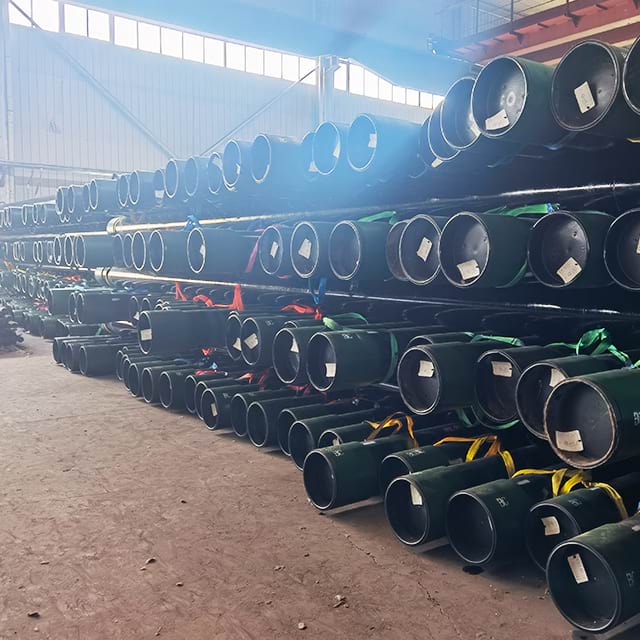 Large-diameter ZC casing with green couplings and thread protectors, each length carrying an identification tag for grade, weight, and heat traceability.
The single line to read from this table is the one between 47.0 and 53.5 lb/ft: that is where the API drift crosses below 8.500″ and an 8½″ bit stops passing. Everything at or under 47.0 lb/ft clears an 8½″ bit; everything at or above 53.5 lb/ft does not. Note also that the ID and the drift are not the same number — a 47.0 lb/ft joint has an 8.681″ ID but only an 8.525″ drift, and it is the drift, not the ID, that the bit and any tools must clear.
The Weight Decision — Let the Bit Programme Decide
9⅝" L80 is commonly ordered in the 36 to 58.4 lb/ft band, and 47.0 lb/ft is the workhorse weight for intermediate strings. Lighter and heavier weights exist in the standard; in L80 they are ordered far less often, because the deep, high-pressure designs that call for the heavy walls usually also need more than L80's 80 ksi yield and move to N80 or P110. The full multi-size ladder is in the casing sizes and weight tables →.
The decision that catches people is not the strength; it is the drift, and the table above is the reason: a 9⅝" intermediate string is normally drilled out with an 8½" bit for the next hole section, and 47.0 lb/ft clears that bit (8.525″ drift) while 53.5 lb/ft does not (8.379″ drift, needing an 8⅜″ bit). Going one weight heavier for extra collapse margin can therefore force a smaller bit and a smaller hole all the way down the well. The rule that follows is simple: pick the lightest weight that satisfies your burst and collapse design at the depth in question, then confirm its drift against the planned bit before the weight is fixed. Run the burst and collapse numbers for each weight with the Barlow pressure calculator →.
Worked Example — Burst and Collapse at 47 lb/ft
Take the workhorse weight, 9⅝" 47.0 lb/ft L80: OD 244.48 mm (9.625"), wall 11.99 mm (0.472"), so D/t = 20.4. L80's minimum yield is 552 MPa (80 ksi). Both pipe-body ratings below come straight from the API 5C3 / ISO 10400 formulas — not from a datasheet — so you can reproduce them for any weight in the table.
Barlow internal yield (burst): P = 0.875 × 2 × Yp × t / OD = 0.875 × 2 × 80,000 × 0.472 / 9.625 ≈ 6,870 psi (47.4 MPa). The 0.875 factor applies API 5CT's 12.5% negative wall-thickness tolerance — leave it out and you overstate the rating by one-eighth.
Collapse (plastic regime): at D/t = 20.4 this string sits in the plastic collapse regime — the API 5C3 boundaries for the 80 ksi grade run roughly D/t 14 to 22. Using the plastic coefficients A = 3.071, B = 0.0667, C = 1,955 psi: Pp = 80,000 × [3.071 / 20.4 − 0.0667] − 1,955 ≈ 4,760 psi (32.8 MPa). Both figures match the API 5CT published ratings for 9⅝" 47 lb/ft L80, which is the check that tells you the regime and coefficients were applied correctly.
The takeaway for the weight decision: burst climbs with wall (53.5 lb/ft reaches about 7,930 psi), but so does the drift penalty. Run every candidate weight through the Barlow pressure calculator → and the four-regime collapse model →, then keep the lightest weight that clears your design factors — because that is also the weight that keeps the largest bit.
The Grade Is Already Decided
L80 is on the string because the well is sour. L80 Type 1 is an API 5CT sour-service grade qualified under NACE MR0175/ISO 15156 through its 23.0 HRC (241 HBW) maximum hardness and its restricted 552–655 MPa (80–95 ksi) yield window — not through alloying, since L80-1 mandates no minimum chromium or molybdenum. The full chemistry and the L80-1 / L80-9Cr / L80-13Cr subtypes are on the L80 grade guide →, and the N80 vs L80 comparison → covers the sweet-service alternative. Where L80's envelope ends — on strength, on CO₂, and on the sour-versus-sweet choice — is the next section.
When NOT to Use 9⅝" L80
- Deep high-pressure production beyond L80's 80 ksi yield — step to N80Q, P110 (sweet), or T95/C90 (sour), not a heavier L80 wall alone, which also shrinks the drift. L80 tops out at 655 MPa (95 ksi) maximum yield.
- CO₂ (sweet corrosion) wells — L80-1 is carbon-manganese with no chromium; specify L80-13Cr or a CRA.
- Sour gas strings run with BTC — the grade is right, the connection is not; specify premium.
- Sweet or shallow wells with no H₂S — use N80 for sweet service or K55 for shallow duty; on these strings L80's sour qualification is paid for and unused.
Purchase Order — The Complete 9⅝" L80 Spec
A complete 9⅝" L80 order names four things; the errors start wherever one is left open:
- Size, grade, weight: "9⅝" L80, 47.0 lb/ft" — the weight is mandatory; it sets the wall, drift, and pressure ratings.
- Connection: "BTC" or the named premium connection — and if the string must be gas-tight, specify premium explicitly rather than leaving it to the mill.
- Sour service: "22 HRC maximum, pipe body and coupling, per NACE MR0175/ISO 15156-2" plus PSL-2. The L80 grade permits up to 23.0 HRC — the clause is what closes the gap to the NACE limit, and naming the coupling is what protects the connection.
- Range and documentation: Range 3 unless the rig requires Range 2; EN 10204 3.1 MTC minimum, 3.2 where the project or market requires it.
To match grade, weight, and connection to your well conditions, use the Pipe Grade Selector →. On receipt, confirm the MTC shows the ordered grade, weight, and connection, and that the reported hardness is at or below 22 HRC on both pipe body and coupling — not merely below the 23.0 HRC API ceiling.
Frequently Asked Questions
Which weight of 9⅝" L80 casing should I order?
For most 9⅝" L80 intermediate strings the common band is 36 to 58.4 lb/ft, and 47.0 lb/ft is the workhorse weight. The deciding factor is usually not strength but the bit programme: 47.0 lb/ft leaves enough drift for an 8½" bit to pass, while 53.5 lb/ft does not. Pick the lightest weight that meets your burst and collapse design at the depth in question, then confirm its drift against the planned bit before fixing it. For the full 9⅝" weight ladder with wall, ID and drift, see the API 5CT casing sizes and weight tables.
Is BTC good enough for a 9⅝" L80 string, or do I need a premium connection?
BTC (buttress) is the standard API choice for a 9⅝" L80 intermediate string — its near-100% joint tensile efficiency carries the hang weight of a long large-diameter string, and it is adequate for sour oil and moderate-pressure service. Move to a premium metal-to-metal connection when the string must be gas-tight, is a sour gas producer, is HPHT, or is significantly deviated or horizontal. API buttress is not a gas-tight connection, so the connection decision on a 9⅝" gas string is premium regardless of the pipe-body rating.
Will an 8½" bit pass through 9⅝" L80 casing?
It depends on the weight. At 47.0 lb/ft the API drift is 8.525", so an 8½" (8.500") bit passes with about 0.025" clearance. At 53.5 lb/ft the drift drops to 8.379", and an 8½" bit will not pass — that string needs an 8⅜" bit. This is why the weight choice is a drilling-programme decision, not only a strength decision: going heavier for collapse margin can force a smaller hole all the way down.
Why does a 9⅝" L80 connection matter more in sour service?
In a sour (H2S) well the connection is often the weakest sulphide-stress-cracking link in the string, because thread roots concentrate stress. On a sour 9⅝" L80 string the connection therefore deserves the same NACE scrutiny as the pipe body — specify the 22 HRC hardness limit on the coupling as well as the pipe, and prefer a premium metal-to-metal connection where the service is sour gas or the seal must hold gas pressure. BTC is acceptable for many sour oil strings but is not a gas-tight seal.
What is the difference between 9⅝" L80 and 9⅝" N80 for this string?
Same size, same dimensions, same 80 ksi minimum yield — so at a given weight they carry the same burst and collapse. The difference is service: N80 is a sweet-service grade with no hardness limit, while L80 is qualified for sour service through its 23.0 HRC maximum hardness. Choose L80 when the well is sour and N80 when it is not; do not pay for L80's sour qualification on a sweet string. See the N80 vs L80 comparison for the full trade-off.
When should a 9⅝" string move from L80 to P110?
Move to P110 when the burst or collapse design at 9⅝" exceeds what L80's 80 ksi minimum yield supports at an available wall — heavier L80 wall alone is often not the answer, because the heavy walls also shrink the drift. P110 provides 110 ksi minimum. But P110 is a sweet-only grade: if the well is sour, the upgrade is to a higher-strength sour grade such as T95 or C90, not P110.
What must a complete 9⅝" L80 purchase order specify?
Four things: the size and grade (9⅝" L80), the nominal weight (e.g. 47.0 lb/ft — mandatory, because it sets wall, drift and pressure ratings), the connection (BTC or the named premium connection), and, for sour service, '22 HRC maximum, pipe body and coupling, per NACE MR0175/ISO 15156-2' plus PSL-2. Leaving weight or connection open lets the mill fill the gap with whatever it runs as standard, which is where the drift-versus-bit and gas-tightness mismatches start.