
Casing tonnage = kg/m from API 5CT Table C.18 × total metres ÷ 1,000. So 1,000 m (3,281 ft) of 9⅝″ 47 lb/ft casing is 69.94 t on the nominal threaded-and-coupled mass, or 68.75 t on the plain-end mass. Neither is the mass API 5CT actually checks. Section 7.5 Equation (8) builds each length's calculated mass from plain-end mass × length plus an end-finish term, and Table C.18 note b says the nominal mass is "shown for information only". Joints = metres ÷ joint length, so joints per tonne is a band set by your length range, not one number. Which mass you are invoiced on, and which "ton", are terms you write on the PO.
I'm Hazel Wang, technical sales at ZC Steel Pipe. We supply API 5CT casing from 4½″ to 20″, seamless and electric-welded, to operators and contractors in Africa, the Middle East, South America and Southeast Asia, and a casing tender written in metres or joints still has to be quoted, packed and shipped in tonnes. This page is the arithmetic I do to get from one to the other, with the clause behind each step.
How do you calculate casing tonnage from metres or joints?
Multiply metres by the kg/m in API 5CT Table C.18 to get kilograms, divide by 1,000 for metric tonnes, and divide the metres by the joint length for joints; for 9⅝″ 47 lb/ft (244.48 mm OD) that gives 69.94 t or 68.75 t per 1,000 m, depending on which Table C.18 column you use.
Three steps, in order:
- Metres × kg/m = kilograms. Take the kg/m from Table C.18 for your exact OD and lb/ft. The OD-and-wall formula, 0.02466 × t × (OD − t), does reproduce the plain-end column (for 9⅝″ 47 lb/ft: 0.02466 × 11.99 × (244.48 − 11.99) = 68.74 kg/m against the tabulated 68.75). It cannot give you the nominal threaded-and-coupled column, because that one is not a bare-pipe figure.
- Kilograms ÷ 1,000 = metric tonnes. Reverse it when the tender is in tonnes: tonnes × 1,000 ÷ kg/m = metres.
- Metres ÷ joint length = joints. This is where people expect one number and get a range, because no two joints are the same length. I explain the band in the joints section below.
Worked example: 1,000 m of 9⅝″ 47 lb/ft casing
| Mass basis (API 5CT 11th ed., Table C.18) | kg/m | Tonnes for 1,000 m (3,281 ft) |
|---|---|---|
| Nominal threaded-and-coupled, column 4 (information only, note b) | 69.94 | 69.94 t |
| Plain-end mass wpe, column 8 (the starting term of Eq. 8, no couplings) | 68.75 | 68.75 t |
The gap is 1.19 t per 1,000 m, about 1.7 % of the plain-end figure. Neither row is "the invoiced mass". The plain-end row is bare pipe. The nominal row is printed for information only, and Table C.18 does not say how it was built. When you know the connection, the better figure is Equation (8) itself: plain-end mass × length plus the end-finish mass em for that connection, which I work through below. How the invoice is settled is a separate question, and I come back to it in the PO section.
Check which "ton" your quote is in (the unit section covers all three). And a hookload or buoyed string weight in mud is a well-design number, not purchase tonnage. For line pipe or process pipe the ASME route is different, and the ASME B36.10M pipe weight formula and chart covers it.
This is not a textbook size. 9⅝″ 47 ppf with BTC ends in Range 3 is exactly what we shipped on a 1,200-piece API 5CT K55 PSL1 casing order to the Middle East in 2023, for an intermediate or production string on onshore oil wells. The order was recorded in pieces, which is how well plans count casing; freight and finance count in tonnes, and the conversion between the two is what this page walks through. I won't give you that order's tonnage, because the record is in pieces and I'd rather show you the method than a number I would have to reconstruct.

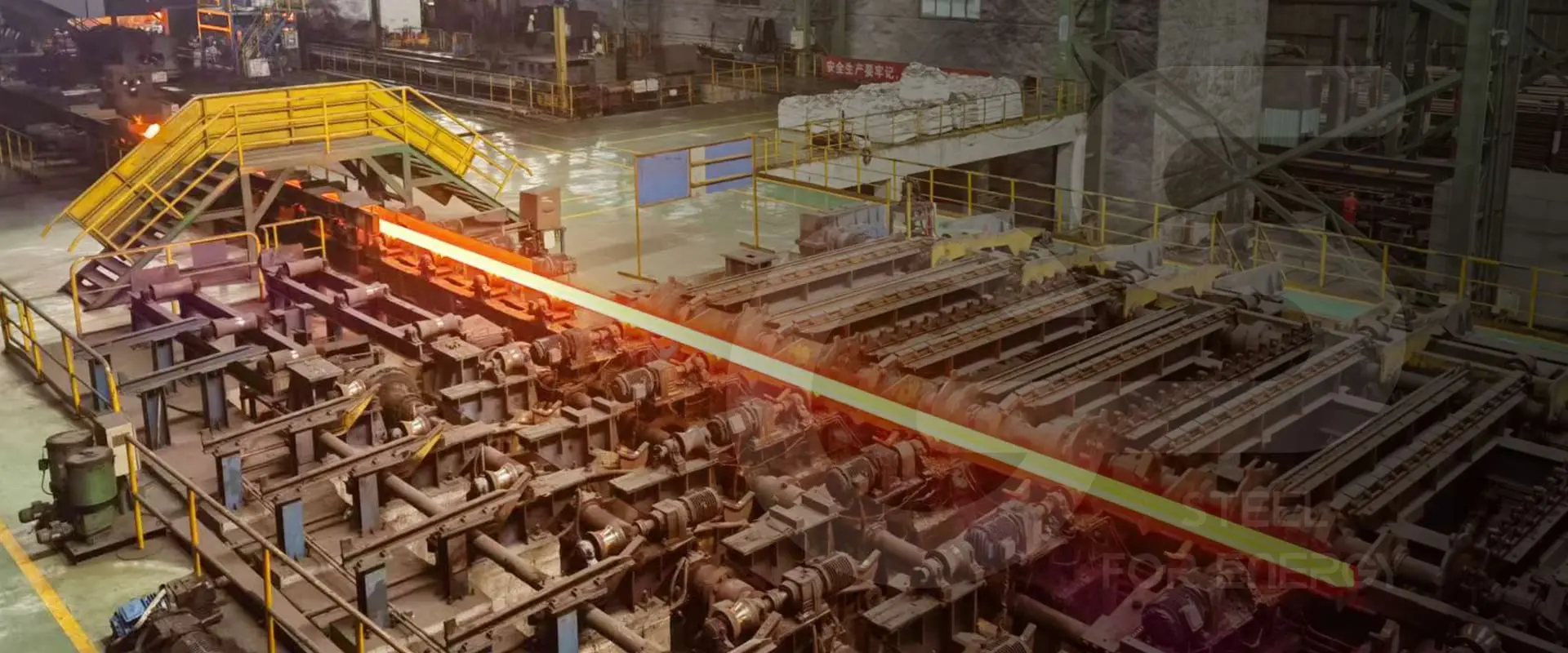
Casing from the K55 BTC Middle East order on the mill floor. API 5CT requires every length to be measured (Section 7.6) and weighed (Section 9.13.7) individually.
If you are still choosing the casing itself, our API 5CT casing and tubing range lists grades, connections and size coverage.
Tonnes per 1,000 m and metres per tonne for common casing sizes
For 9⅝″ 47 lb/ft casing, one metric tonne is 14.3 m on the nominal threaded-and-coupled mass and 14.5 m on the plain-end mass in API 5CT Table C.18; the exact API mass, Section 7.5 Equation (8), is plain-end mass × length plus a fixed end-finish term per joint.
API 5CT casing (11th ed. Table C.18): tonnes per 1,000 m and metres per tonne on the nominal threaded-and-coupled mass (information only, note b) and the plain-end mass (wpe, base term of Section 7.5 Eq. 8). Neither is the Eq. 8 calculated mass; joint count depends on the length range.
| Size: OD, nominal mass | Tonnes per 1,000 m, nominal T&C | Tonnes per 1,000 m, plain-end | Metres per tonne, nominal T&C | Metres per tonne, plain-end |
|---|---|---|---|---|
| 13⅜″ (339.72 mm), 68 lb/ft | 101.19 | 98.46 | 9.9 | 10.2 |
| 9⅝″ (244.48 mm), 36 lb/ft | 53.57 | 51.93 | 18.7 | 19.3 |
| 9⅝″ (244.48 mm), 47 lb/ft | 69.94 | 68.75 | 14.3 | 14.5 |
| 9⅝″ (244.48 mm), 53.5 lb/ft | 79.62 | 78.72 | 12.6 | 12.7 |
| 7″ (177.80 mm), 29 lb/ft | 43.60 | 42.78 | 22.9 | 23.4 |
| 5½″ (139.70 mm), 23 lb/ft | 34.05 | 33.57 | 29.4 | 29.8 |
Tonnes per 1,000 m is the kg/m read in a different unit, so you can read a tonnage for any metreage straight off it. On every row the plain-end figure is lower than the nominal one, and that holds across all 99 casing rows in Table C.18. Budget threaded-and-coupled casing from plain-end mass alone and you leave out the couplings, so you under-estimate the tonnes for a given metreage.
Notice too that the gap is not a fixed percentage: it is 1.19 kg/m at 9⅝″ 47 but 0.90 kg/m at 9⅝″ 53.5. That is the first sign that couplings do not add a neat percentage, which matters later.
For a size not in this table, look up the Table C.18 kg/m by size, and for lb/ft or short-ton figures use the lb/ft, kg/m and tonne converter. Every casing size and weight is in the full API 5CT casing weight and dimension table. The two most-ordered strings have their own pages too: 9⅝″ casing weights and connections and 7″ casing weights and coupling clearance.
Which weight does API 5CT use: calculated mass or the nominal lb/ft?
The lb/ft in an API 5CT casing designation is the nominal threaded-and-coupled mass, not the plain-end mass, and API 5CT Section 7.5 Equation (8) calculates the mass of each length from the plain-end mass plus the end-finish term, not from the nominal.
It is easy to mistake the nominal weight for the plain-end weight. They are different columns. In plain English:
- The 47 in "9⅝″ 47 lb/ft" is a label for ordering. Table C.18 note a says the labels are "for information and assistance in ordering".
- The mill checks each length against a calculated mass built by Equation (8), length by length.
- The plain-end mass, the base of that equation, is lower than the nominal: 68.75 kg/m against 69.94 kg/m at 9⅝″ 47.
What API 5CT 11th edition says. Section 7.5: "The masses determined as described in 9.13.7 shall conform to the calculated masses as specified herein (or adjusted calculated masses for martensitic chromium grades L80 9Cr or L80 13Cr) for the end-finish specified in the purchase agreement, within the tolerances stipulated in 7.11.3."
Equation (8): WL = [(wpe) (Lef) + (em)] (km), where WL is the calculated mass of a pipe of length L (kg); wpe is the plain-end mass (kg/m); Lef is the length of pipe including end-finish (m), as defined in 7.6; em is the mass gain due to end-finishing (kg); and km is "the mass correction factor: 1.000 for carbon steels; 0.989 for martensitic chromium steels."
Table C.18 note b: "Nominal linear masses, threaded and coupled (column 4) are shown for information only." Note d describes the em column as "Mass gain or loss due to end-finishing; see 7.5."
The nominal mass is spread per metre; the real end-finish mass arrives per joint. Equation (8) adds em once per length, whatever the length. A per-metre figure cannot track that: the coupling's share of the mass shrinks as the joint gets longer. The nominal kg/m in column 4 is information only, and Table C.18 does not tie it to any joint length or connection. The same 47 lb/ft also weighs differently per joint with long round, buttress or special-clearance buttress ends, because Table C.18 tabulates the end-finish mass separately for each connection. No flat coupling percentage appears anywhere in the standard.
The API 5CT specification reference carries the grade and dimension tables behind these clauses. One thing API 5CT does not decide is which of these masses your invoice is settled on. That is a purchase order term, and the PO section below gives you the wording.
How many joints are in my tonnage, and why is the answer a range?
Joints per tonne is a band, not a number, because API 5CT Section 7.6 measures each joint individually "in meters and hundredths of a meter" and its length floats anywhere inside the ordered range, so the same tonnage gives more joints at the short end of the range and fewer at the long end.
For casing, Table C.22 sets the ranges as total range length, inclusive: Range 2 is 7.62–10.36 m (25.0–34.0 ft) and Range 3 is 10.36–14.63 m (34.0–48.0 ft). Work it in three steps for 100 t of 9⅝″ 47 lb/ft:
- Tonnes to metres, on both bases. 100 t × 1,000 ÷ 69.94 kg/m = 1,429.8 m (4,691 ft) nominal. On plain-end mass, 100 t × 1,000 ÷ 68.75 kg/m = 1,454.5 m (4,772 ft).
- Metres to joints, at each edge of the range.
| 100 t of 9⅝″ 47 lb/ft | Range 3: all joints at 14.63 m (48.0 ft) | Range 3: all joints at 10.36 m (34.0 ft) | Range 2: all joints at 10.36 m (34.0 ft) | Range 2: all joints at 7.62 m (25.0 ft) |
|---|---|---|---|---|
| Nominal basis, 1,429.8 m | 97.7 joints | 138.0 joints | 138.0 joints | 187.6 joints |
| Plain-end basis, 1,454.5 m | 99.4 joints | 140.4 joints | 140.4 joints | 190.9 joints |
- Decide what you are actually buying. The real tally always sits inside these edges, but the spread is wide: in Range 3 the same 100 t can be about 98 joints or about 138. A drilling programme needs a depth plus a rathole margin, not a weight, so fix the joints or metres on the PO, add pup joints for spacing-out, and let the tonnes float under a cap (the next two sections).
The edges are theoretical extremes, but they show why a single "joints per tonne" figure is always somebody's assumption about average length. Table C.22 also gives a permissible variation, max of 1.83 m (6.0 ft) for casing Range 3 and 1.52 m (5.0 ft) for Range 2. Note a limits that rule, though: it "applies to rail car shipment to the point of use and does not apply to order items of less than 18,144 kg of pipe." For an export order shipped by container or breakbulk, don't count on that rule to narrow your band — write the length spread you need into the PO. Table C.22 sets no "minimum average length" for a casing range in the 11th edition either; if you need one, specify it.
For what each range means and how length choice changes connection count, see the R1, R2 and R3 casing length range guide.
Tender in metres, invoice in tonnes: what do you write on the PO so they match?
API 5CT does not set an invoicing basis: Section 9.13.7 requires each length of casing to be "weighed separately" to check mass tolerance, and whether the invoice is settled on scale weight or on the Section 7.5 Equation (8) calculated mass is a term the PO has to state.
Section 9.13.7 also tells you what a scale weight contains: "Threaded-and-coupled pipe may be weighed with the couplings screwed on or without couplings, provided proper allowance is made for the mass of the couplings." The same applies to thread protectors: pipe "shall be weighed with or without thread protectors if proper allowances are made for the mass of the thread protectors." So a scale weight is a corrected figure too, and you want to know what it was corrected for.
The bare-tonnes PO. This is the trap. A PO line that reads "9⅝″ 47 lb/ft K55 BTC R3 casing, 70 MT" gives no mass basis, no ton definition, no length count and no cap. The mill can compliantly ship any tally that meets its own mass checks, on whichever basis its own sales terms use, and you find out which basis that was when the invoice lands. What to write instead:
Item: API 5CT 11th ed. casing, [OD] in [lb/ft] lb/ft, grade [grade], PSL [1/2/3]
Connection: [STC / LTC / BTC / premium], Range [2/3]
Quantity: [n] joints OR [m] metres (approx. [t] metric tonnes, for reference only)
Invoicing basis: [calculated mass per API 5CT 7.5 Eq. (8) | scale weight per API 5CT 9.13.7]
Unit: metric tonne (1,000 kg)
Delivered quantity: +[x] % / -[y] % of the order item
Thread protectors: [included in | excluded from] the invoiced mass
Pup joints: separate line item, by length and quantity
Tally: joint-by-joint length, and mass if scale-weighed, with the packing list
One more line to settle: which length counts. The tally length is the measured length of each joint including its end finish (Section 7.6). The length that ends up in the hole is the made-up length, which is shorter because the coupling and pin overlap after make-up. If your tender was written as "metres in hole", tell the supplier, so the metres quoted and the metres shipped measure the same thing.
That block is the quantity part of a full purchase specification. Grade, testing, inspection and documentation are covered in the OCTG casing purchase specification and RFQ checklist. The K55 order above is a good reminder of why the quantity line matters: it was recorded in pieces, and pieces is the number a rig counts.
If you want this done for your tender, send us the tender line — OD, lb/ft, grade, connection, range and quantity. We will send back joints, metres and tonnes on both mass bases, with the invoicing basis and the tonne unit written into the quotation.
How far can delivered tonnage run over or under the order under API 5CT?
API 5CT Table 18 (Section 7.11.3) limits how far under its calculated mass an order item may fall, minus 1.75 % at 18,144 kg (40,000 lb) or more and minus 3.5 % below that, but sets no upper limit on an order item, so your purchase order must cap the overweight.
API 5CT 11th ed. Table 18, standard mass tolerances on calculated mass (Section 7.11.3).
| Amount | Plus | Minus |
|---|---|---|
| Single lengths | +6.5 % (+10 % when specified minimum wall ≥ 90 % of specified wall) | −3.5 % |
| Carload 18,144 kg (40,000 lb) or more | none printed | −1.75 % |
| Carload less than 18,144 kg (40,000 lb) | none printed | −3.5 % |
| Order items 18,144 kg (40,000 lb) or more | none printed | −1.75 % |
| Order items less than 18,144 kg (40,000 lb) | none printed | −3.5 % |
Only the single-length row has a plus limit. The +10 % condition is quoted from Section 7.11.3: "When the specified minimum wall thickness is equal to or greater than 90 % of the specified wall thickness, the single length positive mass tolerance shall increase to +10 %." If you tighten the minimum wall on your PO, you also widen the heavy side of every length.
The carload rows will probably not apply to you. Section 3.1.4 defines a carload as the "quantity of product loaded on a railway car for shipment from the product-making facilities". API 5CT gives no matching definition for "order item", but an export order shipped by container or breakbulk is not a railway carload, so the order-item row is the one that applies to it.
Worked example. Take 100 lengths of 9⅝″ 47 lb/ft carbon-steel casing with regular buttress couplings, each 12.00 m (39.4 ft) — an assumed length inside Range 3, chosen for round numbers. Equation (8) per length: 68.75 kg/m × 12.00 m + 11.39 kg = 836.39 kg (× km 1.000). Each length may weigh between 807.12 kg (−3.5 %) and 890.76 kg (+6.5 %). The order item is 83,639 kg, comfortably over 18,144 kg, so it may not fall below 82,175 kg (−1.75 %), a margin of 1,464 kg. Above 83,639 kg, Table 18 prints no limit.
The open-ended order item. Each length is capped, but the order item is not. A shipment where most lengths sit near the heavy side of their own tolerance still passes Table 18, so in principle the order item can run up to 6.5 % above its calculated mass (more where the +10 % condition applies) with no line in the standard to point to. If you pay by the tonne, that overweight is on your invoice. The +[x] % line in the PO block above closes it. Agree the number with your supplier, because it depends on mill practice, and not on API 5CT.
What is in the tonnage and what is not: couplings, protectors, pups, jointers and 13Cr
Couplings are inside the API 5CT calculated mass as the end-finish term em of Section 7.5 Equation (8), thread protectors are not, and pup joints and jointers are separate line items; each row below starts with a yes or no and its clause.
| Item | In the API 5CT calculated mass? | What to write on the PO |
|---|---|---|
| Couplings and end finish | Yes, as em in Eq. (8), tabulated per connection in Table C.18. For 9⅝″ 47 lb/ft: long round 12.03 kg (12.09 kg on the note f row for grades of 758 MPa / 110 ksi minimum yield or more, such as P110), regular buttress 11.39 kg, special-clearance buttress 0.25 kg per length; no short round value listed | State the connection exactly; it changes the mass per joint |
| Thread protectors | No. Section 9.13.7 allows weighing with or without protectors "if proper allowances are made" | "Protectors excluded from invoiced mass" (or included, if that is your deal) |
| Pup joints | Separate. Own length series in Table C.22: 0.61, 0.91, 1.22, 1.83, 2.44, 3.05 and 3.66 m (2 to 12 ft), tolerance ±0.076 m (±3 in.) | Own line: size, length, quantity |
| Jointers | Only if specified. Section 7.7: round thread casing only, two pieces coupled to make a standard length, capped as a share of the order | "No jointers" or the share you accept |
| L80 9Cr / L80 13Cr | Yes, corrected. km = 0.989 on the whole Eq. (8) mass (Table C.18 note c) | Budget the tonnes on the corrected mass |
Two rows change the arithmetic itself. Couplings add a fixed mass per length, not per metre: at 9⅝″ 47 lb/ft, a 12.00 m length weighs 837.03 kg with long round ends (in a grade below 758 MPa minimum yield, such as K55 or L80), 836.39 kg with regular buttress and 825.25 kg with special-clearance buttress, against 839.28 kg if you multiply the nominal 69.94 kg/m by 12.00 m and 825.00 kg on plain-end mass alone.
So which per-metre figure is the better shortcut depends on the connection. I checked every Table C.18 casing row that carries an em value for the connection, at Range 3 lengths: with long round or regular buttress ends at about 12 m, nominal × length lands closer to the Equation (8) mass than plain-end × length on most rows, usually a little high. With special-clearance buttress ends it is the other way round on every row, short round ends split both ways, and there are exceptions even for buttress, such as 13⅜″ 68 lb/ft (12.00 m: 1,196.49 kg by Eq. (8), 1,214.28 kg on nominal, 1,181.52 kg on plain-end). The safe rule: once you know the connection's em, compute Equation (8) and stop using a per-metre shortcut.
Table C.18 note d calls em a gain or loss; at 9⅝″ 53.5 lb/ft the special-clearance buttress value is −1.22 kg, so a special-clearance coupling can make the length lighter than plain-end mass × length.
The second is chrome. Martensitic chromium steel is less dense, so the same 12.00 m buttress length in L80 13Cr is 836.39 × 0.989 = 827.19 kg. Budget 13Cr in carbon-steel tonnes and your budget comes out 1.1 % high, not low. When 13Cr is the right grade in the first place is covered in the L80 Type 1 vs 13Cr vs 9Cr comparison.

A buttress pin end under gauge inspection. The coupling that screws onto this thread is the em term in Equation (8), and it is listed per connection, not per metre.
Pups deserve their own line every time. When they are ordered with full joints of the same size and grade, pups mixed into a full-joint tonnage hide how many full joints you received. Sizes and ordering details are in the API 5CT pup joint guide. Spare couplings bought loose are a separate supply item too — see API 5CT couplings.
Is the 'ton' on a casing quote a short ton, a metric tonne or a long ton?
Assume nothing: a casing quote in "tons" may mean short tons, metric tonnes or long tons, which differ by about 10–12 % (short ton against metric tonne, and short ton against long ton), so ask and write "metric tonne" (or the unit you want) on the PO.
| Unit | Pounds | Kilograms | 9⅝″ 47 lb/ft, 1,000 m on nominal mass |
|---|---|---|---|
| Metric tonne (t, MT) | 2,204.62 lb | 1,000 kg | 69.94 t |
| Short ton (US ton) | 2,000 lb | 907.18 kg | 77.10 short tons |
| Long ton (UK ton) | 2,240 lb | 1,016.05 kg | 68.84 long tons |
These are unit definitions, not spec data. The example column uses the 69.94 kg/m nominal mass of 9⅝″ 47 lb/ft (Table C.18). The gap between the short-ton and metric figures is the one that hurts — call it the mystery ton. The same 1,000 m of pipe is 77.10 short tons or 69.94 metric tonnes, a number about 10 % bigger for exactly the same steel, simply because each short ton is smaller.
Don't convert lb/ft yourself. API 5CT kg/m values are designated SI values in Table C.18. They are not always lb/ft × 1.488 to the last decimal, and a small difference is the standard's intent, not a typo. Read the kg/m from the table or from our Table C.18 size lookup. The metric-to-short-ton converter handles the unit side.
Why does the invoiced tonnage not match my calculation? Six causes and the packing-list check
Most tonnage mismatches on an API 5CT casing order come from a mixed mass basis, a mixed ton unit or an uncapped order item, and each one can be diagnosed from the packing list before you approve the invoice.
The packing list is the one document nobody reads until the invoice arrives. Read it first. Here is what it can tell you:
| Failure | Mechanism | Diagnostic on the packing list | Fix |
|---|---|---|---|
| The plain-end budget | Budget built on wpe; shipment invoiced on a T&C basis | Invoice/budget ratio near 1 + em ÷ (wpe × length): about 1.014 for 12.00 m regular buttress lengths at 9⅝″ 47 | Budget T&C casing on Eq. (8) with the em for your connection; state the basis on the PO |
| The mystery ton | Quote in short tons read as metric tonnes | Tonnes × 1.102 matches the quoted figure | Write "metric tonne (1,000 kg)" on the PO |
| The chrome mismatch | 13Cr budgeted at carbon-steel mass | Invoice about 1.1 % under budget for the right metres | Apply km = 0.989 to the calculated mass |
| The open-ended order item | No plus cap; Table 18 has none | Total mass well above Eq. (8) for the tallied lengths | +[x] % cap on the PO |
| The protector tax | Scale weight taken with protectors and no allowance | Per-length scale masses consistently above calculated | "Protectors excluded" on the PO; ask for the allowance used |
| The hookload mix-up | Buoyed string weight or hookload used as purchase tonnage | Budget lower than any Table C.18 column for the metres | Use Table C.18 mass in air for purchasing |
Each failure leaves a ratio you can spot with a calculator, so you can find the cause before anyone argues about scales.
When this calculation does not apply:
- Water-well, piling or structural casing. These are not API 5CT products, and Table C.18 masses do not describe them.
- String design loads in the well. Hookload and buoyed weight belong to the drilling engineer's model, not the PO.
- Premium connections. Table C.18 lists em for API round thread and buttress only; for a premium connection, ask the connection owner for the coupling or box mass.
- Non-API sizes or weights. If the size is not in Table C.18, there is no API calculated mass to check against; agree the formula in writing.
Packing-list checklist before you approve the invoice:
- Joint-by-joint tally with individual lengths in metres to two decimals (Section 7.6).
- Total tallied metres against the tender metres, and against the made-up length if the tender was in metres in hole.
- Mass basis on the invoice matches the basis on the PO.
- Per-length masses provided if the invoice is on scale weight (Section 9.13.7), with the coupling and protector allowance stated.
- Pup joints and loose couplings on their own lines, not inside the full-joint tonnage.
- Ton unit stated on the invoice, and it is the one on the PO.
- Total inside the PO plus-cap and not below the Table 18 order-item minus limit.
Ask for a packing list per container or per bundle group, with joint numbers that trace back to the tally; then each container's lengths can be checked against its share of the order instead of reconciling one big total at the end. How many joints of a given size fit a 40 ft container, a flat rack or a breakbulk hold is a different calculation, covered in our container, breakbulk and flat-rack shipping guide. Where the delivered tonnage is counted, at the mill or at your port, is decided by your Incoterm. The Incoterms 2020 guide for steel pipe buyers explains where risk and quantity pass.
When you are ready to quote, send us the order details: OD and lb/ft, grade and PSL, connection, range, quantity in joints or metres, and destination port with Incoterm. We will reply with joints, metres and tonnes on both mass bases and the invoicing basis written in. If you are building the whole purchase specification, start with the casing RFQ checklist.
Frequently Asked Questions
How many joints of 9 5/8" 47 lb/ft casing are in one tonne?
Roughly one, but it is a band rather than a number. One metric tonne of 9 5/8 inch 47 lb/ft casing is 14.3 m on the nominal threaded-and-coupled mass of 69.94 kg/m, or 14.5 m on the plain-end mass of 68.75 kg/m, both from API 5CT Table C.18. Divide that by the joint length: casing Range 3 in Table C.22 runs from 10.36 m to 14.63 m (34.0 to 48.0 ft), so on the nominal basis 100 tonnes is about 98 joints if every joint is at the long end and about 138 if every joint is at the short end. Order the joints or metres the well needs and let the tonnes follow.
Is the lb/ft on API 5CT casing the plain-end weight?
No. The lb/ft in a casing designation is the nominal threaded-and-coupled linear mass, and API 5CT Table C.18 note b says those nominal masses are shown for information only. The plain-end mass is a separate, lower column: for 9 5/8 inch 47 lb/ft it is 68.75 kg/m against a nominal 69.94 kg/m. The mass the mill must meet is the calculated mass of Section 7.5 Equation (8), which starts from the plain-end mass and adds the end-finish mass of the connection.
Does API 5CT say whether casing is invoiced on calculated weight or scale weight?
No. Section 9.13.7 requires each length of casing to be weighed separately so the mill can check it against the mass tolerance, and Section 7.5 defines the calculated mass it is checked against, but neither clause sets an invoicing basis. Whether you pay on the Equation (8) calculated mass or on scale weight is a commercial term, so write it on the purchase order.
Can a mill deliver more tonnes of casing than I ordered under API 5CT?
Yes, as far as the mass tolerance goes. API 5CT Table 18 limits an order item only on the minus side, at minus 1.75 percent for order items of 18,144 kg (40,000 lb) or more and minus 3.5 percent below that, and prints no plus limit for an order item at all. Single lengths are held to plus 6.5 and minus 3.5 percent. If you need a ceiling on the delivered tonnage, the purchase order has to set it.
Is a 'ton' on a casing quote a short ton or a metric tonne?
It can be either, or a long ton. A metric tonne is 1,000 kg, a short ton is 2,000 lb or 907.18 kg, and a long ton is 2,240 lb or 1,016.05 kg, so a quote in short tons differs from one in metric or long tons by about 10 to 12 percent. Ask which unit the quote uses and write 'metric tonne' or the unit you want on the purchase order.
Do couplings add to casing tonnage, and is the extra the same for STC, LTC and BTC?
Couplings are in the API 5CT calculated mass as the end-finish term em of Section 7.5 Equation (8), and Table C.18 lists that term separately for each connection, so it is not the same. For 9 5/8 inch 47 lb/ft it is 12.03 kg per length for long round thread (12.09 kg on the Table C.18 note f row for grades of 758 MPa minimum yield or more, such as P110), 11.39 kg for regular buttress and 0.25 kg for special-clearance buttress, and no short round value is listed for that weight. A flat percentage added for couplings has no basis in the standard.
Does 13Cr casing weigh less than carbon-steel L80 of the same size?
Yes, slightly. Table C.18 note c says the masses shown are not accurate for martensitic chromium steels because their density is lower, and Section 7.5 Equation (8) applies a mass correction factor km of 0.989 to the whole calculated mass of L80 9Cr and L80 13Cr, against 1.000 for carbon steel. For the same metres, the calculated tonnage of 13Cr casing is therefore 1.1 percent lower than carbon-steel L80 of the same size and weight.
How do I convert casing lb/ft to kg/m?
Read the kg/m from API 5CT Table C.18 instead of converting. The SI masses in Table C.18 are designated values in their own right, so multiplying lb/ft by a conversion factor will not always reproduce them, and a small difference is not an error. Our size lookup tool returns the tabulated kg/m for each casing size, and the unit converter handles lb/ft, kg/m and short-ton conversions.