
API 5CT 11th edition, Table C.1, lists five 13⅜″ casing weights: 48.0, 54.5, 61.0, 68.0 and 72.0 lb/ft. Every listed 13⅜″ cell is plain end, short round thread (STC) or buttress thread (BTC), so long round thread (LTC) does not exist at any weight or grade. Which grade you can get depends on the weight:
- 48.0: H40 only (plain end or STC)
- 54.5 and 61.0: J55 and K55 only
- 68.0: J55/K55, L80/R95, N80, C90/T95, P110 (C110 plain end only)
- 72.0: L80/R95, N80, C90/T95, P110, Q125 (C110 plain end only)
A copyable order line is in the complete 13⅜″ PO line section below.
If a line on your RFQ is not on that grid, it is not a listed API 5CT cell. Clause 7.2 only opens two doors, and only by agreement: plain-end pipe in other sizes and walls, and an intermediate wall within a grade's own listed series. A grade at a weight its column does not reach is not covered. Better to find that out now than from a quote.
Updated 23 November 2026. Checked against API 5CT 11th edition, Table C.1 and Annex E. By Hazel Wang, technical sales, ZC Steel Pipe.
I'm Hazel Wang at ZC Steel Pipe. We supply API 5CT casing from 4½″ to 20″, seamless and electric-welded, to drilling contractors and stockists in Africa, the Middle East, South America and Southeast Asia.
Which grades and weights can you order in 13⅜″ casing?
Table C.1 of API 5CT 11th edition lists five 13⅜″ weights and codes every listed cell as plain end (P, no thread), short round thread (S, sold as STC) or buttress (B, sold as BTC). Where Table C.1 prints a dash, the cell is not listed. Don't put it on an RFQ. The full standard is summarised on our API 5CT 11th edition spec page.
13⅜″ casing grades, weights and end finishes listed in API 5CT 11th ed. Table C.1 (— = not listed)
| Weight (lb/ft) | Wall (mm) | H40 | J55/K55 | L80/R95 | N80 | C90/T95 | C110 | P110 | Q125 |
|---|---|---|---|---|---|---|---|---|---|
| 48.0 | 8.38 | PS | — | — | — | — | — | — | — |
| 54.5 | 9.65 | — | PSB | — | — | — | — | — | — |
| 61.0 | 10.92 | — | PSB | — | — | — | — | — | — |
| 68.0 | 12.19 | — | PSB | PSB | PSB | PSB | P | PSB | — |
| 72.0 | 13.06 | — | — | PSB | PSB | PSB | P | PSB | PSB |
Read across your weight's row: a code means you can order it, and a dash means you can't. OD is 339.72 mm (13.375 in) at every weight. Two lines buyers often send have no cell: "48# J55 BTC" (48.0 is H40 only, plain end or STC) and 72.0 lb/ft K55 (J55 and K55 stop at 68.0). C110 is plain end only at both weights it appears.
One footnote matters if you buy chrome: footnote c says that the masses are not accurate for 9Cr and 13Cr L80, and "a mass correction factor of 0.989 may be used". The dimension table, C.18, is firmer: there the factor "shall be used", and Equation (8) in 7.5 applies 0.989 to martensitic chromium steels. ID and drift for each weight live in our API 5CT casing sizes and weight tables.
Does 13⅜″ casing come with LTC, STC or BTC?
Table C.1 gives 13⅜″ no long round thread code, and Table C.27 has no long-coupling dimensions at 13⅜″, so 13⅜″ LTC is not an API 5CT product. The rule you sometimes hear, "no LTC above 13⅜″", is off: in Table C.1 the L code is missing from 10¾″ through 18⅝″ and returns at 20″.
Some supplier product pages and published size charts still list 13⅜″ LTC. A simple test: if a quote offers 13⅜″ LTC, ask the supplier which Table C.1 cell they are quoting. There isn't one.
That leaves STC and BTC. The trade-offs are in our guide to how STC, LTC, BTC and premium connections differ, and running and handling are in the buttress thread field guide.
Neither API round thread nor buttress is gas-tight. Both seal on thread compound in the thread helix, with no metal-to-metal seal. If the 13⅜″ string has to hold gas at the connection, the answer is a gas-tight premium connection, whatever the weight and grade.
When NOT to order an API 13⅜″ STC or BTC line
- The string must be gas-tight at the connection: go premium.
- Your clearance is tighter than the regular BTC coupling allows (see the coupling section below).
- The well may be sour and nobody has checked the grade: run it through the sour service selector first.
Is 13⅜″ casing surface or intermediate, and how does that set the grade and weight?
At 13⅜″, Table C.1 lists L80, N80, C90/T95 and P110 only at the two heaviest weights, so a higher-grade intermediate string is always a heavy string. Call it the heavy-weight tax: once the design needs L80, N80 or anything stronger (80 ksi minimum yield and up), you buy 68.0 or 72.0 lb/ft whether you need the wall or not.
13⅜″ casing: string role, listed grades and weights (API 5CT 11th ed. Table C.1), with minimum yield
| If the string needs… | Grades listed at 13⅜″ | Weights where listed (lb/ft) | Minimum yield (MPa / ksi) |
|---|---|---|---|
| Lightest load, short surface string | H40 | 48.0 (plain end or STC only) | 276 / 40 |
| Surface or intermediate, moderate load | J55, K55 | 54.5, 61.0, 68.0 | 379 / 55 |
| Intermediate, higher load or deeper | L80, N80, C90, T95, P110 | 68.0, 72.0 | L80 552 / 80 · N80 552 / 80 · C90 621 / 90 · T95 655 / 95 · P110 758 / 110 |
Of the grades in that last row, L80 Type 1, C90 and T95 are the ones usually run in sour wells; N80 and P110 are not. API 5CT itself qualifies no grade for a specific sour service application, so check the well conditions in the selector below.
Full properties for the first two rows are on the J55, K55 and H40 grade page. Unless you were already at 68.0 lb/ft, a grade upgrade is also a tonnage upgrade, so price both at once.
For a sour intermediate string, start with L80 for sour intermediate strings and check whether the string needs a sour-service grade. Deep, high-pressure work is on the P110 grade page, and the 9⅝″ string run inside 13⅜″ is in our 9⅝″ L80 casing guide.
What does a complete 13⅜″ casing PO line look like?
A complete 13⅜″ PO line states size, weight, grade, end finish and coupling type, range, drift type, test pressure basis and quantity, and the first four must match a cell Table C.1 lists. Miss one field and you get a question back instead of a price.
Fields of a 13⅜″ casing purchase order line (API 5CT 11th edition)
| Field | What to write | Why |
|---|---|---|
| Size | 13⅜″ (339.72 mm) OD | Size label ("Label 1") in Table C.1 |
| Weight | One of 48.0, 54.5, 61.0, 68.0, 72.0 lb/ft | The only five listed |
| Grade | A grade with a code at that weight | Dashes are not orderable |
| End finish and coupling | STC, or BTC with regular coupling | No LTC; no tabulated special clearance OD (see below) |
| Range | R1 4.88–7.62 m (16–25 ft), R2 7.62–10.36 m (25–34 ft) or R3 10.36–14.63 m (34–48 ft) | Table C.22 |
| Drift (a gauge bar, the mandrel, pushed through each length to prove the bore) | Standard, or alternative drift (tabulated mandrel for 72.0 lb/ft only; other weights need a mandrel set in the PO) | Clause 7.10 a) and b) |
| Test pressure | Standard per 9.12.3, or higher by agreement; for H40/J55/K55 the agreed alternative uses f = 0.8 | Clauses 9.12.2 and 9.12.3 a) |
| Coupling make-up | Power-tight (made up fully at the mill; the default), handling-tight (made up only enough for handling) or shipped separately; Q125 ships with couplings separate unless power-tight is specified | Clauses 7.14.1 and 7.14.2 |
| Quantity | Joints or metres, and destination | Tonnage follows from weight |
If the PO says nothing, clause 7.14.1 gives you power-tight, except on Q125: clause 7.14.2 says its API-thread couplings "shall be shipped separately unless power-tight make-up is specified in the purchase agreement".
Here is a worked line, built on a cell we have actually shipped and confirmed as PSB in Table C.1:
| Example 13⅜″ PO line |
|---|
| 13⅜″ (339.72 mm) OD casing, 68.0 lb/ft, API 5CT 11th edition Grade K55, BTC with regular couplings power-tight, Range 3, standard drift, standard hydrostatic test per 9.12.3, [quantity] joints, delivered to [port] |
That cell, 13⅜″ 68 ppf K55 BTC R3, went to Africa in 2021 as part of a 2,000-tonne OCTG and line pipe package. The casing serves as an "intermediate or surface casing string in conventional onshore wells". The same shipment carried API 5L X56 LSAW and GR.B seamless line pipe, so the real work was coordination: we scheduled production across seamless and LSAW mills and consolidated the inspection and shipping documents for about 2,000 tonnes of three different products.
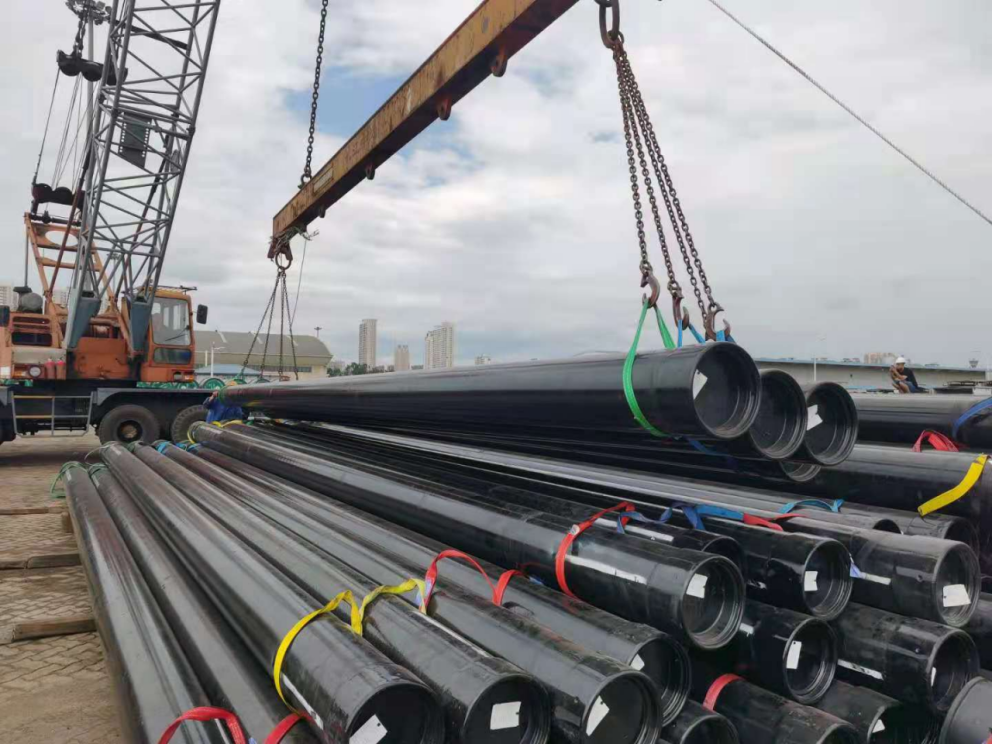
Loading in progress for the 2021 mixed OCTG and line pipe package to Africa.
Three lines we won't quote as written, because the cell does not exist:
- "13⅜″ 54.5 lb/ft L80 BTC": L80 is not listed at 54.5.
- "13⅜″ 72.0 lb/ft K55 BTC": K55 stops at 68.0.
- "13⅜″ 68.0 lb/ft N80 LTC": no L code at 13⅜″.
We come back with the nearest listed cell instead. A wall between two listed weights is different: footnote e allows intermediate walls "in accordance with 4.2.3 and 7.2 and API 5B", and Clause 7.2 limits that to the grade's own listed series. So a K55 wall heavier than 68.0 lb/ft is still not covered. Treat any intermediate wall as an agreement item, confirmed on the quote.
Our API 5CT casing range covers every listed 13⅜″ cell. Send us your casing string list and get back one quotable PO line per string, with any unlisted cell flagged. To quote without a second round of emails, include OD and weight, grade, end finish, range, quantity, destination port, drift type and the documents you need.
What coupling OD does 13⅜″ casing use, and is there a special-clearance BTC?
The regular 13⅜″ BTC coupling in Table C.28 has an outside diameter of 365.12 mm (14.375 in), and the special clearance OD column prints a dash at 13⅜″, so your annulus check (the gap between this coupling and the pipe it runs inside) uses the regular OD. Special clearance couplings are a reduced-OD option for tight holes, and footnote d of Table C.1 says "Buttress casing is available with regular, special clearance couplings or special clearance couplings with special bevel", but at this size there is no special clearance diameter to order against.
13⅜″ casing coupling dimensions, API 5CT 11th ed. Tables C.27 (round thread) and C.28 (buttress)
| Coupling | Outside diameter W | Minimum length NL | Mass |
|---|---|---|---|
| STC (Table C.27) | 365.12 mm (14.375 in) | 203.2 mm (8.0 in) | 25.42 kg (56.04 lb) |
| BTC regular (Table C.28) | 365.12 mm (14.375 in) | 269.88 mm (10⅝ in) | 31.77 kg (70.03 lb) |
| BTC special clearance (Table C.28) | — | — | — |
STC and regular BTC couplings have the same outside diameter at 13⅜″, so switching to STC buys no clearance, only a shorter coupling (203.2 mm against 269.88 mm) with 6.35 kg less steel. Clause 8.6 makes special clearance couplings a purchase-agreement item ("When specified in the purchase agreement … shall be furnished"), and its heading excludes Q125. But with no tabulated OD at 13⅜″, there is nothing standard to specify.
Check the coupling OD against the drift of the outer string, not its ID, using the size lookup tool; the other coupling tables are in our API 5CT coupling dimensions guide. If 365.12 mm does not fit, the answer is a premium connection with a slimmer coupling or flush design, with its OD taken from the licensor data sheet, not an API line.
What is the drift of 13⅜″ casing, and is 12¼″ the API drift?
Standard drift for 13⅜″ casing is the inside diameter minus 3.97 mm (5/32 in), tested with a 305 mm (12 in) mandrel per Table C.23, so it changes with every weight. The larger 311.15 mm (12.25 in) alternative drift mandrel in Table C.24 comes with three conditions:
- It is tabulated only for 72.0 lb/ft.
- It is used only when the purchaser orders "alternative drift pipe" (7.10 a)).
- That pipe must be marked as described in Section 10, as 7.10 requires.
Alternative drift at any other 13⅜″ weight is possible only with a mandrel specified in the purchase agreement (7.10 b)). Every length is drifted: 7.10 says "Each length of pipe shall be drift-tested throughout its entire length."
Is 12¼″ the drift? 12¼″ is the bit size commonly run inside 13⅜″ casing, and it is often quoted as "the" 13⅜″ drift. In API 5CT it is only the tabulated alternative mandrel for 72.0 lb/ft. The other four weights have no Table C.24 row, so 12¼″ is not a tabulated API drift for them. That is a statement about what the table lists, not about which pipe passes a 12¼″ mandrel. Per-weight ID and drift are in the 13⅜″ ID and drift tables.
13⅜″ is the last size in the middle drift band. Table C.23 deducts 3.18 mm (1/8 in) below 9⅝″, 3.97 mm (5/32 in) from 9⅝″ to 13⅜″, and 4.76 mm (3/16 in) above 13⅜″. A flat "ID minus 1/8 in" rule, which some published drift guides still give, gives a 13⅜″ mandrel 0.79 mm too large. One size up, at 16″, the deduction changes again. If an inspector's gauge was cut to the wrong rule, good pipe fails the drift.
What hydrostatic test pressure applies to 13⅜″ casing, and why is K55 tested lower than L80?
The mill pressure-tests every length with water, and API 5CT 9.12.3 sets the pressure with Equation (9): p = 2 × f × Ys min × t / D, where Ys min is the grade's minimum yield, t the wall and D the specified OD. The factor f is 0.6 "for Grades H40, J55, and K55 larger than Label 1: 9 5/8" and 0.8 "for all other grades and sizes". Under 9.12.3 a), a test using f = 0.8 for H40, J55 and K55 is allowed "by agreement between the purchaser and the manufacturer". NOTE 1 of 9.12.2 is clear: "The hydrostatic test pressures specified herein are inspection test pressures, are not intended as a basis for design and do not necessarily have any direct relationship to working pressures." So a lower test number on a 13⅜″ K55 certificate comes from the factor, not a weaker pipe: K55 still has its 379 MPa (55 ksi) minimum yield.
13⅜″ casing hydrostatic test pressures, computed per API 5CT 11th ed. 9.12.3 Eq. (9) from Table C.1/C.18 wall and minimum yield; not tabulated in the standard
| Grade | Weight (lb/ft) | Wall (mm) | Standard test (MPa) | By agreement, f = 0.8 (MPa) |
|---|---|---|---|---|
| H40 | 48.0 | 8.38 | 8.0 (f = 0.6) | 11.0 |
| J55/K55 | 54.5 | 9.65 | 13.0 (f = 0.6) | 17.0 |
| J55/K55 | 61.0 | 10.92 | 14.5 (f = 0.6) | 19.5 |
| J55/K55 | 68.0 | 12.19 | 16.5 (f = 0.6) | 22.0 |
| L80 / N80 | 68.0 | 12.19 | 31.5 (f = 0.8) | — |
| L80 / N80 | 72.0 | 13.06 | 34.0 (f = 0.8) | — |
| P110 | 68.0 | 12.19 | 43.5 (f = 0.8) | — |
| P110 | 72.0 | 13.06 | 46.5 (f = 0.8) | — |
| Q125 (threaded) | 72.0 | 13.06 | 53.0 (f = 0.8) | — |
Worked example, 68.0 lb/ft K55: p = 2 × 0.6 × 379 MPa × 12.19 mm ÷ 339.72 mm = 16.32 MPa, rounded to the nearest 0.5 MPa as 9.12.3 requires, so 16.5 MPa. None of these values reaches the 69.0 MPa (10,000 psi) cap in 9.12.3. Plain-end Q125 is tested "as agreed upon between the purchaser and the manufacturer" (9.12.2).
NOTE 2 warns that with the higher test, couplings with API threads "can leak at a pressure less than the alternative test pressure" because of limited bearing pressure between coupling and pin.
What to check on the mill certificate before it ships
- Grade, weight and end finish match a listed Table C.1 cell.
- Test pressure matches the standard value or the agreed one.
- Drift type is stated; alternative drift pipe is marked.
- Coupling type and range match the PO and packing list.
- Thread protectors are fitted on both ends.
The full pre-shipment list is in our casing RFQ and inspection checklist.
Why does a 13⅜″ L80 or P110 order cost more than K55?
At 13⅜″, a higher grade forces one of the two heaviest weights in Table C.1, so the same string length means more tonnes. The heat treatment changes too. API 5CT requires L80 and P110 to be quenched and tempered. For K55, heat treatment is not mandatory. If it is applied, it is normalised, normalised and tempered, or quenched and tempered, at the manufacturer's option or as the purchase agreement specifies.
The drivers, one line each:
- Tonnes per metre: 54.5 lb/ft is 81.10 kg/m nominal and 68.0 lb/ft is 101.19 kg/m (Table C.1, for information only). For 1,000 m of string (assumed length), that is about 81.1 t against 101.2 t, roughly 20 t more steel.
- Agreement items: an intermediate wall or alternative drift each needs confirming on the quote (see the PO and drift sections above).
To turn joints or metres into tonnes, use our guide to casing tonnage from joints and metres. Collapse for a given grade and weight runs through the collapse calculator. For connection strength, use the BTC joint strength calculator.
Where does the make-up torque for 13⅜″ BTC casing come from?
API 5CT 11th edition gives no make-up torque for buttress casing at any size. Annex G says so in a NOTE: "This standard does not include requirements for torque." API RP 5C1, Care and Use of Casing and Tubing, appears in 5CT only in the bibliography.
Buttress make-up is commonly described as running the coupling to the triangle stamp on the pin, but don't take that from a web page: get the make-up procedure from the mill or the thread data sheet for your order.
Background on where buttress make-up guidance comes from is in our article on BTC make-up torque and API 5C1. For the rig side, read the BTC stabbing and make-up procedure.
When you send your order, ask for the mill's BTC make-up data sheet with the quote, so it arrives with the pipe and not after it.
Frequently Asked Questions
Can I order 13 3/8 inch casing with LTC threads?
No. API 5CT 11th edition Table C.1 gives no long round thread code (L) at any 13⅜ inch weight or grade, and Table C.27 has no long round coupling dimensions at 13⅜ inch. Every listed 13⅜ inch cell is plain end, short round thread (STC) or buttress (BTC), so write STC or BTC on the order. A quote offering 13⅜ inch LTC was built from an old or copied chart.
Which grades can I get in 13 3/8 inch 68 lb/ft casing?
At 68.0 lb/ft, API 5CT Table C.1 lists J55/K55, L80/R95, N80, C90/T95 and P110 as plain end, STC or BTC (code PSB), and C110 as plain end only (code P). H40 and Q125 are not listed at 68.0 lb/ft. Q125 appears only at 72.0 lb/ft.
Can I order 13 3/8 inch L80 casing in 54.5 or 61 lb/ft?
No. The L80/R95 column of API 5CT Table C.1 is not listed at 54.5 or 61.0 lb/ft. At 13⅜ inch, L80 is listed only at 68.0 and 72.0 lb/ft, plain end, STC or BTC. If your design needs L80, write 68.0 lb/ft; if it needs 54.5 or 61.0 lb/ft, the listed grades are J55 and K55.
Is 13 3/8 inch casing a surface string or an intermediate string?
It can be either, and the role decides the grade, which then decides the weight. J55 and K55 are listed at 54.5, 61.0 and 68.0 lb/ft and cover the lighter surface and intermediate jobs. If the string needs L80, N80, C90, T95 or P110, API 5CT Table C.1 lists those grades only at the two heaviest weights, 68.0 and 72.0 lb/ft.
Is there an API special-clearance BTC coupling for 13 3/8 inch casing?
Not as a tabulated size. Table C.1 footnote d says buttress casing is available with special clearance couplings in general, but Table C.28 prints a dash in the special clearance outside diameter column at 13⅜ inch. Plan the annulus on the regular buttress coupling OD of 365.12 mm (14.375 in), or move to a premium connection if that does not fit.
Is 12 1/4 inch the drift for 13 3/8 inch casing?
Only for the heaviest weight, and only as an alternative drift (the drift is the gauge bar, or mandrel, pushed through each length). Table C.24 gives a 311.15 mm (12.25 in) alternative drift mandrel for 13⅜ inch 72.0 lb/ft, used only when the purchaser orders alternative drift pipe, and that pipe must be marked under clause 7.10. Alternative drift at other weights needs a mandrel specified in the purchase agreement. Standard drift is the inside diameter minus 3.97 mm (5/32 in) on a 305 mm (12 in) mandrel per Table C.23, so it is different at every weight.
Why is the hydrotest pressure on my 13 3/8 inch K55 certificate lower than on L80, and is it the working pressure?
The test-pressure formula in API 5CT 9.12.3 uses a factor f of 0.6 for Grades H40, J55 and K55 larger than 9⅝ inch and 0.8 for all other grades, so 13⅜ inch K55 is tested at a lower pressure. A test with f of 0.8 can be agreed under 9.12.3 a). It is not a working pressure: NOTE 1 of 9.12.2 says the hydrostatic test pressures are inspection test pressures and are not intended as a basis for design.
What is the make-up torque for 13 3/8 inch 68 ppf BTC casing?
API 5CT gives no make-up torque for buttress casing at any size; its Annex G states that the standard does not include requirements for torque. We do not publish a figure for it. Get the make-up procedure from the mill or the thread data sheet for your order, and ask for it with the quote.